


In short ⚡
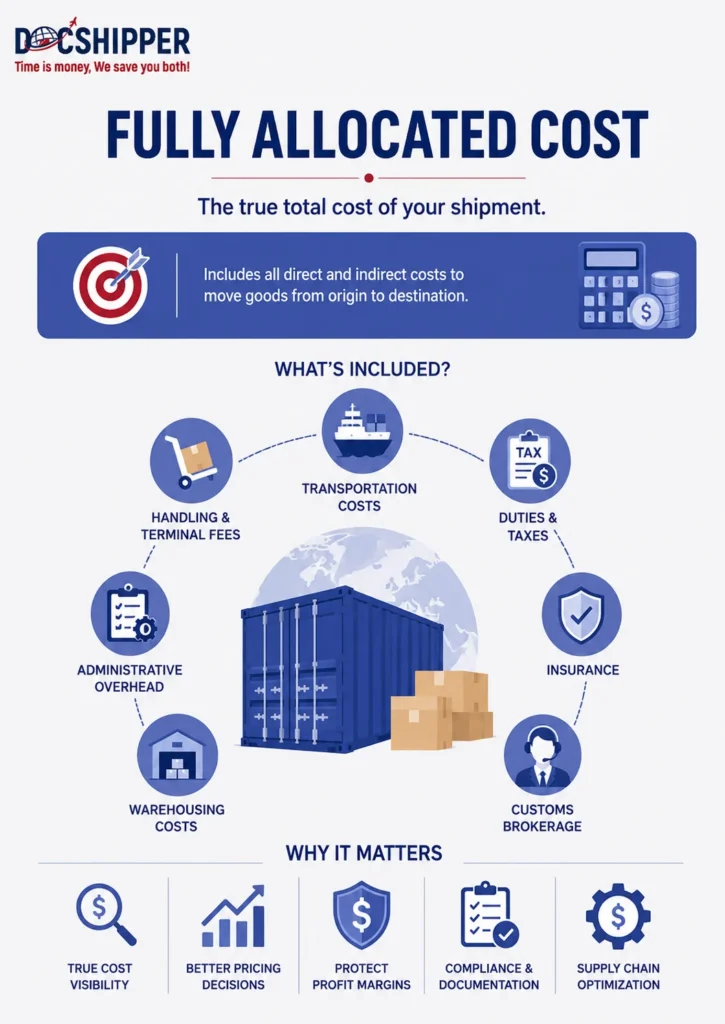
Fully Allocated Cost is an accounting method that assigns all direct and indirect costs to products, services, or shipments. In international logistics, it encompasses transportation fees, warehousing, customs duties, insurance, administrative overhead, and labor costs—providing the total economic impact of moving goods from origin to destination.Introduction
Many importers underestimate the true landed cost of their shipments by focusing solely on freight rates. This oversight leads to budget overruns, incorrect pricing strategies, and diminished profit margins. Fully Allocated Cost addresses this gap by capturing every expense incurred throughout the supply chain.
Understanding this comprehensive costing approach is essential for accurate financial planning, competitive pricing, and strategic sourcing decisions in global trade. It transforms cost visibility from fragmented line items into a unified economic picture.
- Comprehensive Scope: Includes all direct expenses (transport, duties) and indirect costs (overhead, administration)
- Decision-Making Tool: Enables accurate comparison between suppliers, routes, and logistics partners
- Profit Protection: Prevents underpricing by revealing hidden costs often excluded from basic calculations
- Compliance Foundation: Supports transfer pricing documentation and customs valuation requirements
- Supply Chain Optimization: Identifies cost drivers for targeted efficiency improvements
Methodology & Strategic Implications
The Fully Allocated Cost method operates on the principle that every resource consumed in delivering a product must be accounted for. Unlike variable costing, which tracks only direct expenses, this approach allocates fixed and variable overhead across all units using predetermined cost drivers.
In international logistics, the calculation begins with direct transportation costs—ocean freight, air cargo, or ground trucking. Next, customs-related expenses are added: import duties calculated on CIF value, merchandise processing fees, harbor maintenance fees, and customs brokerage charges. Insurance premiums based on cargo value and transit risk complete the direct cost layer.
The complexity increases with indirect cost allocation. Warehousing expenses must be apportioned based on storage duration and space utilization. Administrative overhead—staff salaries for procurement teams, compliance officers, and logistics coordinators—is distributed proportionally. According to the U.S. Census Bureau trade guidelines, accurate cost allocation is critical for trade statistics reporting and transfer pricing compliance.
Financial implications extend beyond simple accounting. Transfer pricing regulations in multinational operations require arm’s-length pricing between related entities. Fully Allocated Cost provides the documentation foundation for demonstrating that intercompany charges reflect economic reality rather than tax optimization.
At DocShipper, we build Fully Allocated Cost models for clients by tracking every touchpoint from supplier pickup through final delivery. This granular visibility enables our customers to negotiate from a position of knowledge rather than assumption, often uncovering 12-18% cost reduction opportunities through route optimization and carrier consolidation.
Practical Scenarios & Data
Consider a practical comparison between two sourcing options for 10,000 units of electronic components. The surface-level analysis shows Chinese suppliers offering $2.50/unit versus Vietnamese suppliers at $2.75/unit—a seemingly clear advantage for China.
| Cost Element | China Source | Vietnam Source |
|---|---|---|
| Unit Product Cost | $2.50 | $2.75 |
| Ocean Freight (per unit) | $0.42 | $0.38 |
| Import Duty (7.5%) | $0.22 | $0.00 (GSP eligible) |
| Customs Brokerage | $0.08 | $0.08 |
| Warehousing (30 days) | $0.15 | $0.15 |
| Insurance (0.5% of value) | $0.01 | $0.02 |
| Admin Overhead (allocated) | $0.12 | $0.12 |
| Fully Allocated Cost | $3.50 | $3.50 |
The Fully Allocated Cost reveals they are economically identical despite the 10% surface price difference. The Vietnamese supplier’s duty-free status under Generalized System of Preferences (GSP) eliminates the tariff disadvantage, while slightly lower freight costs from Vietnamese ports offset the higher unit price.
A second scenario illustrates time-sensitivity impact. An electronics retailer faces a choice between ocean freight at 35 days transit or air cargo at 5 days for a product with 15% monthly inventory carrying costs:
- Ocean Option: $4,200 freight + $1,050 carrying cost (1.75 months) = $5,250 total
- Air Option: $18,500 freight + $175 carrying cost (0.25 months) = $18,675 total
- Break-Even Point: Air becomes viable when inventory carrying exceeds 48% monthly or obsolescence risk is high
- Peak Season Premium: Air freight differential narrows by 30-40% during Q4 ocean capacity constraints
- Carbon Allocation: Air transport generates 50x emissions per ton-kilometer, adding sustainability cost considerations
These calculations demonstrate why Fully Allocated Cost must drive logistics mode selection rather than freight quotes alone. The methodology transforms procurement from a transactional function into strategic supply chain design.
Conclusion
Fully Allocated Cost provides the financial precision required for sustainable international trade operations. By capturing every expense from factory gate to final destination, it enables informed decisions on sourcing, routing, and pricing strategies that protect profit margins.
Need expert guidance on implementing comprehensive cost tracking for your supply chain? Contact DocShipper for customized logistics solutions that maximize visibility and minimize landed costs.
📚 Quiz
Test Your Knowledge: Fully Allocated Cost
Which statement best defines Fully Allocated Cost in international logistics?
A company compares two suppliers with identical Fully Allocated Costs but different surface prices. What does this scenario reveal?
An importer must choose between ocean freight ($5,250 total) and air cargo ($18,675 total) based on Fully Allocated Cost including inventory carrying costs. When should air freight be selected?
🎯 Your Result
📞 Free Personalized QuoteFAQ | Fully Allocated Cost: Definition, Calculation & Practical Examples
While often used interchangeably, Total Landed Cost typically focuses on product-specific expenses to the point of sale, whereas Fully Allocated Cost includes broader organizational overhead allocation across all cost objects. Both methodologies capture direct and indirect expenses, but Fully Allocated Cost extends to departmental and facility-level costs distributed through activity-based costing principles.
Overhead allocation uses predetermined rates based on cost drivers such as shipment weight, volume, transaction count, or labor hours. Common methods include dividing total annual overhead by projected cargo volume to establish a per-unit rate, or allocating based on the proportion of direct costs each shipment represents relative to total operations.
Sunk costs already incurred, opportunity costs of alternative decisions, and future capital investments unrelated to current operations are typically excluded. Marketing expenses for the destination market and post-delivery customer service costs may also fall outside the scope depending on the specific cost accounting framework being applied.
Quarterly reviews align with financial reporting cycles and capture seasonal variations in freight rates and tariff changes. However, significant events—carrier contract renewals, trade policy shifts, fuel surcharge adjustments, or warehouse lease modifications—require immediate recalibration to maintain accuracy in pricing and sourcing decisions.
Yes, though with additional complexity. LCL shipments require proportional allocation of container costs based on cubic meter or weight share, plus specific charges for cargo consolidation and deconsolidation. The methodology accounts for shared container expenses while isolating consignee-specific costs like individual customs clearance and final delivery.
Incoterms define the point where costs and risks transfer between buyer and seller, establishing which party bears specific expenses. Under EXW terms, the buyer's Fully Allocated Cost includes all logistics elements, while DDP transfers most costs to the seller. The cost model must align with contractual terms to accurately reflect financial responsibility.
FTAs reduce or eliminate import duties on qualifying goods, significantly lowering the customs component of landed costs. However, compliance costs increase—certificate of origin documentation, recordkeeping requirements, and potential supply chain adjustments to meet rules of origin criteria must be factored into the comprehensive cost model.
Enterprise Resource Planning (ERP) systems like SAP and Oracle include cost allocation modules, while specialized Transportation Management Systems (TMS) such as BlueJay and MercuryGate offer landed cost calculators. Cloud platforms like Coupa and trade compliance solutions from Amber Road integrate duty calculations with broader cost tracking frameworks.
Exchange rate volatility introduces variance between quotation and payment dates, potentially altering costs by 3-7% in normal markets or 15%+ during currency crises. Hedging strategies through forward contracts stabilize predictability, while cost models should incorporate currency risk premiums or use weighted average rates for planning purposes.
Tax authorities require intercompany transactions between related entities to reflect arm's-length pricing—what independent parties would charge. Fully Allocated Cost provides the documentation foundation proving that internal charges cover actual economic costs plus appropriate markup, supporting compliance with OECD Transfer Pricing Guidelines and reducing audit risk.
These penalty fees for extended container use are typically allocated directly to the specific shipment causing the delay rather than spread across all cargo. The cost model should track root causes—port congestion, customs holds, or warehouse capacity constraints—to identify systemic issues driving these avoidable expenses and implement corrective measures.
Advanced models incorporate environmental costs through carbon footprint calculations multiplied by internal carbon prices or regulatory compliance costs under emissions trading schemes. Transportation mode selection increasingly factors CO2 per ton-kilometer alongside traditional financial metrics, with air freight carrying significantly higher environmental allocations than ocean transport.
Need Help with
Logistics or Sourcing ?
First, we secure the right products from the right suppliers at the right price by managing the sourcing process from start to finish. Then, we simplify your shipping experience - from pickup to final delivery - ensuring any product, anywhere, is delivered at highly competitive prices.


Fill the Form
Prefer email? Send us your inquiry, and we’ll get back to you as soon as possible.
Contact us




