In short ⚡
Shipping fulfillment is the end‑to‑end process that takes an order from checkout through inventory management and warehousing, into transportation, delivery, and returns. It goes beyond “just shipping” by integrating order execution, documentation, customs compliance, last‑mile delivery, and reverse logistics into one measurable workflow.
We hope you’ll find this article genuinely useful, but remember, if you ever feel lost at any step, whether it’s finding a supplier, validating quality, managing international shipping or customs, DocShipper can handle it all for you!
What shipping fulfillment really covers from checkout to doorstep
Shipping fulfillment is the end to end operating system that takes an order from checkout, through inventory management and warehousing, into transportation, and all the way to delivery and returns.
Here’s the thing, most delivery issues you feel on the customer side actually start upstream, in procurement choices, packaging rules, carrier selection, or a missing customs document that no one noticed until the cargo hit the port of loading.
From experience, you’ll notice fast that “fast shipping” is rarely the problem, the problem is a leaky workflow with too many handoffs and not enough tracking and tracing discipline.
- Commercial layer: order data, address validation, service level promises, fraud checks.
- Warehouse layer: picking, packing, palletization, cross-docking, kitting, labeling.
- Transport layer: carrier selection, load optimization, freight consolidation, multimodal transport, containerization.
- Border layer: customs brokerage, customs clearance, tariff classification, duties and taxes, freight insurance where needed.
- After-delivery layer: proof of delivery, claims, reverse logistics, refunds and exchanges.
Checklist, what you need for shipping fulfillment to actually work:
- Clean SKU master data and real time stock accuracy.
- Document rules by lane, including commercial invoice, packing list, and when a bill of lading is required.
- Clear ownership for exceptions, delays, damages, and returns.
- Tracking and tracing milestones that match your customer promise, not just your carrier’s scan events.
DocShipper Info
We map your full workflow, from supplier to doorstep, eliminating blind spots before they become delays
Clear definition of shipping fulfillment and why it is more than “just shipping”
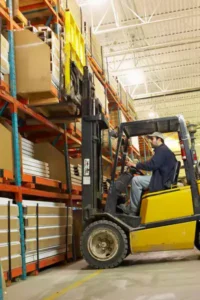
Shipping fulfillment includes shipping, but it starts earlier and ends later, it’s the combination of order execution, warehousing, distribution, transportation, and reverse logistics wrapped into one measurable workflow.
If you treat it as “just shipping,” you’ll overpay on freight rates, miss lead time targets, and fight fires around duties and taxes because the decision points happened before the shipment ever moved.
A quick real-world scenario we see a lot, you negotiate great freight on paper, then the first container lands and customs asks for a document correction.
Suddenly your “cheap” freight becomes storage, demurrage, rework, and customer tickets, all because the shipping fulfillment workflow didn’t lock the paperwork and Incoterms responsibilities upfront.
Practically speaking, shipping fulfillment includes:
- Pre-ship readiness: packaging specs, carton labels, HS code preparation, export compliance checks.
- Warehouse execution: wave picking, QC, packing rules, delivery order preparation for certain lanes.
- Freight execution: freight forwarding plan, carrier booking, load optimization, freight consolidation.
- Border compliance: customs clearance orchestration with your customs brokerage partner.
- Customer outcome: last-mile delivery performance and reverse logistics speed.
Insider note: you’ll reduce exceptions faster by standardizing your milestone definitions around widely used frameworks like the SCOR model from APICS, because it forces you to treat fulfillment as a repeatable supply chain process, not a one-off shipment.
| Topic | “Just shipping” focus | Shipping fulfillment focus |
| Start point | Carrier booking | Checkout, order validation, inventory allocation |
| End point | Delivery scan | Delivered, returns processed, refund or exchange completed |
| Main cost drivers | Freight rates | Pick/pack efficiency, packaging, freight, duties and taxes, exceptions |
| Cross-border risk | “Customs will handle it” | Incoterms, documents, tariff codes, customs clearance timing |
| What you measure | Transit time | End to end lead time, cost per order, on-time-in-full, return cycle time |
How shipping, fulfillment, and 3PL services connect in one value chain
Shipping fulfillment is the value chain, shipping is the transportation slice, and a 3PL provider is often the operator you hire to run parts of it, typically warehousing, pick/pack, and distribution.
But you can’t outsource accountability, if your 3PL executes and your freight forwarding agent books the cargo, you still need one integrated set of milestones, documents, and service levels.
We’ve seen the classic split-brain failure, the 3PL ships what’s in the bin, the freight forwarding agent consolidates whatever shows up at the dock, and nobody catches that the commercial invoice doesn’t match the packing list.
Then customs clearance slows down, last-mile delivery gets rescheduled, and you’re left explaining the delay, not the carrier.
Here’s how the pieces connect, end to end:
- Fulfillment operations: warehousing, slotting, cycle counts, pick/pack, palletization, cross-docking.
- Transportation management: carrier selection, linehaul planning, multimodal transport, load optimization.
- Freight forwarding: export coordination, containerization, booking, bill of lading, port of loading handoff.
- Customs brokerage: tariff and HS code validation, duties and taxes, clearance coordination.
- Customer delivery: last-mile delivery, proof of delivery, returns pickup and reverse logistics.
Workflow, how we align your partners in one chain:
1) Define your promise, delivery windows, tracking milestones, and return rules.
2) Map responsibilities by Incoterms, who owns freight, insurance, and customs clearance.
3) Connect warehouse events to transport events, pick complete, packed, handed to carrier, departed, arrived, out for delivery, delivered.
4) Standardize documents, invoice, packing list, bill of lading or airwaybill, and exception playbooks.
5) Review freight rates and service levels quarterly, then adjust carrier selection by lane performance.
At DocShipper, we act as your logistics provider across freight forwarding, import export coordination, and operational control, so your fulfillment and your shipment execution stop working in silos.
DocShipper Advice
Let us align your warehouse, freight, and customs milestones into one accountable value chain
Key steps in a robust shipping fulfillment workflow you can map today

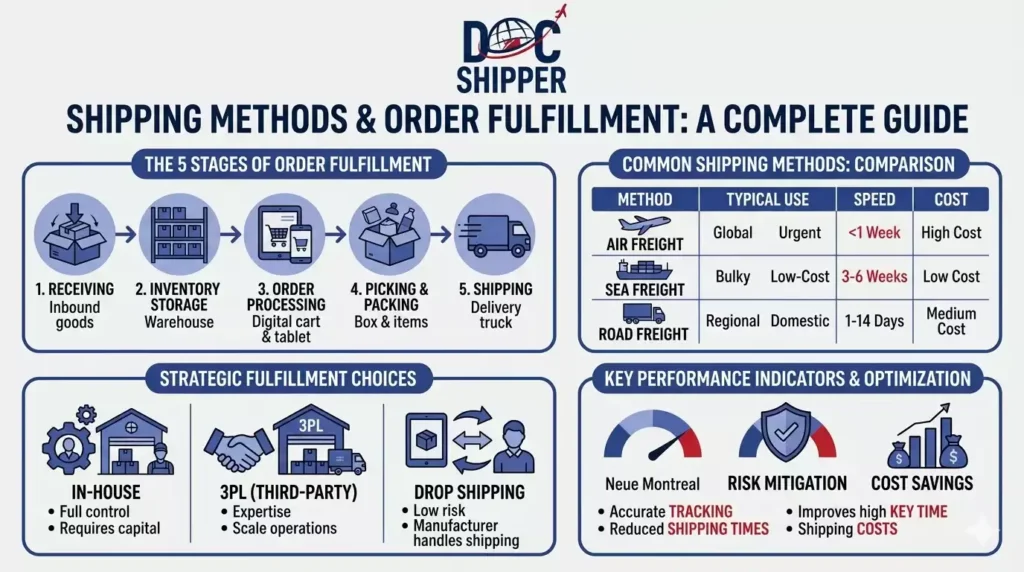
A solid shipping fulfillment workflow is basically a scoreboard plus a playbook, you know what “done” looks like at every handoff, and you know who fixes what when reality hits.
This is the moment where most importers get stuck, your warehouse says “shipped,” your customer says “not delivered,” and your carrier tracking doesn’t explain the gap.
Checklist, your workflow map needs these anchors:
- Order and payment status rules, including fraud holds and address validation.
- Inventory allocation logic, backorders, split shipments, just-in-time replenishment triggers.
- Packaging and labeling standards by carrier and by country.
- Document set by lane, including export docs, bill of lading details, and customs clearance requirements.
- Tracking and tracing milestones with ownership for exceptions.
- Reverse logistics path, inspection on return, restock vs refurbish vs scrap.
DocShipper Alert
We build milestone based dashboards that connect warehouse, carrier, and customer visibility
From order capture to dispatch: warehouse and documentation milestones
Your shipping fulfillment performance is often decided before the carton gets sealed, because warehousing discipline and documentation accuracy set the ceiling for speed and cost.
If inventory management is off by even a few percent, you’ll ship partials, pay extra freight, and burn lead time with needless back-and-forth.
We once helped a brand that kept blaming “carrier delays,” but the real issue was a simple one, their WMS released orders before the cycle count finished.
The warehouse picked ghost stock, then scrambled to substitute SKUs, then rushed dispatch with inconsistent weights, and freight rates jumped because the carrier re-rated every shipment.
Workflow, warehouse to dispatch in practical steps:
1) Order capture, validate address, service level, and promised delivery date.
2) Inventory allocation, reserve stock, decide split shipment vs hold.
3) Pick, pack, and QA, confirm SKU, serial, batch, and carton count.
4) Labeling, apply carrier labels, country labels, and carton markings needed for distribution.
5) Documentation, generate commercial invoice, packing list, and export data, align values for customs clearance.
6) Handover, manifest the shipment, stage for pickup, confirm dispatch scan.
- Operational tip: lock carton dimensions and weights, then enforce them, it’s the fastest way to stabilize freight rates.
- Cross-border tip: validate HS codes and declared values before pickup, not after the cargo is already moving.
From linehaul to last mile: tracking, proof of delivery, and reverse logistics
In shipping fulfillment, linehaul is where your shipment covers distance, but last-mile delivery is where your customer judges you.
You can run perfect freight forwarding and still lose goodwill in the final 10 miles if tracking and tracing is vague or proof of delivery is messy.
A scenario you’ve probably lived, the tracking page says “delivered,” but your customer swears nothing arrived.
When we dig in, it’s often a missing POD signature, a wrong unit number, or a handoff to a local subcontractor that didn’t scan consistently.
Workflow, linehaul to delivery and returns:
1) Linehaul departure, confirm carrier departure scan and estimated arrival.
2) In transit monitoring, exception alerts for missed scans or route deviations.
3) Arrival and sortation, confirm hub receipt, validate weight and piece count.
4) Out for delivery, last-mile delivery window communication to the customer.
5) Proof of delivery, capture POD, photo, signature, or geotag where available.
6) Returns initiation, authorize return, issue label, schedule pickup or drop-off.
7) Reverse logistics, inspect on receipt, decide restock, refurbish, or claim with freight insurance if damaged.
- Tracking must-haves: event timestamps, location scans, and one customer-facing status per milestone.
- Exception must-haves: clear playbooks for “held at customs,” “address issue,” “damaged shipment,” and “refused delivery.”
| Milestone | What you want to see | What breaks most often |
| Departed linehaul | Confirmed departure scan, stable ETA | Missed scans, poor carrier selection for the lane |
| Customs clearance | Documents matched, duties and taxes paid on time | Invoice mismatches, wrong tariff code, missing importer data |
| Out for delivery | Delivery window and contactability | No access, wrong address format, subcontractor gaps |
| Delivered | POD with signature or photo | “Delivered” without evidence, disputes and chargebacks |
| Return received | Fast inspection and disposition | Returns stuck in limbo, inventory not updated |
One compliance reality you can’t ignore: for cross-border shipments, your tracking isn’t just customer comfort, it’s an audit trail, and that’s why we align milestones to carrier and customs events commonly referenced by WCO practices in international movements.
Looking for a Reliable Shipping & Sourcing Partner?
Core elements of an efficient shipping fulfillment operation
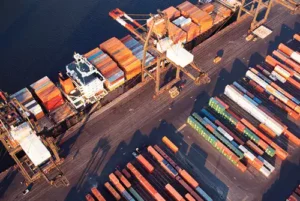
Shipping fulfillment only performs when every operational brick is aligned, from system integration to last mile execution. You cannot optimize cost or speed if one component is weak.
You need process discipline, real time data, and accountable partners across the chain. Here are the core elements you must control.
- Order Management System integration, syncing checkout, ERP, WMS, and carrier APIs
- Inventory accuracy, cycle counting, SKU traceability, lot and serial control
- Warehouse operations, slotting, picking method, packing standards, quality checks
- Carrier selection logic, cost versus transit time matrix
- Customs and compliance management, HS codes, valuation, export documents
- Tracking and visibility, milestone tracking and proactive alerts
- Returns workflow, RMA approval, inspection, restocking or disposal
| Component | What You Must Measure | Impact on Performance |
| Picking accuracy | Error rate below 0.5% | Fewer returns and reshipments |
| Order processing time | Order to dispatch under 24h | Faster delivery promise |
| Freight cost per order | Cost per kg or per parcel | Margin protection |
| On time delivery rate | Above 95% | Customer retention |
At DocShipper, we build these elements into one synchronized workflow. You gain control over suppliers in China, freight booking, customs clearance, and final delivery under one operational dashboard.
DocShipper Info
We integrate sourcing, freight, customs, and delivery into one controlled operational dashboard
How your inventory strategy and fulfillment network shape cost and speed
Your inventory positioning directly determines your shipping fulfillment performance. Distance equals cost and transit time.
Centralized inventory reduces storage cost but increases last mile expense. Distributed inventory increases warehousing complexity but shortens delivery windows.
| Strategy | Advantages | Risks |
| Single warehouse | Lower fixed cost, easier control | Longer transit, higher express spend |
| Multi warehouse regional model | Faster delivery, lower parcel cost | Inventory imbalance risk |
| China origin fulfillment | Low storage cost, ideal for global ecommerce | Customs complexity, longer lead time |
| Local in country fulfillment | Next day delivery possible | Higher overhead |
- Map your top 20 destination countries by volume
- Calculate landed cost per unit including duties
- Simulate delivery promise under each warehouse scenario
- Align inventory buffer with supplier lead time
We often help you combine China consolidation with regional fulfillment hubs. You reduce inbound freight cost while maintaining competitive delivery speed.
DocShipper Advice
We design hybrid networks combining China consolidation and regional hubs to balance speed and cost
Shipping fulfillment models that fit different growth stages

Your shipping fulfillment model must evolve with your revenue and SKU complexity. What works at 100 orders per month will collapse at 10,000.
Choosing the right model protects your margin and customer experience. Choosing the wrong one creates stockouts and cash flow pressure.
| Growth Stage | Recommended Model | Why |
| Startup | Supplier direct shipping or small 3PL | Low fixed cost |
| Scaling ecommerce | Hybrid China consolidation plus regional 3PL | Balanced speed and cost |
| Established brand | Multi node fulfillment network | Service level optimization |
| Cross border heavy volume | Bonded warehouse or DDP model | Smoother customs and tax control |
- Direct to consumer parcels
- B2B palletized distribution
- Marketplace fulfillment integration
- Subscription recurring shipments
At DocShipper, we adapt the model to your sourcing structure in China and your target markets. You keep flexibility while we manage freight, compliance, and fulfillment execution.

DocShipper Info
We adapt fulfillment structures to your growth stage, markets, and sourcing footprint
Best practices to keep your shipping fulfillment compliant, visible, and scalable
Cross border shipping fulfillment collapses without compliance discipline. Customs delays destroy your delivery promise.
You must standardize documentation and automate tracking. You must monitor KPIs weekly, not quarterly.
- Validate HS codes before mass production
- Pre calculate duties and VAT for DDP shipments
- Automate shipping label generation
- Use milestone based tracking, not only final delivery status
- Implement return inspection protocol
- Review carrier performance scorecards monthly
| KPI | Target Benchmark | Why It Matters |
| Order accuracy rate | Above 99% | Reduces reverse logistics cost |
| Average delivery time | Market competitive | Conversion rate impact |
| Return rate | Category dependent | Quality signal |
| Landed cost per order | Within margin target | Profitability control |
We integrate sourcing control in China with export documentation and destination compliance checks. You scale internationally without regulatory surprises.
DocShipper Alert
We standardize documentation and KPI control so you scale internationally without regulatory shocks
Conclusion
Shipping fulfillment is not a single action, it is a synchronized operational ecosystem. You must design it strategically if you want predictable growth.
- You align systems, warehouse execution, carriers, and compliance
- You position inventory based on demand geography
- You select a fulfillment model adapted to your growth stage
- You monitor cost, speed, and accuracy with clear KPIs
- You integrate sourcing, freight, customs, and delivery into one workflow
When you control every link, from Chinese supplier to final customer, your shipping fulfillment becomes a competitive advantage instead of a cost center. That is exactly where we position you at DocShipper.
FAQ | How to master shipping fulfillment to cut costs and keep delivery promises
Shipping fulfillment is the full end‑to‑end flow from checkout to delivery and returns, not just the transport leg. It covers:
- Before shipping: order validation, inventory allocation, packaging rules, HS codes, export compliance.
- In the warehouse: picking, packing, labeling, palletization, staging for carrier pickup.
- In transit: carrier booking, linehaul, customs clearance, last‑mile delivery.
- After delivery: proof of delivery (POD), claims, returns, refunds or exchanges.
“Just shipping” focuses on:
- Booking a carrier.
- Moving cargo from A to B.
- Tracking only transit time.
Shipping fulfillment focuses on:
- Total lead time (order to delivered/returned).
- Cost per order (operations + freight + duties + exceptions).
- On‑time, in‑full delivery and return cycle time.
Think of one value chain with specialized players:
- Fulfillment operations (often your 3PL): warehousing, slotting, pick/pack, labeling, dispatch.
- Transportation management: carrier selection, linehaul planning, multimodal routing.
- Freight forwarder: export coordination, bookings, containerization, bill of lading / airwaybill, port handoff.
- Customs broker: HS code validation, duties and taxes, customs clearance at origin/destination.
- Last‑mile carrier: out‑for‑delivery, POD capture, returns pickup.
To make them work as one team, you should:
- Define a single milestone map (picked → packed → handed to carrier → departed → cleared → out for delivery → delivered → returned).
- Assign clear ownership by Incoterms (who owns freight, insurance, and customs).
- Standardize documents (invoice, packing list, BL/AWB) so all partners use the same data.
- Review performance by lane (cost, lead time, on‑time delivery) and adjust partner roles if needed.
Before a parcel even leaves the building, you need a tight warehouse and documentation flow:
- Order capture
- Validate address and service level.
- Confirm payment and fraud checks.
- Calculate a realistic promised delivery date.
- Inventory allocation
- Reserve stock in real time.
- Decide split shipment vs hold until complete.
- Trigger replenishment if thresholds are hit.
- Pick, pack, and QA
- Use the right picking method (wave, batch, zone).
- Verify SKU, serial/lot, and quantities.
- Apply packaging rules by product and destination.
- Labeling and documents
- Generate carrier labels and internal carton IDs.
- Create commercial invoice and packing list for export lanes.
- Align weights, values, and HS codes to avoid customs re‑rating.
- Handover to carrier
- Manifest shipments and stage by route.
- Capture a dispatch scan for each parcel.
Locking carton dimensions/weights and standard document templates at this stage is the fastest way to stabilize rates and avoid customs delays.
You need one simple, visible flow from linehaul to return:
- Tracking and delivery
- Event scans at key points: departed linehaul, arrived hub, out for delivery, delivered.
- One customer‑facing status per milestone (no cryptic carrier codes).
- Proactive alerts for exceptions (customs hold, address issue, damaged in transit).
- Clear delivery window communication for last‑mile.
- Proof of delivery (POD)
- Capture signature, photo, or geotag where possible.
- Store POD centrally for support, chargebacks, and audits.
- Returns and reverse logistics
- Simple RMA process (portal or automated form).
- Predefined return reasons to analyze root causes.
- Standard steps on receipt: inspection, grading, restock/refurbish/scrap.
- Automated triggers for refund or replacement, not manual email chains.
Done well, this setup reduces “Where is my order?” tickets, improves dispute resolution, and keeps inventory records accurate.
Where you place stock is one of your biggest levers:
- Centralized (single warehouse)
- Pros: lower fixed costs, easier to manage inventory accuracy.
- Cons: longer zones, higher express spend to hit tight delivery promises.
- Multi‑warehouse / regional hubs
- Pros: shorter transit distances, cheaper parcel rates, faster delivery.
- Cons: inventory balancing risk, more complex planning and systems.
- Origin (e.g., China) fulfillment
- Pros: low storage cost, efficient consolidation for global ecommerce.
- Cons: customs complexity, longer lead times to end customers.
- Local in‑country fulfillment
- Pros: next‑day or 2‑day delivery feasible, strong customer experience.
- Cons: higher overhead and setup cost.
To choose the right mix:
- Map your top destinations and volumes.
- Calculate landed cost per unit (freight + duties + storage + last mile).
- Simulate delivery times per scenario.
- Align safety stock with supplier lead times in each node.
Focus on a small set of operational and financial KPIs:
- Speed and reliability
- Order processing time (order → dispatch).
- On‑time delivery rate vs promised window.
- Average delivery time by country/lane.
- Cost and efficiency
- Freight cost per order (or per kg/parcel).
- Landed cost per order (including duties and handling).
- Warehouse productivity (orders or lines picked per labor hour).
- Quality and customer impact
- Order accuracy rate (pick/pack errors).
- Return rate by SKU and reason.
- Exception rate (damaged shipments, customs holds, address issues).
Review trends weekly, then:
- Fix bottlenecks (warehouse vs carrier vs customs).
- Re‑tune carrier mix and service levels.
- Adjust inventory placement or safety stock if delays become structural.
Your model should evolve with volume, SKU count, and geography:
- Early stage
- You: in‑house or a small 3PL; keep it simple and low‑fixed‑cost.
- Trigger to change: order volume and SKUs increase, international markets open up.
- Scaling ecommerce
- Move to a hybrid model: origin consolidation (e.g., China) plus regional 3PLs.
- Goal: keep inbound freight cheap while improving delivery speed in key markets.
- Established brand / multi‑country
- Implement multi‑node fulfillment or country‑specific hubs.
- Add capabilities for B2B pallets, marketplaces, subscriptions if relevant.
- Cross‑border heavy
- Consider bonded warehouses and DDP flows to smooth customs and taxes.
Reassess your model when:
- Monthly order volume roughly doubles.
- You enter a new region with different customs rules.
- Your current setup can’t meet delivery promises without expensive express upgrades.
Need Help with
Logistics or Sourcing ?
First, we secure the right products from the right suppliers at the right price by managing the sourcing process from start to finish. Then, we simplify your shipping experience - from pickup to final delivery - ensuring any product, anywhere, is delivered at highly competitive prices.
Fill the Form
Prefer email? Send us your inquiry, and we’ll get back to you as soon as possible.
Contact us