Drop and hook trucking: cut wait times, boost capacity, and lower costs

  • admin 21 Min
  • Published on June 23, 2021 Updated on April 13, 2026
img

In short ⚡

Drop and hook trucking is a model where a driver drops a loaded or empty trailer at a facility and immediately hooks to another pre-staged trailer instead of waiting at a dock for loading or unloading.

This shifts time risk from the driver’s clock to yard planning, trailer pool management, and warehouse staffing, cutting dwell time and detention.

We hope you’ll find this article genuinely useful, but remember, if you ever feel lost at any step, whether it’s finding a supplier, validating quality, managing international shipping or customs,  DocShipper can handle it all for you!

Free shipping quote 24h      I want to talk to a sourcing expert

What is drop and hook in trucking?

Drop and hook is a trucking model where you drop a loaded or empty trailer at a facility and hook to another trailer, instead of waiting at a dock for loading or unloading.

If you’ve ever watched a driver burn two hours in a yard with a “we’ll get to you” promise, you already understand why drop-and-hook shows up in every serious distribution and supply chain playbook.

Simple definition of drop and hook vs. live load

Last peak season, we saw a shipper schedule “fast” appointments, then run short on warehouse labor, the carrier arrived on time and still sat for 3.5 hours.

That’s the moment drop and hook stops being jargon and starts being a strategy you can measure.

Here’s the clean way to think about it in transportation and warehousing operations.

Model What happens on arrival What your driver does Main operational constraint
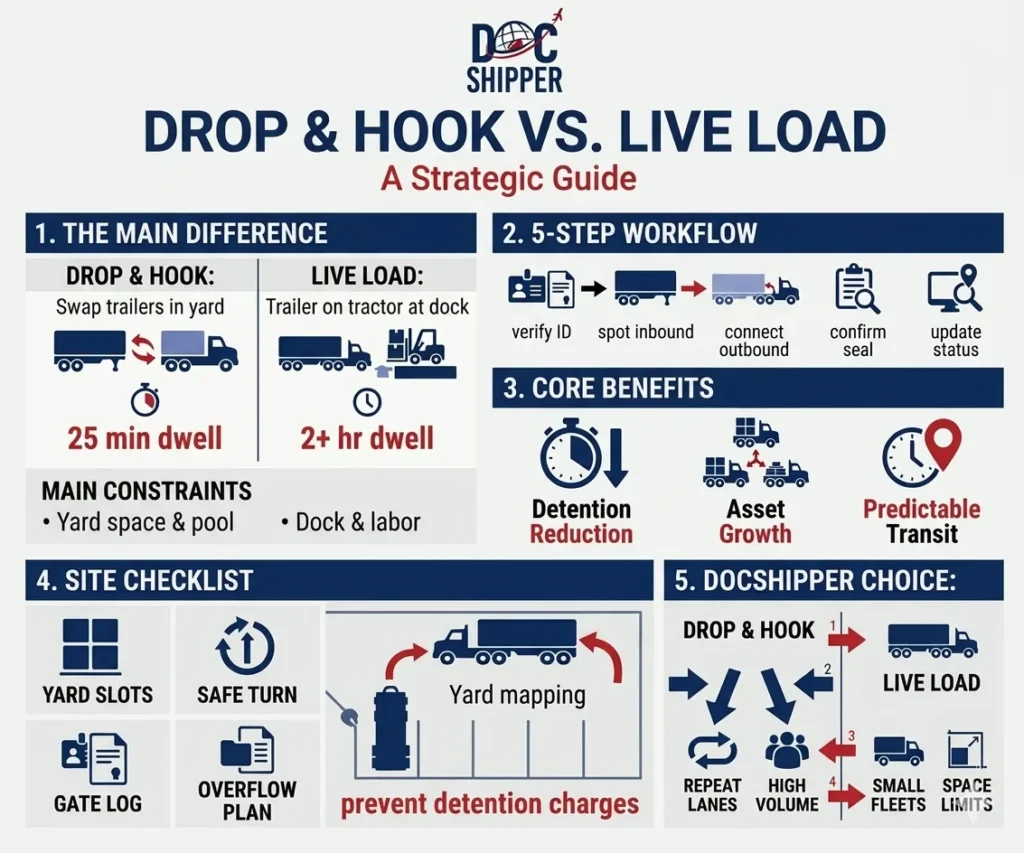
Drop and hook You swap trailers in the yard. Drop one trailer, hook another, leave fast. Yard space and trailer pool management.
Live load / live unload The trailer stays on the tractor at the dock. Wait while the facility loads/unloads your cargo. Dock availability, labor, and loading time variability.

In plain terms, drop and hook shifts time risk away from the driver’s clock and onto your yard planning, staffing, and trailer availability.

How a typical drop and hook move works step by step

Quick tip: if you want drop-and-hook to feel “instant,” you must treat it like a mini yard management process, not a casual trailer swap.

This is the workflow we usually map with shippers and 3PL teams when they’re trying to reduce lead time variability.

Here’s a simple step-by-step drop and hook workflow you can copy into your dispatch playbook.

  • Pre-arrival: confirm trailer number, seal status, and appointment window in your dispatch notes.
  • Gate check: verify ID, trailer condition, and whether the consignment is sealed and documented.
  • Drop: driver spots the inbound trailer in the assigned yard slot or door.
  • Hook: driver connects to the outbound trailer, checks airlines, lights, and landing gear.
  • Departure checks: confirm seal, weight, and paperwork like the bill of lading or pickup reference.
  • Tracking: update status for routing, transit time monitoring, and receiver ETAs.

You’ll notice fast that the “magic” is not the hook itself, it’s the discipline around yard locations, trailer readiness, and clean handoffs between warehouse and transportation teams.

Key terminology drivers and shippers must know

What trips people up is vocabulary, you’ll hear five terms in one phone call and half of them get used wrong.

Use this checklist to align your carrier, warehouse, and freight broker conversations on drop and hook moves.

  • Trailer pool: a set number of trailers staged at shipper/receiver for continuous swaps.
  • Power-only: a tractor shows up without a trailer to hook and go.
  • Detention: time-based charges when the driver waits beyond “free time” at dock or yard.
  • Lumper: third-party labor paid to load/unload, common at certain distribution centers.
  • Yard spot: a designated parking location for staging, often tied to inventory flow and cross-docking.
  • Seal: tamper-evident lock, critical for claims, compliance, and freight insurance documentation.
  • No-touch freight: the driver doesn’t assist with loading/unloading, typical in drop-and-hook programs.

And yes, even if you’re focused on domestic trucking, your paperwork discipline matters because those same habits carry into import export lanes, customs clearance files, and claims handling.

How live loading works and why it creates delays

Live load is the default in many networks, but it’s also where time disappears.

When you compare drop and hook vs live load, the real difference is whether your shipment waits with the trailer already attached to the tractor.

What is a live load and live unload?

Two months ago, we watched a driver check in for a “30-minute live unload,” then get told the dock team was still finishing a prior palletization job.

The unload eventually happened, but the driver lost the next pickup window, and the whole day’s distribution plan collapsed.

A live load means your trailer stays on the tractor while the shipper loads the freight.

A live unload is the same concept at delivery, the receiver unloads while the driver waits.

From experience, you can schedule appointments all you want, but live operations are vulnerable to labor shortages, dock congestion, and inventory surprises.

Where driver detention and hidden costs come from

Direct tip: if you only track detention as a carrier charge, you’re missing the bigger cost, the lost utilization of tractors, drivers, and time-sensitive bookings.

That’s why industry guidance around efficiency and capacity, including what you’ll see referenced in OECD transport and logistics analyses, keeps circling back to reducing unproductive waiting time.

Here are the most common “silent drains” you’ll see in live load environments, even when the freight rate looks fine.

  • Appointment stacking: too many trucks booked in the same hour, creating yard queues.
  • Labor mismatch: not enough pickers, forklifts, or dock staff for the planned volume.
  • Rework: wrong labels, mixed SKUs, or damaged pallets forcing repalletization mid-load.
  • Documentation gaps: missing references, BOL errors, or last-minute changes in handling instructions.
  • Facility rules: mandatory PPE, check-in windows, or lumpers that slow the flow.

One more thing you’ll feel in real life, the moment a driver waits, your routing plan becomes a guess, which hits ETAs, last-mile delivery windows, and customer service.

Safety, damage risk, and labor impact in live loading

Here’s the uncomfortable truth: live loading increases the number of rushed handoffs between people, forklifts, and freight, and that’s when incidents happen.

When the dock is under pressure, teams cut corners, and your cargo pays for it.

Use this quick checklist to spot live-load risk before it turns into claims and exceptions that derail your transit time.

  • Forklift traffic crosses pedestrian paths or driver waiting zones.
  • Unstable palletization or mixed-weight stacks that shift during transportation.
  • Seal control is unclear, causing disputes about shortages or tampering.
  • Temperature exposure at open docks for sensitive freight.
  • Rushed counts leading to shortages, overages, or wrong-SKU shipments.

Live load can work, but you’ll want tight dock procedures, clear roles, and consistent handling standards if you care about damage rates and labor strain.

When live loading still makes sense for your operation

You don’t need to force drop and hook everywhere.

Sometimes live loading is the least bad option given your trailers, yard space, and how your inventory management actually functions day-to-day.

One-trailer fleets and small carriers

We once worked with a small carrier running a single trailer on a tight regional loop, they tried drop-and-hook because a big shipper demanded it.

By day three, the trailer pool math didn’t work, they spent more time repositioning than hauling freight.

If you’re operating with limited equipment, a live load can be more realistic than building a trailer pool you can’t support.

It also simplifies booking and dispatching, because your tractor and trailer stay paired.

Space limitations at shipper and receiver facilities

Have you looked at your yard lately and asked, “Where would we even park ten extra trailers?”

That’s the most common reason live load stays in place, there’s no room for staging in a crowded warehouse footprint.

Use this short checklist to decide if your site can physically support drop and hook.

  • Dedicated yard slots for empties and loads, with clear signage and numbering.
  • Safe turning radius for tractors to hook without blocking docks.
  • Gate process to manage trailer IDs, seals, and arrival/departure timestamps.
  • Overflow plan for peak volume weeks and late pickups.

If you can’t stage trailers, live load might remain your best option until you redesign the yard or add a nearby staging lot.

Lack of yard trucks or on-site shunting capacity

Practical tip: drop-and-hook becomes messy when nobody can move trailers internally.

If you don’t have a yard jockey, shunter, or any on-site switching capacity, the wrong trailer ends up at the wrong door, and drivers start hunting for equipment.

In that setup, a controlled live unload may keep operations simpler, especially when you’re also juggling freight consolidation and cross-dock transfers.

When drop and hook is the better choice

If you’re fighting dock congestion, missed appointments, and unpredictable driver availability, drop and hook is usually the cleanest lever you can pull.

You’ll get the biggest win when your freight flows are repeatable and your distribution network can support trailer staging.

High-volume, repeat lanes and predictable freight

We’ve seen the pattern again and again, a shipper runs the same lane daily, same DC, same appointment windows, yet they still do live load “because that’s how it’s always been.”

Once they switch that lane to drop and hook, the carrier stops padding schedules, and the shipper stops paying for chaos.

This model fits best when your freight is stable, your dock team can preload, and your outbound schedule behaves like a system, not a surprise.

It also supports better tracking and more reliable lead time commitments to customers.

Trailer pools, yard space, and staffing requirements

Direct tip: start small, then scale, because trailer pools fail when you guess instead of calculating.

Below is a simple planning workflow we use to right-size a drop and hook pool without overbuying or under-staging.

Follow this step-by-step workflow to size your trailer pool.

  • Step 1: count weekly shipments per lane and your peak-day volume.
  • Step 2: measure average load time plus “ready-to-go” buffer for warehouse staging.
  • Step 3: add dwell time at receiver, including their unloading schedule.
  • Step 4: estimate cycle time door-to-door, including transit time and yard moves.
  • Step 5: set minimum pool size, then add a contingency trailer count for exceptions.

On staffing, you’ll want clear ownership between warehouse, yard, and dispatch, otherwise trailers sit “loaded” but not actually ready.

Matching drop and hook to your service level and SLAs

Bold reality: if your SLA promises tight delivery windows, live load variability will eventually break it.

Drop-and-hook gives you more control over cut-off times, preload timing, and exception handling when volume spikes.

Use this quick comparison to match drop and hook with the service level you’re selling.

Service requirement Live load fit Drop and hook fit
Retail appointment compliance Risky if docks run behind. Strong, you can stage trailers and protect ETAs.
High-frequency replenishment Hard to sustain without detention. Ideal with preload and predictable dispatch windows.
Cross-docking velocity Possible, but fragile under labor swings. Often best, you decouple dock work from driver time.

If you’re coordinating with a 3PL or 4PL, aligning SLAs with trailer availability and yard rules is what keeps the program from turning into daily firefighting.

Advantages and disadvantages of drop and hook

Drop and hook programs can radically change how you manage capacity, detention, and driver productivity. But before you shift from live load to drop and hook, you need to weigh the operational gains against the structural requirements.

You’ve probably heard that drop and hook is “always better.” That’s not entirely true.

DocShipper Advice

Considering the shift but unsure about ROI?
We evaluate utilization gains, trailer needs, and yard capacity before you invest in structural changes

Time savings, higher asset utilization, and lower detention

Last year, we supported a regional carrier that was losing nearly three hours per stop under live load conditions. Once they moved to a drop and hook model on repeat lanes, average dwell time fell below 25 minutes.

That difference changes everything.

With drop and hook trucking, you disconnect from a preloaded trailer and hook to another one instantly. No waiting at docks, no queue behind other trucks, no frustrated dispatch calls.

You immediately benefit from:

  • Reduced detention fees and fewer billing disputes
  • Higher tractor utilization, more turns per day
  • Better driver satisfaction and lower turnover
  • Predictable transit times on high-volume lanes

According to insights shared in World Bank logistics performance analyses, dwell time reduction directly improves overall supply chain efficiency. You feel that impact first in your fleet’s productivity metrics.

Looking for a Reliable Shipping & Sourcing Partner?

We handle the entire sourcing process, supplier research, negotiation, production, and inspections, so you can focus on what matters most: growing your business.

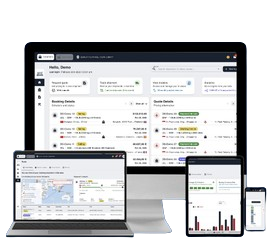
DocShipper Platform

One platform. Your entire supply chain

Sourcing, freight, customs & documents — all centralised, all visible, 24/7.

Cost, planning, and space trade-offs

Here’s the hard truth. Drop and hook requires capital and planning discipline.

You cannot operate efficiently without extra trailers, yard space, and coordination. If your ratio of trailers to tractors is too tight, the system collapses back into live load behavior.

Before implementing drop and hook, you should evaluate the following trade-offs:

Factor Drop and Hook Impact Operational Consideration
Trailer count Higher requirement Typically 2.5 to 4 trailers per tractor
Yard space More storage needed Requires organized yard layout
Planning Higher coordination Preloaded trailers must be ready
Capital Upfront investment ROI depends on lane density

If your facility is already space-constrained, you’ll feel pressure fast.

Special cases: temperature-controlled and sensitive freight

Have you ever tried running drop and hook with reefer freight during peak summer?

It works, but only if you control temperature compliance tightly. In temperature-controlled or high-value cargo, the drop and hook model introduces extra monitoring requirements.

For reefer, pharma, or fragile goods, you must consider:

  • Continuous temperature monitoring
  • Seal integrity and tamper prevention
  • Battery and fuel levels for reefers in yard dwell
  • Liability transfer points between parties

We once saw a shipper lose product because reefers sat unplugged in a yard for 18 hours. The model was sound, but yard discipline was missing.

If you handle sensitive freight, drop and hook demands stricter SOPs than live load.

Traditional vs. modern drop and hook programs

Not all drop and hook programs are built the same. Some are rigid trailer loops designed decades ago, others are dynamic systems powered by telematics and real-time yard visibility.

You’ll notice the difference in scalability and control almost immediately.

DocShipper Info

Still running manual trailer loops?
Upgrade to data-driven drop and hook visibility with telematics and yard management integration

Fixed trailer loops and capacity limits of legacy setups

In traditional setups, you assign fixed trailer pools to specific lanes. That’s simple, but it caps flexibility.

Many early drop and hook networks relied on static allocation. Once volume spikes or lanes shift, imbalance appears quickly.

Common limitations include:

  • Underutilized trailers sitting idle
  • Imbalance between origin and destination pools
  • Manual tracking via spreadsheets
  • Slow response to demand variability

As highlighted by the OECD in freight transport modernization studies, static asset allocation reduces responsiveness in volatile markets. You feel that rigidity when your trailers accumulate at the wrong end of the lane.

Using telematics, IoT, and yard management systems

Direct tip, if you want modern drop and hook performance, integrate technology early.

Telematics, IoT sensors, and yard management systems transform how you control trailer pools. Instead of guessing trailer locations, you see real-time status.

Modern systems allow you to:

  • Track trailer dwell time by location
  • Monitor door activity and yard movements
  • Automate gate check-in and check-out
  • Receive alerts for extended idle trailers

When we deploy digital yard visibility for clients, detention disputes often drop within weeks. Data removes ambiguity.

Data-driven planning, visibility, and exception handling

What happens when volume suddenly jumps 30 percent on one lane?

In a data-driven drop and hook program, you detect imbalance before it becomes a crisis. You adjust trailer allocations dynamically.

This is where advanced planning meets execution control:

  • Forecast trailer demand by lane
  • Balance pool levels weekly
  • Set dwell time thresholds
  • Create escalation workflows for exceptions

You stop reacting and start orchestrating.

How carriers and shippers can transition from live load to drop and hook

Moving from live load to drop and hook is not a flip of a switch. It’s an operational redesign that touches contracts, yard layout, dispatch, and warehouse workflows.

This is where most teams hesitate.

DocShipper Advice

Ready to transition from live load to drop and hook?
DocShipper pilots selected lanes and structures contracts, trailer pools, and training for smooth rollout

Assessing current operations and identifying pilot lanes

We once worked with a shipper convinced they were “not ready” for drop and hook. After reviewing their data, two lanes were perfect candidates.

You should always start small.

Before launching, walk through this operational checklist:

  • Identify lanes with repeat volume and stable schedules
  • Measure average dwell time under live load
  • Calculate current detention spend
  • Confirm yard space availability
  • Assess trailer-to-tractor ratio

This diagnostic phase prevents expensive missteps.

Building trailer pools, contracts, and yard processes

Strong statement, without structure, drop and hook fails.

You must formalize trailer pool ownership, maintenance responsibility, and liability clauses. Contracts should clarify who controls equipment and who bears storage risk.

A simple transition workflow looks like this:

  • Define trailer pool size per lane
  • Adjust carrier agreements for drop terms
  • Design yard slot allocation plan
  • Establish preloading cut-off times
  • Implement check-in and inspection protocol

When processes are documented, friction decreases dramatically.

Training drivers and warehouse teams for no-touch freight

Have you prepared your teams for no-touch freight expectations?

Drop and hook shifts responsibility from dock synchronization to yard coordination. Drivers need clear drop locations and seal verification steps.

Warehouse teams must preload trailers accurately and on time. That discipline determines success.

From experience, early training sessions prevent confusion such as trailers staged in the wrong row or missing paperwork. Small operational habits make or break the model.

Conclusion

Drop and hook is not simply a faster alternative to live load. It’s a structural decision about how you deploy assets, manage space, and design your freight network.

If you align trailer pools, yard processes, and data visibility, you unlock serious efficiency gains.

Here are the key takeaways you should remember:

  • Drop and hook reduces dwell time and improves tractor utilization
  • It requires more trailers, yard space, and coordination discipline
  • Modern technology dramatically enhances trailer pool control
  • Not all lanes qualify, start with repeat, high-volume corridors
  • Training and process clarity determine long-term success

If you evaluate your operation honestly and design the transition carefully, drop and hook can shift your network from reactive to optimized. And that’s where real capacity gains begin.

FAQ | Drop and hook trucking: cut wait times, boost capacity, and lower costs

Look for a combination of operational and financial red flags, not just “drivers complain a lot.” Concretely, a lane is ready when you can check most of these boxes:
If you can’t meet those conditions, you’re usually better off stabilizing live-load operations first (tighter appointment discipline, clearer dock rules) before layering in drop and hook.

  • Average live-load dwell time consistently above 60–90 minutes, with frequent outliers.
  • Detention paid on that lane at least 2–3 times per month.
  • Same origin/destination pair, same consignee, and similar SKUs week after week.
  • You can forecast volume on that lane at least 4–6 weeks out.
  • Both shipper and carrier are willing to commit a minimum trailer pool for 90 days.

Ask us anything!

Need Help with
Logistics or Sourcing ?

First, we secure the right products from the right suppliers at the right price by managing the sourcing process from start to finish. Then, we simplify your shipping experience - from pickup to final delivery - ensuring any product, anywhere, is delivered at highly competitive prices.

Live Chat

Get instant assistance from our team—just click and start chatting!

Live Chat Now
image

Fill the Form

Prefer email? Send us your inquiry, and we’ll get back to you as soon as possible.

Contact us
image

Call us

Reach out to us on WhatsApp for quick, convenient, and personal support.

Call us
image