In short ⚡
To source from China effectively, treat it as full supply chain management: vet suppliers, lock detailed specifications, secure payments, and plan logistics and customs from day one.
Avoid risk and protect margins by combining disciplined supplier verification, clear contracts (MOQs, Incoterms, penalties), staged payments with inspections, and early freight and seasonality planning.
We hope you’ll find this article genuinely useful, but remember, if you ever feel lost at any step, whether it’s finding a supplier, validating quality, managing international shipping or customs, DocShipper can handle it all for you!
What “sourcing from China” really means today
Source from China doesn’t mean “find a factory and wire money” anymore, and you’ve probably learned that the hard way.
Today, it’s a full supply chain management exercise, supplier selection, quality systems, payment security, and the logistics plan that gets your goods through customs clearance with the right commercial invoice, packing list, and HS code.
Here’s the thing, the product is only half the deal.
The other half is how you manage lead time, Incoterms, cargo insurance, shipment tracking, and all the small decisions that protect your margin.
DocShipper Info
DocShipper secures suppliers, payments, and customs documentation so your margins stay protected from factory to final delivery.
Key players: factories, trading companies, and sourcing agents
Two buyers once ordered the “same” item from the “same supplier”, but only one got consistent quality because they were actually dealing with different players behind the curtain.
When you source from China, you’ll usually face three profiles, and each changes your risk, pricing, and control.
This quick mapping will help you decide who you’re really talking to.
| Player | Best for | Typical upsides | Watch-outs |
| Factory (manufacturer) | Custom products, scaling volumes | Better unit cost, deeper technical control, easier tooling ownership | May require higher MOQ, weaker English, slower on documentation |
| Trading company | Mixed SKUs, small to mid orders | Fast quoting, can bundle items, sometimes smoother export paperwork | Less transparency on real production, margin layers, factory may change |
| Sourcing agent | When you need verification and execution | Supplier vetting, negotiation support, quality control coordination | Conflicts of interest if paid by suppliers, unclear scope if not contracted |
A practical tip, ask early who will issue the commercial invoice and who will be the exporter of record, it impacts your import export documentation and sometimes your customs brokerage process.
Online B2B marketplaces and how they connect you to Chinese suppliers
Tip: when you source from China via a B2B marketplace, treat the platform like a lead generator, not a guarantee of supplier reliability.
You’ll notice fast that profiles can look “factory-direct” while the operations behave like a trading setup.
To make marketplaces work for you, you need a tight screening workflow, not more messages.
Use this step-by-step workflow to go from “interesting listing” to “credible supplier.”
Marketplace sourcing workflow
- Step 1: Shortlist 8 to 12 suppliers, then request identical specs, packaging details, and target Incoterms (EXW, FOB, CIF) to compare fairly.
- Step 2: Ask for photos of production lines and QC tools, plus sample lead time and peak season capacity.
- Step 3: Validate export capability, ask who handles bill of lading issuance and whether they can provide consistent packing list formats.
- Step 4: Order samples with clear acceptance criteria, color tolerance, labeling, drop tests, and carton specs.
- Step 5: Move to a pilot order, then schedule pre-shipment checks before final payment.
We’ve seen a very common trap, you negotiate a great unit price, then the supplier quotes “cheap shipping” that quietly excludes export docs, local charges, or even the right tariff classification support.
For a reality check on market dynamics, UNCTAD regularly highlights how global trade concentration and capacity shifts can affect lead times and freight conditions.
Modern payment and escrow options that secure your orders
What happens when a supplier asks for 100% upfront because “it’s standard in China”?
When you source from China, payment terms are one of your strongest risk controls, right up there with inspections.
This checklist keeps your payments aligned with production reality, not promises.
Payment safety checklist
- Confirm the beneficiary name matches the contracting entity, no “friend’s account” explanations.
- Split payments, deposit to start, balance after inspection or after receiving passing results.
- Lock specs in writing, including tolerances, packaging, labeling, and spare parts if relevant.
- Define penalties for late delivery and rework, tied to your lead time constraints.
- Require shipping documents alignment, commercial invoice, packing list, and a clean bill of lading when applicable.
Escrow-style options can help on first deals, especially when your supplier relationship is new and you want leverage to enforce compliance.
Just don’t confuse escrow with quality assurance, you still need inspections and clear acceptance rules.
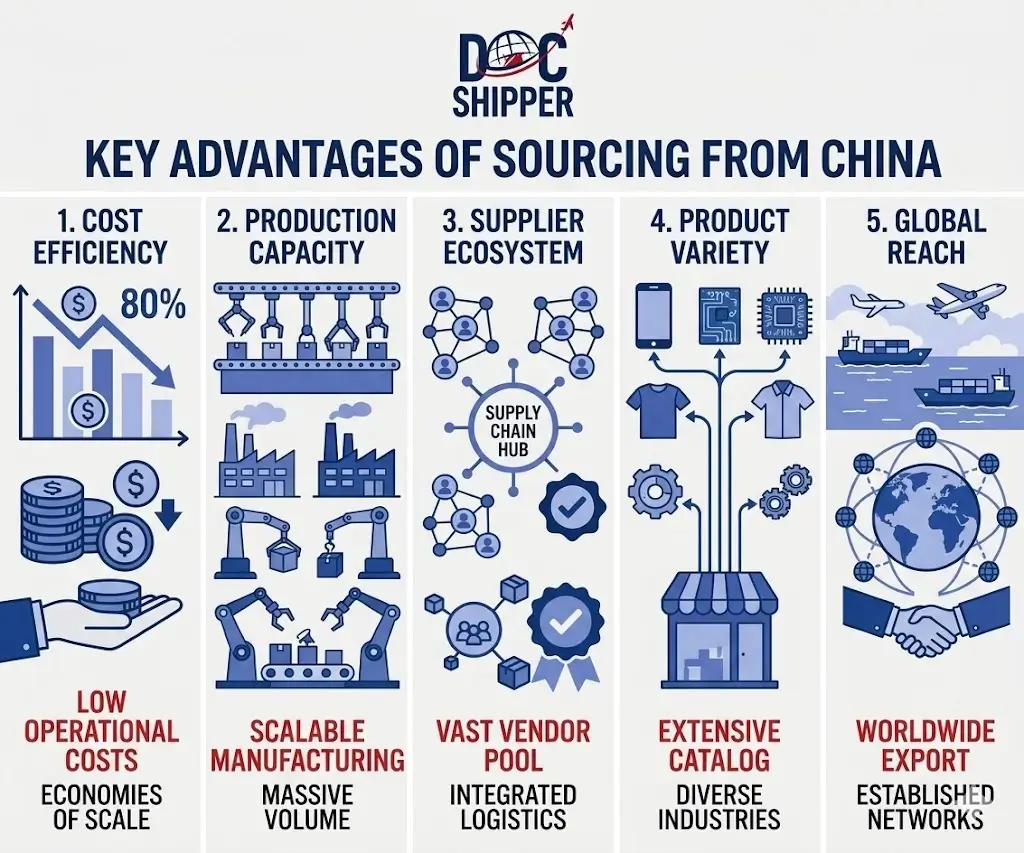
Main advantages when you source from China
If you source from China strategically, the advantage isn’t only “cheap labor”, it’s the ecosystem, suppliers, sub-suppliers, tooling shops, packaging, and logistics routes that are already built for export.
That said, you’ve probably dealt with quotes that look amazing until you add duty and taxes, compliance fixes, and freight volatility.
So let’s talk about the real advantages, and how to keep them real after landed cost.
DocShipper Advice
We help you calculate duties, freight, and compliance upfront to turn quoted savings into real profit.
How China helps you reduce product and tooling costs
A buyer once saved 18% on unit cost, then lost it all because the mold belonged to the factory and the second production run got “repriced.”
When you source from China, your cost advantage often comes from scale, mature supplier clusters, and competitive tooling, but only if you control the right levers.
This short list shows where the savings usually come from.
- Tooling ecosystems (molds, dies, jigs) that quote faster and iterate cheaper.
- Component consolidation, many factories sit near upstream suppliers, cutting internal lead times.
- Packaging optimization, carton sizing and pallet patterns that reduce CBM and ocean freight spend.
- Process engineering, small design tweaks that remove operations and reduce scrap.
To protect those gains, make sure your contract states tooling ownership, storage location, and what happens if you change supplier.
Balancing low prices with consistent product quality
Tip: the cheapest quote is rarely the cheapest landed product once you factor rework, delays, and refunds.
When you source from China, you can absolutely hit strong quality, but you need measurable standards and frequent checks.
This table gives you a practical way to balance price and quality before you place volume orders.
| Decision lever | What you do | What it prevents |
| Golden sample | Approve a reference sample and seal specs | “Looks similar” substitutions |
| In-process checks | Inspect during production, not only at the end | Mass defects discovered too late |
| Pre-shipment inspection | Verify AQL, labeling, cartons, and counts | Chargebacks, returns, and reverse logistics costs |
| Quality clauses | Define rework, replacement, and dispute handling | Endless arguments after payment |
ISO frameworks are a useful reference point when you want suppliers to speak the language of repeatable processes, not “we’ll be careful.”
Leveraging China’s vast product range for your business
How do some importers launch five SKUs in a season while others struggle to finalize one?
When you source from China, you’re tapping into breadth, materials, finishes, packaging styles, and rapid prototyping that can speed up your product roadmap.
Use this checklist to expand your assortment without losing control.
SKU expansion checklist
- Standardize packaging across SKUs to simplify warehousing and picking.
- Group suppliers by category so you can negotiate better MOQs and align lead times.
- Plan consolidation at origin to reduce cargo handling events and damage risk.
- Align labeling and HS codes early to avoid customs rework and holds.
- Build a spare-parts policy to reduce returns and reverse logistics.
We’ve seen brands scale faster when they treat sourcing and logistics as one plan, your assortment choices impact carton sizes, deconsolidation time, and inventory turns.
Why you should work with a sourcing agent in China
If you want to source from China without burning months on trial-and-error, a good sourcing agent is often the difference between “finding a supplier” and building a reliable supply chain.
This is also the moment most importers get stuck, you can’t see the factory, you can’t read between the lines, and every promise sounds confident.
We’ll walk you through what an agent should actually do, beyond sending you a spreadsheet.
DocShipper Info
DocShipper acts as your operational extension in China, from vetting to negotiation and production follow up.
Core responsibilities of a China sourcing agent
One importer thought they hired an “agent,” but all they got was forwarded emails and zero leverage when defects showed up.
When you source from China, a real agent acts like your operational extension, not a messenger.
Here’s what you should expect as a baseline.
- Supplier identification based on capability, not just category keywords.
- RFQ management with apples-to-apples comparisons on specs and Incoterms.
- Negotiation support on MOQs, tolerances, packaging, and penalties.
- Production follow-up to keep lead time realistic.
- QC coordination and corrective action tracking.
- Logistics alignment with your freight forwarding and customs clearance plan.
From a governance angle, ICC guidance on Incoterms helps you structure responsibilities so “who pays what” doesn’t become an expensive surprise.
How agents save you time, money, and prevent scams
Tip: ask your agent to verify the supplier’s business license details and confirm the factory address matches the production site before you pay a deposit.
When you source from China, scams are usually not “Hollywood fake factories,” they’re small inconsistencies, swapped bank accounts, or last-minute price changes when your deadline is close.
This workflow is how a solid agent reduces that risk in the real world.
Anti-scam workflow you can request
- Step 1: Entity verification, company name, registration scope, and bank account consistency.
- Step 2: Capability proof, equipment list, material sources, and recent production evidence.
- Step 3: Sample approval with defined acceptance criteria.
- Step 4: Contract and payment milestones tied to inspection gates.
- Step 5: Shipping document checks before release, invoice, packing list, and HS code alignment.
We’ve handled cases where a “supplier” tried to reroute payments to a new account right after sending a proforma invoice, catching it early saved weeks of dispute.
Quality control, factory audits, and ongoing product checks
Bold truth: if you only inspect at the end, you’re paying to discover problems, not prevent them.
When you source from China, quality control works best as a system, factory audits, in-line checks, and final inspections tied to release of funds.
This checklist keeps your QC program simple and effective.
QC program checklist
- Factory audit to confirm capacity, process controls, and traceability.
- Pre-production meeting to lock specs, packaging, labeling, and test methods.
- In-line inspection when the first batch comes off the line.
- Pre-shipment inspection based on AQL, including carton drop checks if relevant.
- Corrective action loop with photos, root cause, and rework plan.
We’ve seen “minor” labeling mistakes trigger relabeling at destination, which turns into storage fees, delayed delivery, and sometimes painful last mile delivery disruption.
Looking for a Reliable Shipping & Sourcing Partner?


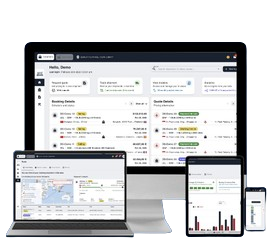
DocShipper Platform
One platform. Your entire supply chain
Sourcing, freight, customs & documents — all centralised, all visible, 24/7.
How a sourcing partner supports logistics and fulfillment
When you source from China, your logistics plan decides whether you win on margin or donate it to delays, demurrage, and rushed air freight.
You’re not just buying goods, you’re booking capacity, choosing multimodal transport, managing customs brokerage, and setting up warehousing and fulfillment that match your sales rhythm.
This is where a sourcing partner, combined with the right freight forwarding setup, keeps your operation stable.
DocShipper Advice
Align sourcing, freight, and fulfillment with one coordinated partner to reduce delays, demurrage, and emergency air shipments.
Planning around Chinese New Year and other seasonal disruptions
One year, a buyer approved production in January and assumed “two weeks” meant two weeks, then Chinese New Year shut the line down and the container missed the season.
When you source from China, seasonal planning is not optional, it’s how you protect your just in time delivery expectations.
Use this checklist to keep your calendar realistic.
Seasonality planning checklist
- Freeze orders early and confirm material availability before holiday shutdowns.
- Pad lead times for production restart, staffing, and QC delays.
- Book freight earlier and request a written freight quote validity window.
- Plan consolidation if you’re shipping multiple SKUs to reduce missed sailings.
- Define backup modes, sea freight baseline, with air freight only for high-margin emergencies.
World Bank logistics research often points out how congestion waves impact transit reliability, you’ll feel it most around peak seasons.
Freight, warehousing, and last‑mile delivery support
Tip: don’t choose a freight option until you know who controls the shipment, that’s what decides your visibility and your ability to fix problems mid-route.
When you source from China, a strong partner can coordinate freight forwarding, cargo handling, and storage so your goods don’t get stuck between ports and pallets.
This table shows how your main transport choices typically compare.
| Mode | Best use case | Pros | Trade-offs |
| Ocean freight / sea freight | Bulk, stable demand | Lowest cost per unit, good for consolidation | Longer transit, port congestion risk |
| Air freight | Urgent, high value | Speed, tighter inventory cycles | Higher cost, dimensional weight surprises |
| Rail freight | Some Asia to Europe lanes | Middle ground on speed and cost | Route variability, capacity constraints |
| Road transport / trucking services | Port to warehouse, regional distribution | Flexible, direct to distribution center | Driver and capacity volatility in peaks |
Make sure your freight contract clarifies responsibilities for delays, damage, and cargo insurance, especially when multiple parties touch the cargo.
Using 3PL and fulfillment services to streamline e‑commerce orders
Do you really want your team packing boxes at midnight because your container arrived late and orders piled up?
When you source from China for e-commerce, a 3PL provider can absorb volatility, speed up shipping, and keep inventory management clean across channels.
This workflow shows how a sourcing partner and a third party logistics setup can fit together.
China-to-customer fulfillment workflow
- Step 1: Arrange origin pickup and export docs, then choose intermodal shipping if it improves reliability.
- Step 2: Use consolidation at origin, then ship under one master plan for easier tracking.
- Step 3: Clear customs with clean paperwork, invoice, packing list, HS codes, and duty values aligned.
- Step 4: Receive into a fulfillment warehouse, perform counts, and slot inventory for fast picking.
- Step 5: Ship orders with tracked methods, manage last mile delivery, and handle reverse logistics for returns.
We’ve seen cross docking work brilliantly when inbound cartons already match pick-face requirements, it cuts storage time and speeds outbound orders.
If you want, we can align your sourcing specs with packaging and labeling that reduces fulfillment friction later, that’s where the margin quietly comes back.
How to build a safe, profitable sourcing strategy in China
When you decide to source from China, you’re not just comparing prices, you’re building a long‑term supply chain strategy that must protect your margins and your reputation.
A profitable sourcing strategy in China balances cost, compliance, quality control, payment security, and logistics planning from day one. If one pillar is weak, the entire structure becomes fragile.
We’ve seen importers rush into production after a few emails, only to discover too late that the factory had no export license or subcontracted everything. That’s where discipline makes the difference.
DocShipper Alert
We audit suppliers, secure payments, and structure compliant import flows so you scale in China without costly surprises.
 Steps to vet reliable Chinese suppliers and agents
Last year, one client thought they had found the perfect supplier on a B2B platform to source from China, until a simple business license check revealed the company had been registered only three months earlier.
You don’t need to be paranoid, but you must be methodical. A proper vetting process protects you from fake factories, trading middlemen posing as manufacturers, and undercapitalized workshops.
Here is the checklist we use internally before validating any supplier or sourcing agent in China.
- Verify the business license and compare the legal name with the bank account holder.
- Request export license confirmation or confirm cooperation with a licensed trading company.
- Check production capability, including machinery, staff size, and monthly capacity.
- Ask for recent third‑party inspection reports or audit summaries.
- Request product samples and compare them against technical specifications.
- Review transaction history and references from overseas buyers.
If you’re serious about sourcing from China, you should also schedule a factory audit, either physically or through a third party. The ICC reminds importers that due diligence is a core element of responsible international trade.
From experience, the small inconsistencies, mismatched addresses, vague answers about capacity, are often the real red flags.
Negotiation, contracts, and managing MOQs
Here’s a practical tip. When you source from China, never start negotiations with price alone, start with specifications and volume forecasts.
If your product specs are vague, you’ll receive vague quotations. Detailed tech packs, material standards, packaging instructions, and quality benchmarks give you leverage.
Your negotiation workflow should look like this.
First, confirm technical drawings and materials.
Second, align on MOQ and tiered pricing.
Third, define Incoterms and payment schedule.
Fourth, draft a bilingual purchase contract.
Fifth, confirm pre‑shipment inspection criteria.
Managing MOQs is often where you feel stuck. You can negotiate by offering:
- Higher unit price for lower initial quantity
- Mixed models in one production batch
- Longer lead time in exchange for reduced MOQ
- Forecast commitment for future orders
When drafting contracts for sourcing from China, ensure you clearly state product specs, penalty clauses for delays, and dispute jurisdiction. Referring to the ICC Incoterms rules helps you avoid misunderstandings on risk transfer and freight responsibility.
We’ve seen buyers lose deposits simply because the contract did not clearly define acceptable quality standards.
Common sourcing risks in China and how to avoid them
What usually goes wrong when you source from China?
The answer is rarely dramatic fraud. More often, it’s small preventable mistakes that compound over time.
The most common risks in sourcing from China include:
- Quality drift between first sample and mass production
- Hidden subcontracting to unapproved workshops
- IP leakage when molds are not contractually protected
- Late shipments due to poor production planning
- Payment risk when sending large deposits without safeguards
To mitigate these risks, you should combine contractual protection with operational controls. That means staged payments, in‑process inspections, and clear escalation procedures.
One importer we supported skipped a pre‑shipment inspection to save a few hundred dollars. The result was a full container of non‑compliant goods blocked at customs.
If you want safe sourcing from China, treat risk management as a recurring process, not a one‑time check.
Conclusion
To source from China successfully, you need more than a supplier list, you need a structured system that protects your cash flow and your brand.
A profitable sourcing strategy in China rests on disciplined vetting, smart negotiation, and continuous quality control.
Here are the key takeaways you should keep in mind.
- Always verify suppliers through licenses, audits, and sample validation before placing deposits.
- Negotiate beyond price, clarify specifications, MOQs, Incoterms, and penalties in writing.
- Use staged payments and inspections to secure production milestones.
- Plan for logistics early, including peak seasons and regulatory compliance.
- Work with experienced sourcing partners when you lack local presence or technical expertise.
If you approach sourcing from China with structure and realism, you’ll cut costs without gambling on quality. And when you combine supplier control, contractual clarity, and logistics planning, you transform importing from China into a scalable competitive advantage.
FAQ | How to source from China successfully while cutting costs and reducing risk
You can spot a trading company by cross‑checking a few concrete signals:
- Product range:
- Factory: narrow, related line (e.g. only LED lights, only phone cases).
- Trader: sells everything from toys to kitchenware to electronics.
- Business license details (ask for a copy):
- Look for “trading” vs “manufacturing” in the registered scope.
- Photos and videos:
- Factory: production lines, machines, workers, in‑process goods.
- Trader: mostly showroom pictures, office desks, catalog shots.
- Sample lead times:
- Long / inconsistent lead times often mean they depend on third‑party factories.
- Technical depth in replies:
- Ask specific process questions (e.g. “What molding temperature and cycle time do you use?”).
- Vague or generic answers are a red flag.
If in doubt, ask for the factory address and suggest a third‑party audit there. Strong pushback is a warning sign.
You usually can’t “win” by just insisting on a lower MOQ; you need to change the economics for the factory:
- Adjust what you’re asking for:
- Use standard colors/materials instead of fully custom.
- Accept generic packaging for the first batch.
- Offer trade‑offs:
- Pay a slightly higher unit price for a smaller MOQ.
- Accept a longer lead time so they can fit you between bigger jobs.
- Combine volume:
- Ask if you can mix several models/SKUs in one production batch.
- Consolidate orders with 1–2 other products from the same factory.
- Show future potential:
- Share a realistic forecast (e.g. “If this batch sells, we plan 3 more runs this year”).
If the MOQ still doesn’t move, it usually means the supplier’s cost structure truly can’t support your volume; look for a smaller or more flexible factory.
Most problems come from assuming Incoterms are “just about shipping price.” They actually define risk transfer and responsibilities. Typical mistakes:
- Choosing FOB/CIF without knowing who controls the cargo:
- CIF from a supplier’s forwarder often hides poor service and extra destination fees.
- Assuming “FOB price” includes everything to your warehouse:
- FOB only covers costs up to loading on the vessel at the port of departure.
- Not checking who books insurance and what’s covered:
- Under CIF, the insurance is often minimal and may not match your real cargo value.
- Mixing documents and Incoterms:
- Wrong Incoterm on the commercial invoice can confuse customs and your broker.
Before confirming, write down:
- Chosen Incoterm + named place (e.g. FOB Ningbo, CIF Hamburg).
- Who books freight, who books insurance, and who pays which local charges.
Think “legal + practical” protection, not just NDAs:
- Contractual safeguards:
- Register your brand and key patents/designs in China if possible.
- Use a bilingual contract stating:
- You own all molds/tooling and product designs.
- Tooling can’t be used for other customers.
- What happens if you change factory (tooling transfer process).
- Operational safeguards:
- Split critical components between suppliers so no one sees the full product.
- Avoid giving full CAD files if not necessary (send derived drawings instead).
- Monitoring:
- Periodically check online marketplaces for copycat listings.
- Ask your agent or auditor to look for your product in the factory’s showroom for other buyers.
Without written tooling ownership and clear IP clauses, you have almost no leverage if the factory starts selling your product elsewhere.
Treat it as both a quality and relationship test. Move fast, but structured:
- Collect evidence:
- Take clear photos/videos by defect type.
- Quantify the issue: how many units, which SKUs, where in the batch.
- Compare with agreements:
- Check your PO, specs, golden sample, and any inspection reports.
- Identify which clauses were breached (tolerances, labeling, function, etc.).
- Propose concrete remedies:
- Rework on next order (free goods or heavy discount).
- Partial refund or credit note.
- Remanufacture of affected quantity at their cost.
- Tie resolution to future orders:
- Don’t place a new PO or pay remaining balances without a written corrective plan.
If the supplier refuses responsibility and your documentation is solid, consider:
- Using an agent or lawyer to negotiate.
- Switching suppliers and tightening QC before the next production.
Focus on verifiable details and controlled payment structure:
- Before any payment:
- Verify the company’s Chinese business license and registration address.
- Make sure the bank account holder name matches the legal entity.
- Call the factory’s official phone number (from government or directory listings), not only WhatsApp/WeChat.
- For the payment itself:
- Avoid sending money to personal accounts or Hong Kong shell entities “for convenience.”
- Start with a smaller trial order and staged payments (e.g. 30% deposit, 70% after inspection).
- Use escrow or a letter of credit on higher‑risk, high‑value first deals.
- Ongoing vigilance:
- Treat any “urgent change of bank account” email as suspicious; confirm on a verified phone number.
- Keep all POs, contracts, and proformas aligned with the same entity name and bank details.
If any element feels inconsistent (different company names, changing addresses, reluctance to share licenses), pause the deal and re‑verify before you send a cent.
Need Help with
Logistics or Sourcing ?
First, we secure the right products from the right suppliers at the right price by managing the sourcing process from start to finish. Then, we simplify your shipping experience - from pickup to final delivery - ensuring any product, anywhere, is delivered at highly competitive prices.


Fill the Form
Prefer email? Send us your inquiry, and we’ll get back to you as soon as possible.
Contact us