In short ⚡
E-commerce shipping covers the entire process from checkout to delivery, not just printing a label. It includes order flow, inventory, fulfillment, transportation, customs, tracking, and returns, and is a strategic lever that affects both delivery speed and profitability.
Optimizing it means matching products, customer expectations, transport modes, and technology to control cost per order while keeping service reliable.
We hope you’ll find this article genuinely useful, but remember, if you ever feel lost at any step, whether it’s finding a supplier, validating quality, managing international shipping or customs, DocShipper can handle it all for you!
What e‑commerce shipping actually includes (beyond putting parcels in the mail)

E commerce shipping isn’t the “label + carrier pickup” moment you see in your dashboard.
It’s the entire logistics chain that connects checkout to delivery, plus all the imports, exports, freight forwarding, and customs clearance work you don’t want to learn the hard way.
Here’s the thing, customers judge you on delivery, but your profit lives in the supply chain details.
At DocShipper, we see brands lose margin because they optimize the last mile while ignoring upstream transportation, inventory management, and freight rates.
We still remember a seller who switched to “faster shipping” after a few late deliveries, only to discover their real bottleneck was a missing HS code on the commercial invoice.
The parcel moved fast, the shipment didn’t, it sat waiting for customs brokerage clarification and blew the promised lead time.
Checklist, what e commerce shipping really includes:
- Order flow, checkout rules, address validation, fraud screening
- Inventory positioning, warehousing, replenishment, safety stock, SKU velocity
- Fulfillment ops, picking, packing, palletization, cartonization, labeling
- Transportation, air cargo, trucking, rail, intermodal, ocean freight, consolidation
- Cross-border compliance, packing list, commercial invoice, Incoterms, duties, taxes
- Proof and control, tracking, exceptions, claims, cargo insurance, returns
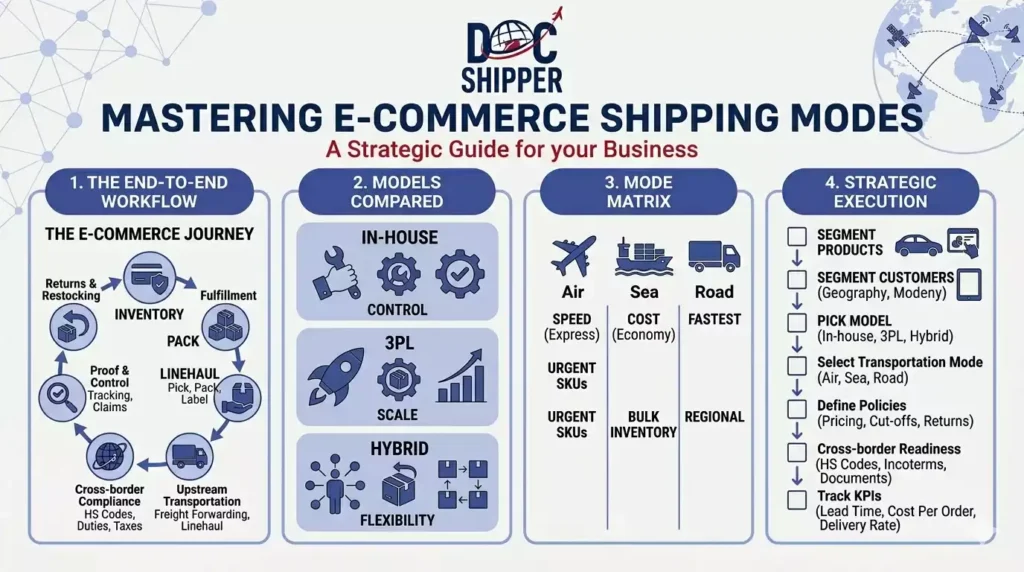
Workflow, end-to-end e commerce shipping (step-by-step):
1 Customer pays, you capture shipping promise and service level.
2 Order routes to the right warehouse or 3PL location based on stock and destination.
3 Pick, pack, label, and generate documents for domestic or export shipments.
4 Hand-off to carriers, linehaul, or freight forwarding for cross-border moves.
5 Customs clearance, duties, and delivery appointment if needed.
6 Last-mile delivery, tracking updates, and exception management.
7 Returns, reverse logistics, restocking, and refund rules.
DocShipper Alert
Audit your full supply chain before scaling faster delivery promises. We align freight, compliance, and fulfillment into one controlled flow.
From checkout to doorstep: key stages in the shipping workflow
In e commerce shipping, each stage adds either speed or risk, and you’ll notice fast which ones you’ve ignored once orders scale.
We usually map your process like a mini supply chain audit, because “fast delivery” without process control just creates expensive chaos.
One real scenario we see a lot, you negotiate great spot rates with a carrier, then your packing process adds 24 hours because nobody standardized carton sizes.
The transit time looks fine on paper, but your actual lead time misses the promise, and customer support pays the price.
Key stages you should measure in e commerce shipping:
- Order cut-off time and how it impacts same-day dispatch
- Pick/pack time by SKU type and warehouse zone
- Handover time to transportation partners and daily pickup schedules
- Linehaul transit time (domestic, intermodal, or international)
- Customs clearance time for imports/exports, plus document accuracy
- Last-mile delivery time and failed delivery rate
- Returns cycle time and restocking impact on inventory management
Practical tip from experience: separate “processing time” from “carrier transit time” in your promises.
That one change prevents you from blaming carriers for delays that actually came from your fulfillment workflow.
Who is involved in your shipping stack: carriers, 3PLs, warehouses, and tech

Your e commerce shipping stack is a team sport, even if it feels like you’re the only one getting yelled at when deliveries slip.
And yes, every party has different incentives, carriers want density, warehouses want predictability, your customers want it now.
We once stepped into an operation where the “carrier issue” was actually a warehouse issue, the 3PL printed labels before final weights were captured.
That triggered billing corrections later, freight rates spiked, and the finance team couldn’t reconcile invoices against orders.
Who touches your e commerce shipping operation:
- Warehouse (in-house or outsourced), storage, picking, packing, cross-docking
- 3PL, fulfillment, warehousing, returns, sometimes customer support workflows
- 4PL, orchestration layer for multiple providers across the supply chain
- Carriers, parcel networks, trucking, last mile, regional couriers
- Freight forwarder, consolidation, air cargo or ocean freight booking, documentation
- Shipping lines, containerization, bill of lading issuance for ocean moves
- Customs broker, HS code validation, customs clearance, duty/tax calculation
- Tech stack, OMS, WMS, TMS, tracking, returns portal
Why this matters: once you ship cross-border, Incoterms and document flow become operational, not “legal”.
We align those details upfront so you don’t discover at dispatch that your commercial invoice doesn’t match the packing list.
How to design an e‑commerce shipping strategy that fits your products and customers
A strong e commerce shipping strategy starts with what you sell and what your customers expect, not what a carrier sales rep promised you.
If you’re moving batteries, cosmetics, fragile glass, or high-value items, your transportation choices, packaging, and cargo insurance rules change immediately.
We’ve seen a brand copy a competitor’s “2-day shipping” policy, then quietly bleed money because their products had low margin and high volumetric weight.
The delivery looked premium, but the supply chain economics didn’t match, and every order was a subsidy.
Checklist, before you lock your e commerce shipping strategy:
- Product constraints, dimensions, weight, hazmat, fragility, shelf life
- Customer promise, speed expectations by region, acceptable delivery windows
- Network design, one warehouse vs multi-node distribution
- Service mix, economy vs express, tracked vs untracked
- Cross-border readiness, Incoterms, customs brokerage, document templates
- Cost controls, contracts vs spot rates, surcharge exposure, packaging strategy
Workflow, designing your e commerce shipping strategy (step-by-step):
1 Segment your SKUs by margin, weight/volume, and damage risk.
2 Segment customers by geography and delivery urgency.
3 Pick fulfillment model, in-house, 3PL, or hybrid.
4 Select transportation modes and carriers for each lane.
5 Define shipping policies, pricing, and cut-off times.
6 Document customs, HS codes, and Incoterms for cross-border orders.
7 Track KPIs and iterate, lead time, cost per order, delivery rate, returns.
Choosing in‑house, 3PL, or hybrid fulfillment for scalable growth
Your e commerce shipping setup will either scale smoothly or snap under volume, depending on how you choose fulfillment.
In-house gives control, 3PL gives speed-to-scale, hybrid gives flexibility, but only if you set clean rules for inventory allocation.
We’ve onboarded clients who rushed into a 3PL contract after a peak season meltdown, then got stuck with storage fees and slow-moving inventory penalties.
The fix wasn’t “leave the 3PL”, it was renegotiating SLAs, redefining replenishment cadence, and tightening inventory management.
Quick comparison (HTML table):
| Model | Best for | Typical risks | What to negotiate |
| In-house fulfillment | High control SKUs, predictable volume, tight QA needs | Capacity limits, labor variability, slower expansion | Carrier contracts, packaging SOPs, cut-off discipline |
| 3PL | Fast scaling, multi-region distribution, operational outsourcing | Hidden accessorials, slower change requests, inventory errors | SLAs, billing model, receiving rules, returns handling, KPIs |
| Hybrid | Mixed SKU profiles, seasonal spikes, test new markets | Split stock, routing mistakes, data sync issues | Allocation logic, WMS/OMS integration, transfer lead times |
For cross-border growth, you’ll often pair a 3PL with a freight forwarder for consolidation and international transportation.
That’s where we step in at DocShipper, we connect freight forwarding, warehousing, and delivery so you don’t manage five vendors that blame each other.
Defining shipping options, speeds, and policies your customers will actually use

In e commerce shipping, more options don’t automatically mean more conversions.
What works is clarity, a small menu of well-priced services, with realistic transit time promises and tracking that doesn’t go silent for days.
We’ve seen stores offer “Express” without defining the cut-off time, so customers ordered at 6 p.m., expected next-day delivery, and got dispatch the following afternoon.
Refunds followed, then chargebacks, then the carrier got blamed, even though the policy was the real problem.
Policies that typically move the needle in e commerce shipping:
- Clear cut-off times tied to warehouse pick waves and carrier pickup
- Region-based promises that reflect real distribution constraints
- Tracked standard as default for fewer “where is my order” tickets
- Free shipping threshold aligned with actual freight rates and margin
- Returns policy designed with reverse logistics cost in mind
For international orders, you also need to decide who pays duties and taxes, and match it to the right Incoterms logic in your checkout language.
We align your documents, commercial invoice, packing list, and customs clearance workflow, so the promise you make at checkout survives the border.

Looking for a Reliable Shipping & Sourcing Partner?
Main e‑commerce shipping methods and services you can offer
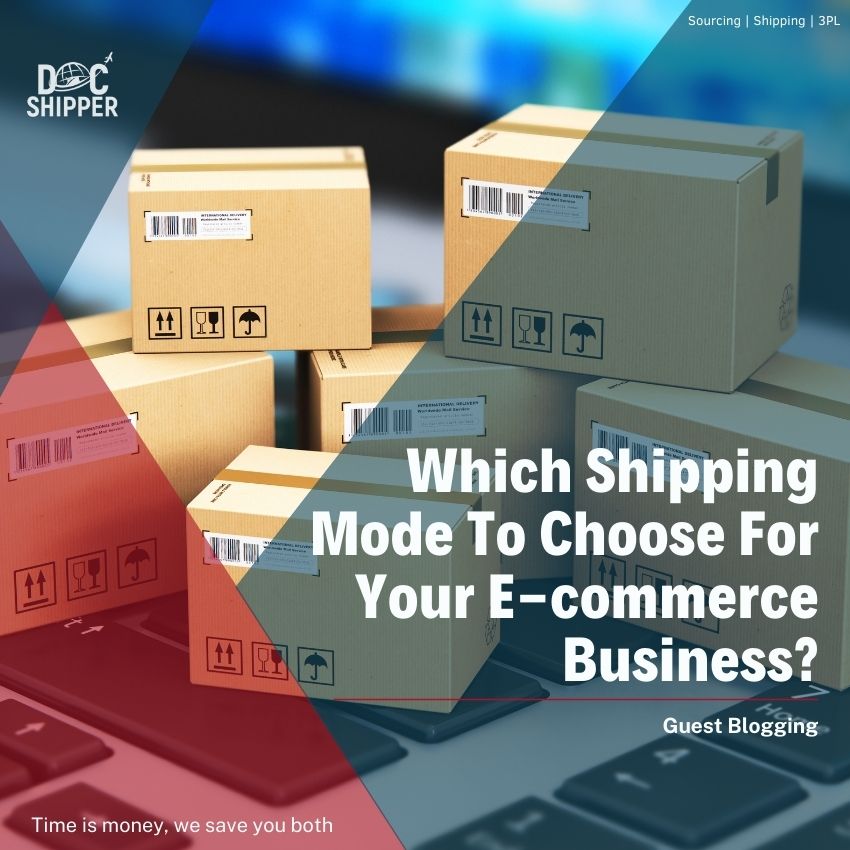
You cannot optimize e commerce shipping until you clearly understand the core transport modes available to you. Each mode impacts your cost structure, delivery promise, inventory planning, and customer satisfaction.
Air, sea, and land are the three pillars of international e commerce logistics. Your job is to match speed, margin, and product constraints with the right transport backbone.
| Mode | Transit Time | Cost Level | Best For | Main Risks |
| Air Freight | 2 to 10 days | High | High value goods, urgent restocks, lightweight SKUs | Capacity volatility, strict weight rules |
| Sea Freight | 20 to 45 days | Low | Bulk inventory, heavy products, low margin goods | Port congestion, longer cash cycle |
| Road Freight | 1 to 7 days regional | Medium | Domestic delivery, cross border within same region | Fuel costs, traffic delays |
| Rail Freight | 15 to 25 days China to EU | Medium | Mid urgency restocking between Asia and Europe | Limited routes, geopolitical exposure |
If you sell fast moving fashion or electronics, air freight protects your sell through rate. If you move bulky furniture or gym equipment, sea freight protects your margins.
- Use air for product launches and stockouts
- Use sea for stable demand and large purchase orders
- Use rail as a compromise between air speed and sea cost
- Use road for final mile and regional distribution
At DocShipper, we help you compare Incoterms, total landed cost, and fulfillment deadlines before you commit to one mode. You do not choose a carrier first, you choose a strategy first.
The wrong mode can destroy your margin faster than a bad supplier.
DocShipper Info
Compare total landed cost across air, sea, rail, and road before locking contracts. Strategy first, carrier second.
Controlling e‑commerce shipping costs without damaging the customer experience
Shipping is one of your largest variable costs in e commerce. But cutting it blindly often kills conversion rates.
Your objective is simple, reduce cost per order while maintaining delivery reliability and perceived speed.
| Cost Driver | Impact | Optimization Lever |
| Dimensional weight | Higher carrier fees | Packaging redesign, carton optimization |
| Delivery zone | Long distance surcharges | Distributed warehousing |
| Express services | Premium rates | Offer tiered shipping options |
| Returns | Double transport cost | Better product descriptions, QC inspections |
Smart cost control starts at sourcing, not at checkout. If your supplier packs inefficiently, you pay more for every shipment.
- Negotiate freight during supplier discussions
- Consolidate shipments at origin
- Audit invoices for hidden surcharges
- Use DDP strategically for smoother customer experience
- Implement quality inspections to reduce return rates
You should also design shipping tiers carefully. Free standard shipping increases conversion, while paid express protects your margin.
Never promise 2 day delivery if your supply chain cannot support it consistently.
We often restructure clients’ freight flows by combining sea freight replenishment with local last mile fulfillment. This hybrid model reduces cost without increasing delivery time.

DocShipper Advice
Redesign packaging, consolidate origin shipments, and rebalance modes to lower cost per order without slowing delivery.
Technology and automation that make e‑commerce shipping more reliable
Manual shipping processes create delays, errors, and customer complaints. Automation gives you visibility and control.
Reliable e commerce shipping is built on data, not guesswork.
- Order management systems sync inventory in real time
- Shipping software compares carrier rates instantly
- Tracking APIs update customers automatically
- Warehouse management systems reduce picking errors
- Analytics dashboards identify delivery bottlenecks
| Tool | Main Benefit | Business Impact |
| OMS | Centralized order control | Fewer fulfillment mistakes |
| WMS | Optimized picking and packing | Lower labor cost per order |
| Carrier API | Real time tracking | Higher customer trust |
| Freight management system | Mode comparison and booking | Lower international freight spend |
You should also automate milestone alerts for customs clearance and port arrivals. Proactive communication reduces support tickets dramatically.
Visibility is your insurance policy against disruption.
At DocShipper, we integrate sourcing, freight, customs, and delivery tracking into one coordinated workflow. You get fewer intermediaries and more accountability.
DocShipper Info
Integrate OMS, WMS, carrier APIs, and freight tools into one coordinated workflow for real control.
Conclusion
You now understand that e commerce shipping is a strategic lever, not just an operational task. The right structure protects both your margin and your customer experience.
- Choose air, sea, rail, or road based on product profile and urgency
- Calculate total landed cost, not just freight rate
- Optimize packaging and consolidation to reduce hidden fees
- Offer shipping tiers aligned with real supply chain capacity
- Invest in automation for visibility and fewer fulfillment errors
- Align sourcing, logistics, and delivery into one integrated workflow
If you want to build a faster, cheaper, and more resilient shipping operation, we can design it with you from factory floor to final mile. Your growth depends on how intelligently you move your goods.
FAQ | E‑commerce shipping: build a faster, cheaper, customer‑first delivery operation
An international forwarder is your architect for cross‑border moves, not “just another carrier.” They typically:
- Plan the end‑to‑end transport route (air, sea, rail, road, or a mix)
- Consolidate your shipments to reduce cost per unit
- Handle documentation (commercial invoice, packing list, bill of lading, AWB)
- Coordinate customs clearance with brokers and manage Incoterms in practice
- Resolve exceptions (delays, rollovers, missed connections, lost or damaged cargo)
- Negotiate space and rates with carriers using their aggregate volume
For e‑commerce brands, a good forwarder protects both your margins and your delivery promise by aligning mode choice, paperwork, and timelines with your real constraints.
Use these simple rules of thumb:
- Choose air freight when:
- You need to recover from stockouts or launch a new product fast
- You ship high‑value, lightweight SKUs where speed protects sell‑through
- You have short product life cycles (fashion drops, seasonal items, electronics)
- Choose sea freight when:
- You replenish stable, predictable demand in bulk
- Your products are heavy, bulky, or low margin (furniture, equipment, commodities)
- Cash flow can support longer lead times and inventory in transit
- Smart combo many brands use:
- First shipment or urgent top‑ups by air
- Base, recurring inventory by sea
- Mode decision based on total landed cost and impact on stock‑outs, not just the freight quote.
Yes, but “express” can mean different things depending on your lane and product:
- We can route parcels and smaller shipments via:
- Dedicated express integrators (e.g., DHL, FedEx, UPS, TNT, Aramex)
- Priority air freight services with tight transit times
- What we clarify with you upfront:
- Target delivery time (door‑to‑door, not just flight time)
- Cut‑off times at origin warehouses
- Volumetric weight impact on pricing (size vs actual weight)
- Customs strategy (DDP vs DAP) to avoid delays at the border
This lets you offer premium shipping options to customers without turning every order into a margin killer.
Carriers rarely charge you on “actual weight only.” They use volumetric (dimensional) weight to price space in the aircraft or truck:
- Volumetric weight basics:
- It’s calculated from parcel dimensions (length × width × height / divisor)
- If volumetric weight > actual weight, you pay for the volumetric number
- What this means for your store:
- Bulky but light items (pillows, shoes, home décor) can be very expensive to ship
- Inefficient packaging inflates your billed weight and kills margin
- How to control it:
- Redesign packaging and cartons to reduce empty space
- Use right‑sized boxes for key SKUs, not “one box fits all”
- Simulate shipping cost per SKU before launching a product or promotion
Optimizing dimensions is often cheaper than negotiating another discount with carriers.
Start with a simple decision matrix tied to products and demand patterns:
- Analyze your SKUs by:
- Margin and price point
- Weight/volume and fragility
- Demand volatility (steady vs spiky)
- Then map modes:
- Air: high value, urgent, low volume, or launch/top‑up inventory
- Sea: stable demand, large quantities, heavy or low‑margin goods
- Rail: mid‑urgency Asia–Europe flows when sea is too slow and air too expensive
- Road: regional distribution and final mile in target markets
- Finally, build rules like:
- “Base stock by sea, safety stock by air”
- “High‑risk stockouts go by air, slow movers only by sea”
The goal is not to pick one mode forever, but to align each lane with product economics and customer expectations.
Reliability is about coordination, not just transport speed. A forwarder or 4PL helps by:
- Orchestrating multiple providers (carriers, warehouses, customs brokers)
- Standardizing your document flow so shipments don’t get stuck at customs
- Consolidating shipments to improve schedule predictability and reduce trans‑shipments
- Monitoring milestones (departure, arrival, clearance, last‑mile handover) in one system
- Proactively managing exceptions and communicating new ETAs to you
For brands with multi‑country sourcing and cross‑border customers, this orchestration layer is what keeps the promise you make at checkout intact all the way to the customer’s door.
Need Help with
Logistics or Sourcing ?
First, we secure the right products from the right suppliers at the right price by managing the sourcing process from start to finish. Then, we simplify your shipping experience - from pickup to final delivery - ensuring any product, anywhere, is delivered at highly competitive prices.
Fill the Form
Prefer email? Send us your inquiry, and we’ll get back to you as soon as possible.
Contact us