


In short ⚡
Full-Service Leasing is a comprehensive vehicle or equipment rental contract where the lessor provides not only the asset but also all maintenance, insurance, repairs, and administrative services for a fixed monthly fee, eliminating operational uncertainties for businesses managing logistics fleets.
Introduction
Many businesses struggle to predict the true cost of vehicle ownership in their logistics operations. Unexpected repairs, fluctuating insurance premiums, and administrative burdens create budget volatility that disrupts financial planning.
Full-Service Leasing addresses this challenge by consolidating all vehicle-related expenses into a single, predictable monthly payment. This financial model has become essential for companies operating international freight operations, last-mile delivery networks, and cross-border transportation fleets.
Key characteristics of Full-Service Leasing include:
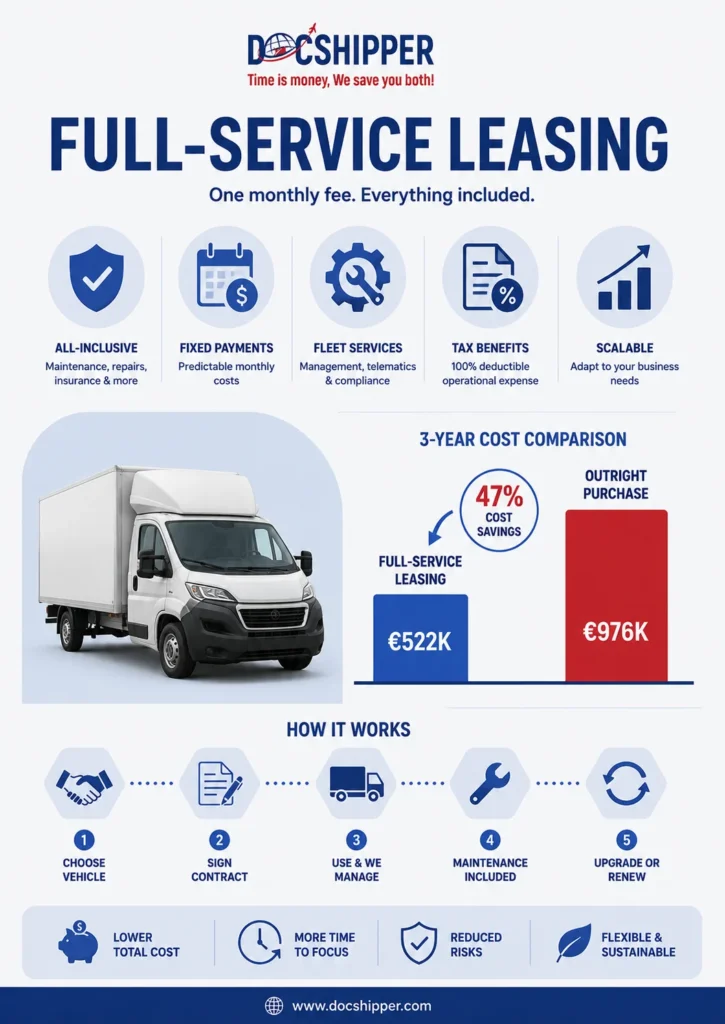
- Comprehensive coverage: Maintenance, repairs, tires, insurance, roadside assistance included
- Fixed monthly payments: Budgetary predictability over contract duration (typically 24-60 months)
- Fleet management services: Telematics, compliance monitoring, and replacement vehicle provision
- Tax optimization: Leasing payments often fully deductible as operational expenses
- No capital investment: Preserves cash flow for core business activities
Understanding Full-Service Leasing Mechanisms
Full-Service Leasing operates through a risk-transfer model where the leasing company assumes financial responsibility for vehicle depreciation and operational costs. The monthly fee calculation incorporates residual value projections, maintenance schedules, and usage patterns specific to each client’s operations.
Contractually, the lessee agrees to predetermined mileage limits (typically 15,000-50,000 km annually for logistics vehicles) and usage parameters. Exceeding these thresholds triggers per-kilometer surcharges ranging from €0.08 to €0.25 depending on vehicle category and contract terms.
The maintenance component distinguishes Full-Service Leasing from operating leases. Lessors partner with authorized service networks to provide scheduled maintenance, tire replacement (typically every 40,000-60,000 km for commercial vehicles), and unexpected repairs. At DocShipper, we systematically negotiate full-service contracts for our clients’ dedicated transport fleets to ensure uninterrupted cross-border operations.
Insurance integration represents another critical element. Policies cover comprehensive damage, third-party liability, and cargo insurance where applicable. According to EU transport regulations, commercial vehicles require minimum coverage of €1.22 million for passenger transport and €620,000 for goods transport.
The administrative burden reduction extends to vehicle registration, tax declarations, and compliance documentation. Leasing companies manage these obligations across jurisdictions—particularly valuable for operations spanning multiple European markets with varying fiscal frameworks.
Cost Analysis & Practical Examples
To illustrate the financial implications, consider a mid-sized logistics company operating 10 refrigerated trucks for international pharmaceutical transport. Comparing full-service leasing against outright purchase reveals significant operational differences.
| Cost Component | Full-Service Leasing (36 months) | Outright Purchase |
|---|---|---|
| Initial Investment | €0 | €850,000 |
| Monthly Payment (per vehicle) | €1,450 | – |
| Annual Maintenance | Included | €18,000 |
| Insurance (comprehensive) | Included | €24,000 |
| Total 3-Year Cost | €522,000 | €976,000 |
This comparison demonstrates that full-service leasing reduces total expenditure by 47% while eliminating capital deployment. The leasing option preserves €850,000 in working capital that can fund inventory expansion or market development.
Practical Use Case: A European e-commerce distributor needed 25 delivery vans for last-mile operations across Germany, France, and Poland. Opting for full-service leasing at €890 per vehicle monthly provided immediate fleet deployment without €1.6 million capital outlay. The contract included telematics monitoring, driver training, and replacement vehicles during maintenance—services impossible to replicate cost-effectively with purchased assets.
Key financial considerations for full-service leasing decisions:
- Cash flow preservation: No large upfront payment improves liquidity ratios
- Tax efficiency: Monthly payments 100% deductible versus depreciation schedules on purchases
- Residual value protection: Lessor absorbs depreciation risk in volatile vehicle markets
- Scalability: Fleet expansion or reduction aligns with business cycles without asset disposal challenges
- Technology refresh: Regular vehicle upgrades ensure compliance with evolving emissions standards (Euro 6d currently, Euro 7 from 2025)
Conclusion
Full-Service Leasing transforms fleet management from a capital-intensive burden into a predictable operational expense, enabling logistics companies to focus resources on customer service rather than asset administration. This model aligns particularly well with international operations requiring regulatory compliance across multiple jurisdictions.
Need expert guidance on structuring your logistics fleet financing? Contact DocShipper for customized solutions tailored to your international transport requirements.
📚 Quiz
Test Your Knowledge: Full-Service Leasing
Q1: What is the primary scope of Full-Service Leasing?
Q2: A common misconception about Full-Service Leasing is that:
Q3: A logistics company with 10 refrigerated trucks chooses Full-Service Leasing over outright purchase. Which statement correctly describes this decision?
🎯 Your Result
📞 Free Quote in 24hFAQ | Full-Service Leasing: Definition, Calculation & Concrete Examples
Most leasing companies offer contracts starting at 24 months, with optimal pricing typically available for 36-48 month terms. Longer commitments (60 months) reduce monthly costs but limit flexibility to upgrade technology or adjust fleet size.
Yes, beyond standard vehicles, full-service agreements cover refrigerated units, tail lifts, GPS tracking systems, and temperature monitoring devices. These additions integrate into the monthly fee based on equipment value and maintenance complexity.
Contracts specify annual mileage allowances (e.g., 40,000 km). Overages incur per-kilometer fees ranging from €0.08 for light commercial vehicles to €0.30 for heavy goods vehicles, calculated at contract termination based on odometer readings.
The included insurance covers accident repairs through the lessor's approved network. Lessees typically pay only contractual deductibles (€500-€2,000 depending on vehicle class). Replacement vehicles are provided during repair periods to maintain operational continuity.
Absolutely. Leading leasing providers offer pan-European coverage with maintenance networks across member states. Contracts address insurance validity in all EU markets and include assistance with temporary import documentation for non-EU transit.
Under IFRS 16 accounting standards, operating leases must be recognized as right-of-use assets and liabilities. However, full-service leasing still improves key metrics compared to purchased assets: lower total liabilities, preserved credit capacity, and enhanced return on assets ratios.
Most agreements allow mileage adjustments with corresponding monthly payment recalculations. Adding vehicles to existing contracts often qualifies for fleet discounts. Early termination typically incurs penalties equivalent to remaining depreciation value plus administrative fees.
Damage from driver negligence, unauthorized modifications, and consumables like fuel and AdBlue are lessee responsibilities. Cargo-related damages (loading equipment misuse, securing failures) also fall outside standard coverage unless specifically negotiated.
Electric commercial vehicles currently command 15-25% higher monthly payments due to purchase price premiums. However, total cost of ownership often favors EVs when factoring in fuel savings (€0.05/km electricity vs. €0.18/km diesel) and lower maintenance requirements (no oil changes, reduced brake wear).
Lessors typically request three years of financial statements, credit reports, and operational details (delivery routes, cargo types, driver experience). For international operations, proof of cross-border transport licenses and customs registrations may be required.
Many providers offer optional driver safety and efficiency training as contract add-ons. These programs reduce accident rates by 20-30% and improve fuel economy by 8-12%, often justifying the €200-€400 per driver training cost through insurance premium reductions.
Lessees return vehicles to specified conditions (normal wear accepted, no structural damage). Options include contract renewal with newer vehicles, lease extensions at reduced rates, or purchase at predetermined residual values (typically 20-35% of original cost for 3-year contracts).
Need Help with
Logistics or Sourcing ?
First, we secure the right products from the right suppliers at the right price by managing the sourcing process from start to finish. Then, we simplify your shipping experience - from pickup to final delivery - ensuring any product, anywhere, is delivered at highly competitive prices.


Fill the Form
Prefer email? Send us your inquiry, and we’ll get back to you as soon as possible.
Contact us




