


In short ⚡
Currency risk, also known as exchange rate risk, is the potential financial loss resulting from fluctuations in foreign exchange rates during international trade transactions. This risk affects importers, exporters, and logistics providers who deal with multiple currencies, impacting profit margins and contract values when exchange rates move unfavorably between transaction initiation and payment settlement.
Introduction
Every international shipment involves a hidden cost that many businesses overlook until it’s too late: currency fluctuation. Between the moment you negotiate a price and the moment payment clears, exchange rates can shift dramatically, turning profitable deals into financial losses.
In global logistics, currency risk represents one of the most unpredictable variables. A container shipped from Shanghai to Rotterdam might be quoted in USD, invoiced in EUR, and paid in GBP—each conversion point introducing potential volatility.
Key characteristics of currency risk in international trade:
- Transaction exposure: Risk between contract signing and payment settlement
- Translation exposure: Impact on consolidated financial statements across subsidiaries
- Economic exposure: Long-term competitive positioning affected by sustained exchange rate movements
- Time sensitivity: Longer payment terms amplify exposure to rate fluctuations
- Volume correlation: Higher transaction volumes multiply potential losses or gains
Understanding Currency Risk Mechanisms
Currency risk emerges from the time lag inherent in international commerce. When an importer in Europe orders goods from Asia with a 60-day payment term, the exchange rate at delivery may differ significantly from the rate at order placement.
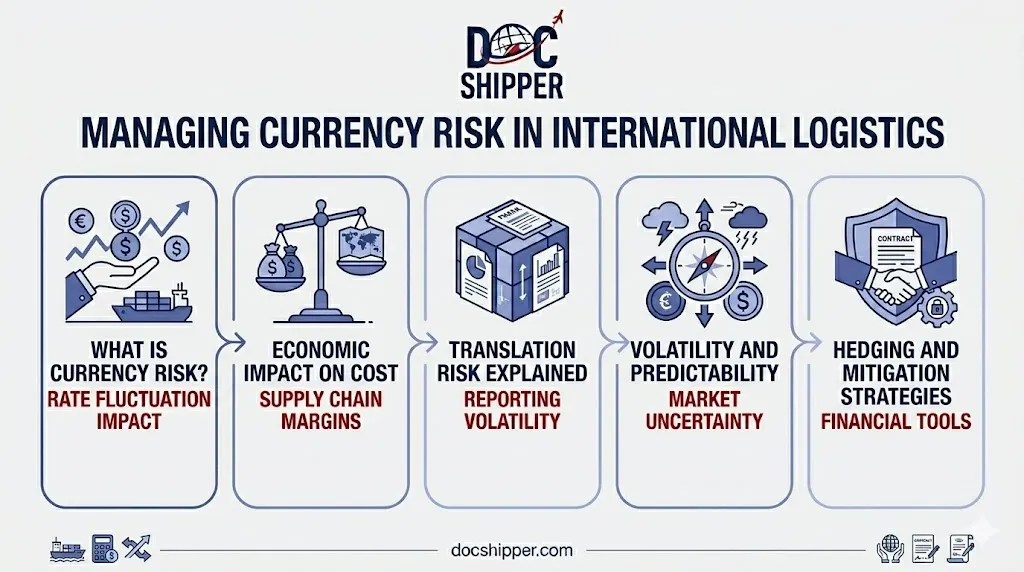
Three primary mechanisms drive this risk. Transaction risk occurs during the period between agreement and settlement—the most immediate concern for logistics operations. Translation risk affects companies with foreign subsidiaries when consolidating accounts. Economic risk influences long-term competitiveness when persistent currency movements alter market dynamics.
Central banks, geopolitical events, inflation differentials, and interest rate policies all contribute to exchange rate volatility. A single policy announcement can trigger 2-5% swings within hours, directly impacting shipment profitability.
Regulatory frameworks also shape currency risk management. The EU MiFID II regulations impose transparency requirements on currency derivative transactions, while national customs authorities require accurate currency conversion documentation for duty calculations.
Hedging instruments provide protection mechanisms: forward contracts lock in rates for future dates, currency options offer protection while preserving upside potential, and natural hedging matches revenue and expenses in the same currency. Payment timing strategies like leading (accelerating payments when rates are favorable) and lagging (delaying when unfavorable) offer tactical flexibility.
At DocShipper, we systematically advise clients on currency exposure during quotation, particularly for high-value shipments or contracts with extended payment terms, ensuring they understand potential rate impacts before committing to transactions.
Practical Examples & Risk Calculations
Understanding currency risk requires examining real-world scenarios. Consider a European importer ordering machinery from the United States with these parameters:
| Parameter | Contract Date | Payment Date (90 days) | Impact |
|---|---|---|---|
| Invoice Amount | $500,000 | $500,000 | Unchanged |
| EUR/USD Rate | 1.10 | 1.05 | -4.5% depreciation |
| EUR Cost | €454,545 | €476,190 | +€21,645 loss |
This 4.5% currency movement erased €21,645 from the bottom line—potentially the entire profit margin on the transaction. For a company processing 50 such shipments annually, unhedged currency exposure could accumulate losses exceeding €1 million.
Hedging scenario comparison: If the importer had purchased a forward contract at 1.10 for €5,000, they would have locked in the original rate, saving €16,645 net. The cost-benefit calculation becomes: (€21,645 potential loss) – (€5,000 hedging cost) = €16,645 protected value.
Volatility impact on logistics costs: Currency fluctuations affect not just product costs but freight rates, insurance premiums, and customs duties calculated in foreign currencies. A 10% depreciation in the importer’s currency increases total landed costs proportionally across all dollar-denominated expenses.
Industry-specific exposure levels:
- High-volume commodities (metals, grains): 2-3% margin compression from 5% currency movement
- Fashion/retail imports: 15-30 day lead times create moderate exposure windows
- Industrial equipment: 90-180 day payment terms generate maximum vulnerability
- E-commerce fulfillment: Daily small transactions reduce per-unit risk but require automated hedging
- Project cargo: Multi-year contracts demand sophisticated hedging strategies across multiple milestones
DocShipper assists clients in quantifying their currency exposure during the quotation phase, providing transparent breakdowns of which cost components are subject to exchange rate fluctuations and recommending appropriate risk mitigation timing.
Conclusion
Currency risk remains an unavoidable reality in international logistics, capable of transforming profitable shipments into financial losses within days. Proactive identification, accurate calculation, and strategic hedging separate successful global traders from those vulnerable to market volatility.
Need expert guidance on managing currency exposure in your international shipments? Contact DocShipper for tailored risk assessment and mitigation strategies.
📚 Quiz
Test Your Knowledge: Currency Risk
Q1 — What is the core definition of currency risk in international trade?
Q2 — A European importer signs a contract to pay $500,000 for machinery at an EUR/USD rate of 1.10. By the 90-day payment date, the rate has dropped to 1.05. What is the financial outcome?
Q3 — A small importer places recurring monthly orders worth $15,000 each from a US supplier, paid in USD, with 45-day payment terms. Which strategy best reduces their currency risk without financial derivatives?
🎯 Your Result
📞 Free Quote in 24hFAQ | Currency Risk: Definition, Calculation & Concrete Examples
These terms are synonymous. Both refer to the potential financial impact from fluctuations in foreign exchange rates during international transactions. Some professionals prefer "exchange rate risk" for precision, while "currency risk" is more commonly used in trade finance contexts.
Multiply the foreign currency amount by the difference between the initial and settlement exchange rates. For example: $100,000 invoice at 1.10 EUR/USD = €90,909. If the rate moves to 1.15, you pay €86,957—a €3,952 gain. Reverse movements create losses.
Hedge when payment terms exceed 30 days, transaction values exceed your risk tolerance threshold, or profit margins are narrow (under 10%). Companies with predictable recurring imports should establish systematic hedging policies rather than case-by-case decisions.
Forward contracts lock in today's exchange rate for a future payment date. You agree to buy a specific currency amount at a predetermined rate, eliminating uncertainty. Banks typically require 10-20% margin deposits, and contracts are binding regardless of future rate movements.
Yes. Many banks offer forward contracts starting at $10,000-$25,000 with fees of 0.5-2% of transaction value. For recurring shipments, even small importers benefit from hedging. Alternatively, negotiating payment in your home currency transfers risk to suppliers.
Customs authorities convert foreign currency invoices to local currency using official rates on the declaration date. If your currency depreciates between purchase and customs clearance, you pay higher duties in local currency terms, compounding the currency loss on the goods themselves.
Natural hedging matches foreign currency revenues with expenses in the same currency. If you sell products in USD and pay suppliers in USD, exchange rate movements affect both sides equally, reducing net exposure without financial derivatives.
Indirectly. Incoterms determine which party pays freight, insurance, and duties—but currency risk depends on the invoice currency and payment terms. An EXW purchase in foreign currency carries the same exchange risk as DDP, though the total exposed amount differs.
EUR/USD typically fluctuates 8-12% annually, USD/CNY 3-6% (due to managed float), and GBP/USD 10-15%. Emerging market currencies show higher volatility (15-30% annually), significantly impacting shipments from developing economies.
Invoice in your home currency when possible to eliminate personal exposure, transferring risk to the counterparty. If negotiating power is limited, major reserve currencies (USD, EUR) offer more hedging tools and tighter spreads than exotic currencies.
Rarely. Most contracts include "hardship clauses" or "material adverse change" provisions, but courts generally enforce agreed prices. Some contracts specify renegotiation triggers (e.g., ±10% rate movement), but these must be explicitly stated in the agreement.
Professional forwarders quote in stable currencies, include currency adjustment clauses for long-term contracts, or build 2-3% buffers into rates. Leading providers like DocShipper maintain multi-currency accounts to minimize conversion costs and offer transparent rate-lock options for clients.
Need Help with
Logistics or Sourcing ?
First, we secure the right products from the right suppliers at the right price by managing the sourcing process from start to finish. Then, we simplify your shipping experience - from pickup to final delivery - ensuring any product, anywhere, is delivered at highly competitive prices.


Fill the Form
Prefer email? Send us your inquiry, and we’ll get back to you as soon as possible.
Contact us




