
In short ⚡
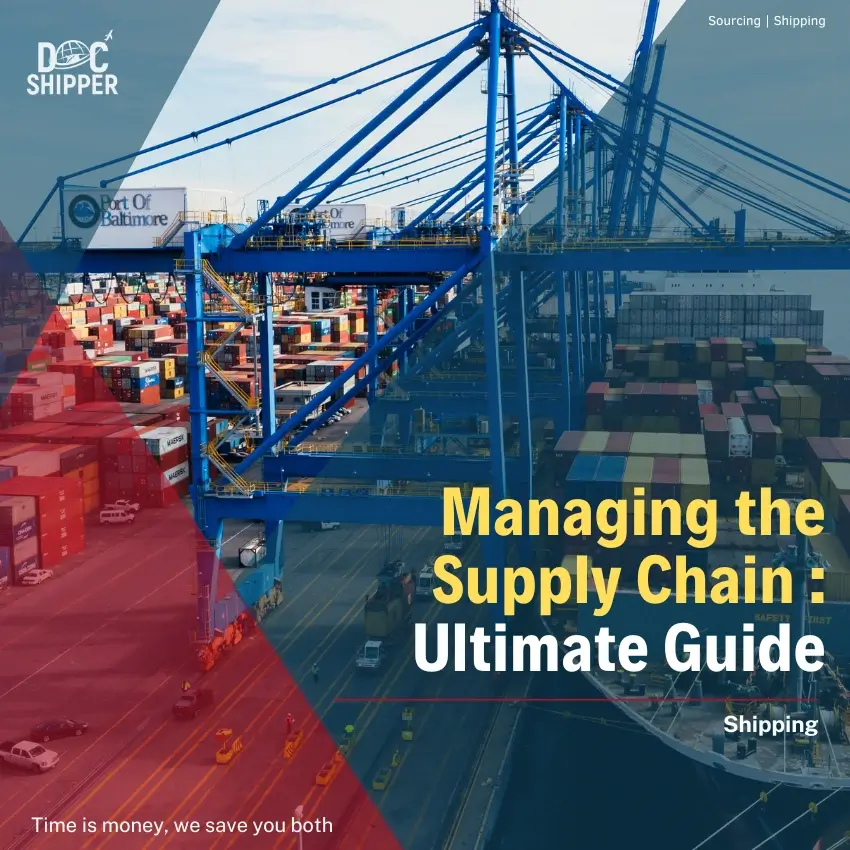
Managing the supply chain means controlling the end‑to‑end flow that turns customer demand into delivered orders, from sourcing and transport to warehousing, customs, and last‑mile delivery.
Done well, it reduces landed cost, improves on‑time, in‑full (OTIF) service, frees working capital, and cuts disruption risk through clear processes, data, and aligned partners.
We hope you’ll find this article genuinely useful, but remember, if you ever feel lost at any step, whether it’s finding a supplier, validating quality, managing international shipping or customs, DocShipper can handle it all for you!
What is supply chain management and how does it impact your business performance?
Managing supply chain isn’t just “moving stuff”, it’s the end-to-end system you run to turn demand into delivered orders, reliably and profitably.
It connects procurement, production, transportation, warehousing, inventory management, customs clearance, and last‑mile delivery into one operational story that your customers feel immediately.
Here’s the thing, you don’t lose margin in one big dramatic moment.
You bleed it through small leaks, wrong Incoterms, inflated freight rates, missing documentation, slow routing decisions, poor consolidation, and lead time surprises that force you into expensive “panic shipments”.
From experience at DocShipper, the fastest way to see the impact is to map the flows and ask one blunt question, “Where does time or cash get stuck?”
- Cost: freight forwarding choices, carrier selection, containerization vs air, load planning, customs duties, warehousing fees, and handling all hit your landed cost.
- Service: lead time, transit time reliability, tracking, fulfillment accuracy, and last‑mile delivery performance decide whether customers reorder or churn.
- Risk: compliance, tariff shifts, cargo damage, missed cutoffs, and weak delivery terms can turn one shipment into a claims nightmare.
- Cash: inventory turns, safety stock levels, payment terms, and delays at customs directly affect working capital.
Most teams only look at “transportation cost per shipment” and stop there.
But true supply chain management is a performance engine, the kind SCOR practitioners at ASCM use to tie operational metrics to revenue, margin, and customer experience.
Checklist, are you really managing supply chain, or just reacting?
- You know your real landed cost per SKU, including freight, tariff, customs duties, insurance, and warehousing.
- You can explain your Incoterms and delivery terms without guessing who pays what, and when risk transfers.
- You track lead time by lane and supplier, not “China to EU takes 30 days”.
- You have a documented process for import/export compliance and shipping documentation (commercial invoice, packing list, bill of lading).
- You can switch carriers, routes, or modes without rebuilding everything from scratch.
Workflow to link supply chain management to business performance
1) Map your physical flow, supplier to port, port to warehouse, warehouse to customer.
2) Map your information flow, PO, booking, bill of lading, tracking, customs entry, proof of delivery.
3) Map your cash flow, deposits, balance payments, freight invoices, duties/tax, chargebacks, returns.
4) Put metrics on each link, cost, time, variability, and failure rate.
5) Fix the biggest constraint first, not the loudest complaint.
DocShipper Advice
Our experts audit your flows, uncover hidden margin leaks, and design a resilient, cost-controlled supply chain aligned with your growth goals.
Core components of a modern supply chain: from sourcing to last-mile delivery
If you’re managing supply chain in the real world, you’re orchestrating multiple “mini-systems” that interact, sometimes nicely, sometimes not at all.
You’ll notice fast that a cheap unit price means nothing if your shipment arrives late, damaged, or blocked in customs clearance.
Think of a modern supply chain as these core components.
- Procurement and sourcing: supplier selection, negotiation, capacity planning, payment terms, and quality expectations.
- Inbound logistics: freight forwarding, freight broker coordination, carrier booking, multimodal transport, consolidation, palletization, and containerization.
- Trade compliance: import/export requirements, tariffs, customs duties, HS classification, and documentation control.
- Warehousing and inventory management: receiving, put-away, cycle counts, storage strategy, cross‑docking, and replenishment rules.
- Distribution and fulfillment: order picking, packing, routing, last‑mile delivery, returns handling, and customer communication.
- Visibility and control: tracking, exception management, freight insurance, claims, and performance analytics.
Quick micro-story that’ll feel familiar.
A buyer negotiated great pricing, then used the wrong Incoterms and assumed the supplier handled export clearance, the cargo missed the vessel, the bill of lading came late, and the warehouse ran out of stock, the “cheap” deal triggered air freight to recover service levels.
At DocShipper, we prevent this by aligning delivery terms, documents, and routing decisions before the cargo moves.
That’s what operational supply chain management looks like, fewer surprises, more control.
| Component | What you control | What usually breaks | What to measure |
| Transportation | Carrier, mode, routing, consolidation, load planning | Missed cutoffs, rolled bookings, hidden surcharges | Freight cost per kg/CBM, on-time departure, transit time variance |
| Customs clearance | Compliance process, documentation, broker coordination | Wrong HS code, missing certificates, duty surprises | Clearance time, holds rate, duty delta vs estimate |
| Warehousing | Slotting, inventory rules, cross‑docking | Stock inaccuracies, slow receiving, space constraints | Inventory accuracy, dock-to-stock time, storage cost per pallet |
| Fulfillment and last‑mile delivery | Pick/pack process, delivery promises, returns flow | Mis-picks, late deliveries, high return rate | OTIF, cost per order, returns cycle time |
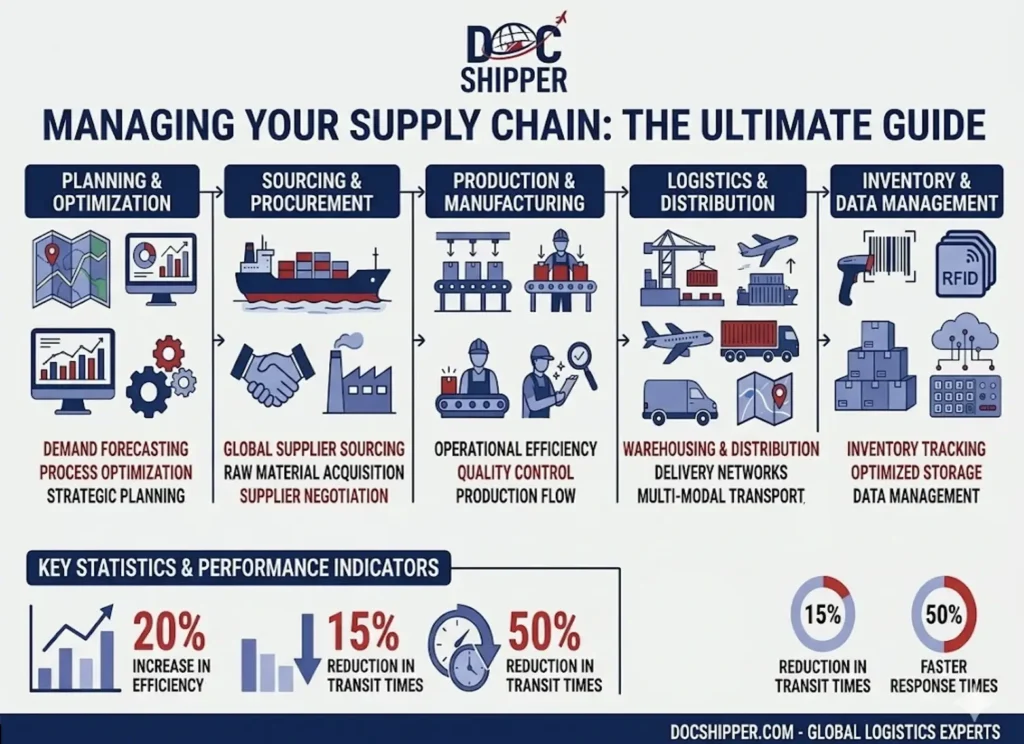
Key differences between logistics, supply chain, and value chain
When you’re managing supply chain, vocabulary mistakes cost you real money, because you’ll optimize the wrong thing.
We’ve seen teams “cut logistics cost” and accidentally increase inventory, duties, and stockouts, the spreadsheet looked great, the business didn’t.
Use this simple distinction.
- Logistics: how you move, store, handle, and deliver cargo and shipments, transportation, warehousing, distribution, tracking, routing, and customs clearance operations.
- Supply chain: the full network and decisions from sourcing to fulfillment, including procurement, production planning, inventory, logistics outsourcing, and risk management.
- Value chain: the bigger business system that creates customer value, product design, marketing, after-sales, and how supply chain choices enable competitive advantage.
| Term | Main focus | Typical owner | Common tools |
| Logistics | Execution of movement and storage | Logistics manager, 3PL, freight forwarder | TMS, WMS, tracking portals, freight audit |
| Supply chain | End-to-end design and control | Supply chain lead, operations director, 4PL | S&OP, demand planning, network design, KPI dashboards |
| Value chain | Competitive differentiation and profit pools | Leadership team | Pricing, portfolio strategy, customer experience metrics |
Micro-story, because this is where confusion bites.
A retailer pushed for cheaper freight rates by shifting to slower ocean lanes, logistics looked “optimized”, but inventory ballooned, warehouse overflow triggered outside storage, and last‑mile delivery got slammed when late containers arrived in bunches.
That’s why we frame decisions in DocShipper around end-to-end flow, not isolated transportation cost.
How to design a supply chain management strategy that fits your goals
Managing supply chain well starts with a strategy that matches what you actually sell and how you promise delivery.
If you skip that alignment, you’ll keep firefighting, late shipments, customs issues, and mismatched inventory, and you’ll call it “market volatility”.
We build strategy by tying targets to levers, service level to inventory, mode to lead time, Incoterms to risk, and logistics outsourcing to control.
And yes, you can do it without turning your business into a six-month consulting project.
Checklist, strategy fit in one page
- Your customer promise is defined, delivery time, OTIF target, and acceptable split shipments.
- Your lanes are segmented, stable vs volatile, high duty vs low duty, fast vs slow.
- Your Incoterms and responsibilities are standardized per supplier type.
- Your inventory policy is explicit, safety stock, reorder points, and exceptions.
- Your sourcing plan includes second-source or contingency routing for critical SKUs.
Workflow to design a supply chain management strategy
1) Define service promise by channel, B2B, eCommerce, marketplace, wholesale.
2) Segment SKUs by value, velocity, and supply risk.
3) Pick lanes and modes per segment, air, ocean, rail, or multimodal transport.
4) Lock Incoterms, documentation rules, and customs clearance ownership.
5) Choose operating model, in-house, 3PL, 4PL, or hybrid, then set KPIs and escalation paths.
Looking for a Reliable Shipping & Sourcing Partner?
Translating business objectives into supply chain priorities (cost, service, risk, ESG)
Managing supply chain gets easier when you stop chasing 12 objectives at once.
You need trade-offs you can defend, because cost, service, and risk don’t all improve together, not without investment.
Here’s a practical translation table we use with clients.
| Business objective | Supply chain priority | What you’ll change | What you’ll measure |
| Lower landed cost | Cost-first network | Consolidation, container utilization, freight rate negotiation, packaging/palletization | Landed cost per unit, cost per shipment, CBM utilization |
| Faster delivery promise | Service-first flow | Position inventory, use cross‑docking, tighten routing, selective air | OTIF, order cycle time, lead time variability |
| Reduce disruption risk | Resilience-first design | Dual sourcing, alternative carriers, buffer stock on critical SKUs | Recovery time, stockout rate, supplier OTIF |
| ESG and compliance | Traceable, compliant operations | Supplier audits, documentation discipline, mode shifts, cleaner carriers | CO2 per shipment, audit pass rate, compliance incidents |
Micro-story, because priorities get real during the first disruption.
A brand insisted on lowest freight rates, then a peak-season carrier rollover added 18 days, they missed a launch window and paid for emergency air cargo, suddenly risk mattered more than a cheap ocean contract.
To keep you grounded, align priorities with a recognized framework like ISO 28000 for supply chain security, then decide where you’ll pay for control and where you’ll accept variability.
DocShipper Info
We translate your business goals into actionable supply chain levers, cost, service, risk, and ESG, with measurable KPIs from day one.
Choosing the right operating model: in-house, 3PL/4PL, and hybrid setups
Managing supply chain isn’t about doing everything yourself, it’s about owning the decisions that protect service, cost, and compliance.
The operating model decides who runs transportation, warehousing, freight forwarding, customs clearance, and exception management day to day.
Let’s make it concrete.
- In-house: you run planning and execution with your own team, systems, and carrier contracts.
- 3PL: you outsource execution like warehousing, fulfillment, distribution, and sometimes transport management.
- 4PL: you outsource orchestration, a lead logistics partner manages multiple 3PLs, carriers, and freight brokers with end-to-end visibility.
- Hybrid: you keep control points in-house, like procurement policy, Incoterms, and supplier management, then outsource specialized execution.
| Model | Best when | Watch-outs | DocShipper can help with |
| In-house | You have volume, stable lanes, and strong ops talent | Tooling gaps, limited carrier leverage, key-person risk | Freight forwarding, customs clearance, multimodal routing, documentation coaching |
| 3PL | You need scalable warehousing and fulfillment fast | Service variability, hidden fees, weak KPI governance | 3PL selection, onboarding, KPI setup, inbound freight + warehousing coordination |
| 4PL | You want one control tower across regions and providers | Loss of transparency if governance is weak | End-to-end control tower approach, exception management, cost-to-serve analytics |
| Hybrid | You need control on risk points, but outsource execution | Handoffs fail without clear processes | Operating playbooks, Incoterms alignment, consolidation plans, tracking and escalation flows |
Micro-story, because operating models break at handoffs.
A client outsourced warehousing to a 3PL but kept freight forwarding elsewhere, nobody owned the inbound appointment booking, containers sat, demurrage piled up, and the warehouse blamed the carrier while sales blamed operations.
We fixed it by assigning a single escalation owner, standardizing the booking workflow, and tightening documentation, bill of lading release, customs entry, and delivery scheduling.
Checklist, picking your operating model without regrets
- You know which decisions must stay under your control, Incoterms, supplier terms, compliance, customer promise.
- You’ve defined KPIs and penalties, OTIF, claims rate, inventory accuracy, and transit time reliability.
- You’ve mapped handoffs, who books, who clears customs, who pays duties, who insures cargo.
- You’ve validated systems compatibility, TMS/WMS, tracking, and reporting cadence.
- You’ve planned for exceptions, customs holds, damaged cargo, partial shipments, and peak-season rollovers.
Workflow to implement the chosen model
1) Document roles, who owns booking, routing, consolidation, clearance, warehousing, and last‑mile delivery.
2) Standardize documentation, commercial invoice, packing list, certificates, and bill of lading rules.
3) Align Incoterms and freight insurance to your risk tolerance.
4) Build an escalation path, cutoffs, contact points, and response times.
5) Review weekly performance, then renegotiate freight rates and service terms with data, not opinions.
Practical steps to manage supply chain operations for cost, service, and risk
When you are managing supply chain operations, you are balancing three forces every day, cost, service level, and risk exposure. If you optimize one blindly, you will damage the others.
You need a structured execution framework, not firefighting. Below is the operational workflow we implement with our clients at DocShipper.
- Step 1: Map your end-to-end flows, suppliers, factories, consolidation hubs, ports, warehouses, last-mile nodes.
- Step 2: Classify products, ABC analysis by margin, demand volatility, and criticality.
- Step 3: Define target service levels, OTIF, lead time, fill rate, by market segment.
- Step 4: Align inventory strategy, safety stock logic, reorder points, buffer positioning.
- Step 5: Secure transport capacity, contract rates, backup carriers, multimodal options.
- Step 6: Implement supplier risk monitoring, financial health, geopolitical exposure, quality history.
- Step 7: Deploy continuous KPI review, monthly S&OP, root cause analysis, corrective action loops.
You cannot manage what you do not measure. Focus on a concise KPI cockpit.
| Objective | Key KPI | Why it matters |
| Cost control | Total landed cost per SKU | Gives you real margin visibility including freight, duties, storage |
| Service level | OTIF, order fill rate | Direct impact on customer satisfaction and retention |
| Inventory efficiency | Inventory turnover, DIO | Prevents cash from being frozen in slow stock |
| Risk management | Supplier concentration ratio | Measures dependency and disruption exposure |
Risk mitigation must be proactive, not reactive. You should systematically stress-test your network.
- Dual sourcing for strategic components.
- Nearshoring or regional diversification.
- Safety stock buffers on long lead-time SKUs.
- Pre-shipment inspection and quality control programs.
- Flexible Incoterms strategy to control transport risk when needed.
At DocShipper, we integrate sourcing, quality inspection, international freight, customs clearance, and distribution under one coordination layer. You reduce fragmentation and gain a single control tower for execution.
DocShipper Alert
Unify sourcing, freight, customs, and distribution under one control tower to reduce risk, improve service, and protect margins.
Digital tools and data you need to control and optimize your supply chain
If you are serious about managing supply chain performance, spreadsheets are not enough. You need real-time visibility and predictive capabilities.
Your digital stack should align with your operational complexity. Here is a practical overview.
| Tool Category | Main Function | When You Need It |
| ERP | Centralizes finance, purchasing, inventory data | Multi-entity or multi-warehouse operations |
| WMS | Warehouse optimization, picking accuracy | High SKU count or e-commerce activity |
| TMS | Freight planning and cost control | Multiple carriers and international routes |
| SRM | Supplier performance tracking | Strategic sourcing and supplier consolidation |
| BI dashboards | Data visualization and forecasting | Need predictive decision-making |
Data discipline is more important than software sophistication. You must standardize inputs before chasing automation.
- Clean SKU master data, dimensions, HS codes, lead times.
- Accurate bill of materials.
- Historical demand segmented by channel.
- Freight cost breakdown by Incoterm.
- Supplier performance scorecards.
Once your data is reliable, you can deploy advanced optimization levers.
- Demand forecasting using rolling 12-month models.
- Network redesign simulations to reduce transport miles.
- Scenario planning for tariff increases or port congestion.
- AI-based safety stock optimization.
We act as an operational 4PL partner when needed, consolidating freight data, supplier information, and customs flows into a unified reporting layer. You gain transparency across sourcing countries like China, Southeast Asia, or Europe without multiplying systems.
DocShipper Info
We centralize your freight, supplier, and customs data into clear dashboards, helping you optimize routes, costs, and inventory with confidence.
Conclusion
You now understand that managing supply chain performance is not a back-office task. It is a strategic growth engine.
- You align cost, service, and risk instead of optimizing them in isolation.
- You map and control end-to-end flows, from sourcing to last-mile delivery.
- You track actionable KPIs, not vanity metrics.
- You mitigate disruption through diversification and structured risk monitoring.
- You leverage digital tools and clean data to move from reactive to predictive management.
- You can outsource complexity to a 3PL or 4PL like DocShipper to gain visibility and operational control.
If you want resilience, margin protection, and customer satisfaction at the same time, you must treat your supply chain as a strategic asset. And you must manage it accordingly.
FAQ | How managing your supply chain boosts resilience, cuts costs, and delights customers
Transportation inside or around the warehouse often creates hidden delays and extra costs. Typical issues include:
To limit the impact, you need: clear dock scheduling rules, standardized communication with carriers, basic KPIs (dock-to-stock time, on‑time loading), and digital tracking of inbound/outbound flows.
- Poor tracking of inbound/outbound trucks, leading to missed cut‑offs and demurrage.
- Weak communication between carrier, warehouse, and planner, creating idle time at docks.
- Unclear slotting or staging rules, so pallets are moved multiple times before loading.
- Lack of visibility on dock-to-stock time, making it hard to promise realistic lead times.
- Safety incidents (damaged goods, staff injuries) that slow operations and increase insurance costs.
Safe internal transport (forklifts, pallet jacks, conveyors) protects people, inventory, and uptime. Focus on:
- Housekeeping basics
- Remove sharp objects and debris immediately.
- Fix loose flooring, broken pallets, or uneven ramps.
- Clean spills right away and mark wet areas.
- Clear and safe circulation
- Separate pedestrian and forklift lanes with markings and barriers.
- Keep cords, hoses, and cables out of walkways or protected in channels.
- Avoid overhanging loads that reduce driver visibility.
- Emergency readiness
- Ensure fire exits are accessible and functional.
- Keep extinguishers visible and inspected.
- Train staff on evacuation routes.
- Storage discipline
- Store items in their designated locations with clear labels.
- Respect racking load limits and use proper palletization.
- Use correct waste bins and avoid blocking safety equipment.
Many firms still manage their supply chain reactively, which creates structural problems such as:
The way out is to align strategy (service promise, Incoterms, inventory policy) with a clear operating model and a small, disciplined KPI set.
- Rising end‑to‑end costs
- Higher freight rates, fuel, and surcharges.
- Escalating warehousing and labor costs.
- Duties and tariff changes inflating landed cost per SKU.
- Tougher customer expectations
- Demand for faster delivery (e‑commerce “Amazon effect”).
- Low tolerance for late, partial, or inaccurate orders.
- More complex risk landscape
- Market volatility, trade disputes, and changing regulations.
- Port congestion, geopolitical disruptions, and carrier rollovers.
- Internal complexity
- Fragmented responsibilities between purchasing, logistics, and sales.
- Lack of visibility on real landed cost, lead-time variability, and stock exposure.
Technology is useful only if it gives you end‑to‑end visibility and faster decisions. Key enablers are:
Used together, these tools help you detect blind spots (bottlenecks, delays, cost leaks), act before they hit customers, and recover faster from disruptions.
- Core systems
- ERP: single source of truth for purchasing, inventory, and finance.
- WMS: improves receiving, storage, picking accuracy, and dock-to-stock time.
- TMS: optimizes carrier selection, routing, and freight spend.
- SRM: tracks supplier performance, lead times, and risk indicators.
- Analytics and intelligence
- BI dashboards for real‑time KPIs, alerts, and forecasting.
- Scenario planning tools to test “what if” (port closure, tariff hike, demand spike).
- Data foundations
- Clean master data (SKUs, HS codes, dimensions, lead times).
- Standardized documentation (commercial invoice, packing list, bill of lading).
A strong logistics partner doesn’t just “move boxes”; it helps you run the supply chain as a controlled system. Concretely, a 3PL/4PL can:
The key is to define clear KPIs, roles (who owns booking, customs, duties, Incoterms), and escalation paths so the partnership actually strengthens your supply chain.
- Take over heavy execution
- Arrange international freight, consolidation, and routing.
- Manage warehousing, picking, packing, and last‑mile delivery.
- Handle customs clearance, documentation, and freight insurance.
- Reduce operational risk
- Use established carrier networks to lower damage and delay risk.
- Offer FTL/FCL options, limiting transshipments and handling.
- Provide reporting and visibility
- Share regular reports on delivery speed, inventory accuracy, and order errors.
- Surface exceptions early (holds, damage, stockouts) so you can act.
- Free your team to focus on growth
- You focus on product, sales, and customer relationships.
- They focus on capacity planning, routing decisions, and day‑to‑day problem solving.
Warehousing is often where margin quietly leaks. A few targeted practices can change that:
Done right, your warehouse becomes a stability buffer instead of a bottleneck, improving service levels while protecting working capital.
- Tight inventory accuracy
- Regular cycle counts instead of rare full counts.
- Real‑time updates on receipts, picks, and adjustments via WMS.
- Smarter storage and handling
- Slot fast movers near docks to cut picking and loading time.
- Use cross‑docking for high‑velocity SKUs to reduce storage days.
- Standardize packaging and palletization for better container and truck fill.
- Clear replenishment rules
- ABC analysis to set different safety stocks by SKU importance.
- Explicit reorder points based on realistic lead times, not guesses.
- Integrated planning
- Share demand and inbound plans with your warehouse and 3PL.
- Use a simple KPI set: inventory accuracy, dock-to-stock time, storage cost per pallet, OTIF.
Need Help with
Logistics or Sourcing ?
First, we secure the right products from the right suppliers at the right price by managing the sourcing process from start to finish. Then, we simplify your shipping experience - from pickup to final delivery - ensuring any product, anywhere, is delivered at highly competitive prices.
Fill the Form
Prefer email? Send us your inquiry, and we’ll get back to you as soon as possible.
Contact us