


In short ⚡
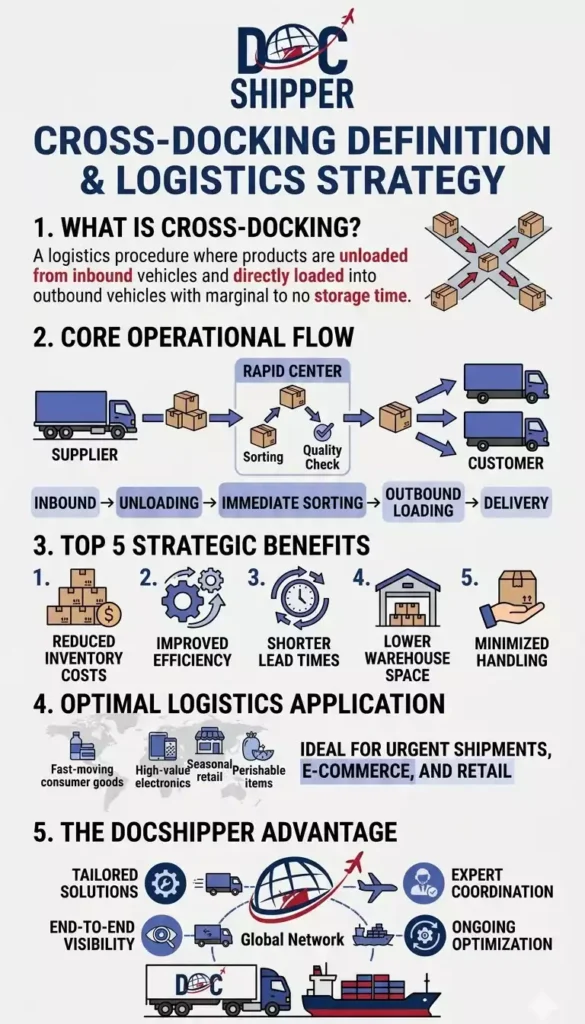
Cross-docking is a logistics technique where incoming goods are directly transferred from receiving docks to shipping docks with minimal or no storage time. This method eliminates warehousing costs, reduces handling, and accelerates delivery times by streamlining the supply chain between suppliers and end customers.
Introduction
Many businesses struggle with excessive inventory costs and slow delivery cycles. Traditional warehousing models require multiple handling steps, prolonged storage periods, and significant space investments that drain operational budgets.
Cross-docking addresses these challenges by transforming distribution centers into transfer hubs rather than storage facilities. This approach revolutionizes supply chain efficiency in international trade and domestic distribution networks.
Key characteristics of cross-docking operations:
- Time-sensitive processing: Products spend less than 24 hours in the facility
- Pre-sorted shipments: Goods arrive ready for immediate redistribution
- Synchronized scheduling: Inbound and outbound logistics coordinated precisely
- Minimal handling: Products move directly from receiving to shipping docks
- Technology-driven: Real-time tracking systems manage flow optimization
Cross-Docking Mechanics & Strategic Implementation
Cross-docking operates through two primary models: pre-distributed and consolidation arrangements. In pre-distributed cross-docking, suppliers prepare shipments according to final destination requirements before arrival. Products are labeled, sorted, and packaged for specific customers or retail locations.
The consolidation model combines multiple smaller shipments from different suppliers into full truckload deliveries. This approach maximizes transportation efficiency and reduces per-unit shipping costs for international freight operations.
Operational requirements for successful cross-docking include advanced warehouse management systems (WMS), automated sorting equipment, and robust communication networks. Facilities must maintain precise dock scheduling to prevent bottlenecks and ensure continuous flow.
Regulatory compliance becomes critical in international cross-docking operations. Customs clearance procedures must align with transfer timelines. According to World Customs Organization guidelines, bonded cross-dock facilities can expedite clearance by pre-processing documentation while goods remain in transit status.
Quality control protocols must occur rapidly without disrupting flow. Inspection procedures verify product integrity, quantity accuracy, and documentation compliance within compressed timeframes. At DocShipper, we implement systematic verification checkpoints that maintain cross-docking speed while ensuring shipment accuracy and customs compliance.
The infrastructure investment for cross-docking facilities differs significantly from traditional warehouses. Designs prioritize dock door density, wide-open floor spaces for sorting, and minimal racking systems. This configuration supports high-volume throughput rather than storage capacity.
Concrete Examples & Performance Data
Cross-docking delivers measurable improvements across multiple performance metrics. Industry studies demonstrate operational advantages that directly impact profitability and customer satisfaction.
| Performance Metric | Traditional Warehousing | Cross-Docking | Improvement |
|---|---|---|---|
| Average Dwell Time | 7-14 days | 12-24 hours | 85-95% reduction |
| Handling Touchpoints | 5-8 touches | 2-3 touches | 60% reduction |
| Storage Cost per Unit | $2.50-$4.00 | $0.40-$0.80 | 75-85% savings |
| Order Fulfillment Speed | 3-5 days | Same day to 24 hours | 80-90% faster |
| Inventory Carrying Costs | 20-30% of product value | 2-5% of product value | 85% reduction |
Use Case: Retail Distribution
A European electronics retailer implemented cross-docking for Asian imports arriving at Rotterdam port. Previously, containers were unloaded into a regional warehouse for 10-day storage before distribution to 45 retail locations.
After transitioning to cross-docking operations:
- Delivery cycle: Reduced from 14 days to 2 days port-to-store
- Warehouse space: Decreased from 50,000 sq ft to 15,000 sq ft
- Labor costs: Cut by 40% through elimination of put-away and picking operations
- Product damage: Reduced by 35% due to fewer handling touchpoints
- Inventory accuracy: Improved to 99.7% through automated scanning systems
Temperature-controlled cross-docking demonstrates particular value in pharmaceutical and food industries. A fresh produce importer processing South American fruit shipments reduced spoilage from 12% to 3% by eliminating extended cold storage periods and maintaining continuous refrigerated chain integrity.
Conclusion
Cross-docking transforms traditional logistics by eliminating storage bottlenecks and accelerating product flow. This methodology delivers substantial cost reductions while improving delivery speed and inventory management precision.
Need expert guidance implementing cross-docking strategies for your international shipments? Contact DocShipper for customized logistics solutions that optimize your supply chain efficiency.
📚 Quiz
Test Your Knowledge: Cross-Docking
1. What best defines cross-docking in logistics?
2. A logistics manager claims that cross-docking is ideal for all product types, including slow-moving items that require customization. Is this correct?
3. A European retailer imports electronics from Asia. After switching to cross-docking at Rotterdam port, which outcome best reflects the expected operational result?
🎯 Your Result
📞 Free Quote in 24hFAQ | Cross-Docking: Definition, Process & Concrete Examples
High-velocity products with predictable demand patterns, pre-packaged goods, and time-sensitive items like perishables or seasonal merchandise perform optimally in cross-docking environments. Products requiring quality inspections or customization are less suitable.
Cross-docking transfers products between vehicles with minimal handling and no storage, while transloading involves changing transportation modes (ocean to rail, for example) and may include brief storage periods. Cross-docking emphasizes speed; transloading focuses on modal optimization.
Essential systems include warehouse management software (WMS), barcode or RFID scanning, transportation management systems (TMS), and real-time visibility platforms. Automated sorting equipment and dock scheduling software enhance operational efficiency significantly.
Small shippers can leverage cross-docking through third-party logistics providers (3PLs) who consolidate multiple clients' shipments. This shared facility approach provides cross-docking benefits without requiring dedicated infrastructure investment.
Cross-docking can accelerate customs processing when facilities operate under bonded warehouse status. Pre-clearance procedures and advanced documentation submission allow goods to clear customs while maintaining transfer momentum through the facility.
Primary risks include transportation delays disrupting synchronized schedules, supplier non-compliance with pre-sorting requirements, system failures interrupting flow, and demand forecast errors causing mismatches between inbound and outbound volumes.
Facility size depends on throughput volume, but cross-docking operations typically need 60-70% less space than traditional warehouses handling equivalent volumes. A facility processing 500 pallets daily might require 20,000-30,000 square feet versus 80,000+ for conventional warehousing.
Most organizations achieve positive ROI within 12-18 months through reduced storage costs, lower labor expenses, and improved inventory turnover. High-volume operations may see returns within 6-9 months, while smaller implementations require 18-24 months.
Cross-docking enables just-in-time inventory approaches, reduces safety stock requirements, and improves inventory turnover rates. Companies transition from push-based to pull-based replenishment models, aligning inventory levels more closely with actual demand.
Hybrid models work effectively, where fast-moving SKUs flow through cross-docking while slower items utilize traditional storage. This approach optimizes facility utilization and accommodates diverse product characteristics within a single distribution network.
Staff require training in rapid sorting techniques, scanning technology, time-sensitive quality checks, and dock scheduling coordination. Emphasis on accuracy under time pressure and cross-functional communication skills ensures smooth operations.
Cross-docking reduces energy consumption by eliminating climate-controlled storage, decreases packaging waste through consolidated shipments, optimizes transportation routes reducing fuel usage, and minimizes product obsolescence and disposal through faster turnover.
Need Help with
Logistics or Sourcing ?
First, we secure the right products from the right suppliers at the right price by managing the sourcing process from start to finish. Then, we simplify your shipping experience - from pickup to final delivery - ensuring any product, anywhere, is delivered at highly competitive prices.


Fill the Form
Prefer email? Send us your inquiry, and we’ll get back to you as soon as possible.
Contact us




