


In short ⚡
Deadweight cargo refers to the total weight of cargo, fuel, provisions, crew, and passengers that a vessel can safely carry. It represents the difference between a ship's displacement when fully loaded and when empty, expressed in metric tons (MT) or long tons (LT).
Introduction
Many shippers confuse deadweight cargo with gross tonnage or net tonnage, leading to costly miscalculations in freight planning. Understanding this fundamental maritime concept is essential for optimizing vessel capacity and ensuring compliance with international shipping regulations.
In international trade, deadweight capacity directly impacts freight rates, route planning, and port operations. Whether shipping bulk commodities or containerized goods, knowing how to calculate and interpret deadweight figures ensures efficient cargo allocation.
Key characteristics of deadweight cargo include:
- Payload capacity: Maximum weight a vessel can transport safely
- Variable component: Includes cargo, fuel, water, stores, and personnel
- Regulatory compliance: Governed by IMO conventions and load line regulations
- Economic indicator: Determines revenue potential per voyage
- Safety parameter: Prevents overloading and ensures vessel stability
Technical Framework & Maritime Regulations
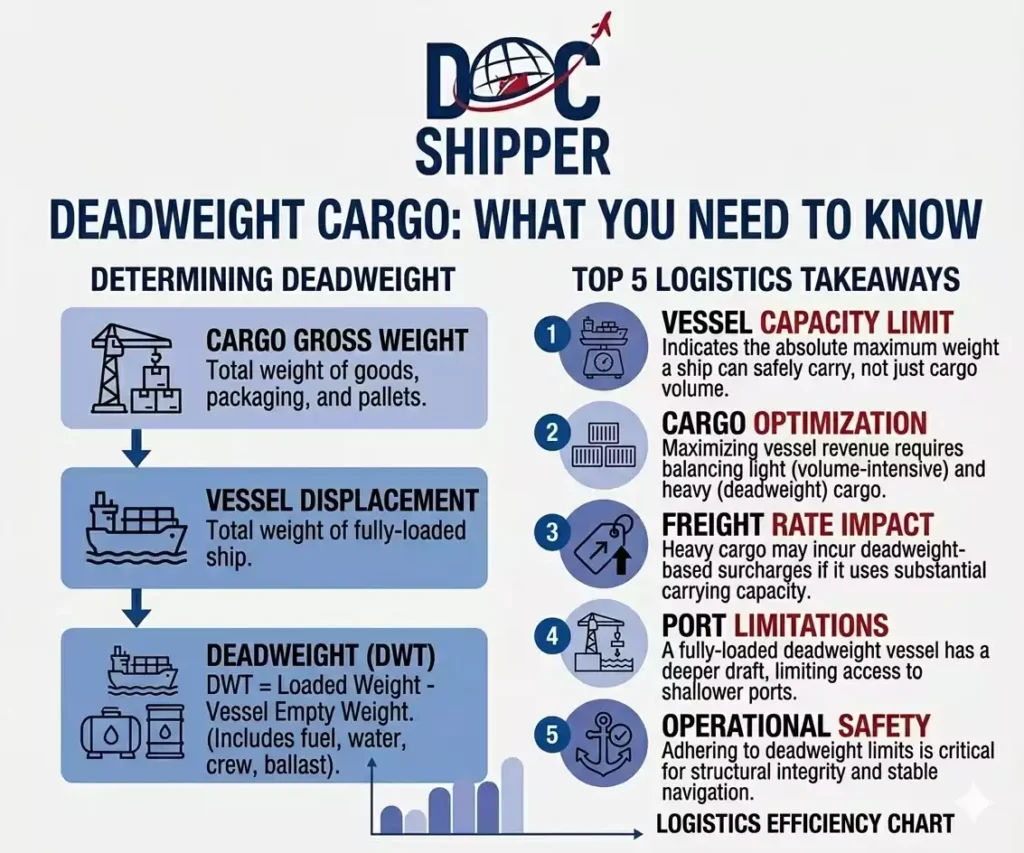
Deadweight tonnage (DWT) serves as the primary measurement for cargo vessel capacity in commercial shipping. The calculation subtracts the lightweight (empty vessel weight) from the loaded displacement at summer load line. This figure encompasses all variable weights aboard the vessel.
The International Convention on Load Lines (1966) establishes maximum permissible drafts for vessels operating in different zones and seasons. Ships must display Plimsoll marks indicating safe loading limits. Exceeding deadweight capacity violates these international maritime safety standards and exposes carriers to significant penalties.
Three critical components define deadweight capacity:
Cargo deadweight represents the actual revenue-generating payload. Bulk carriers typically allocate 95-98% of DWT to cargo, while container ships reserve more space for fuel and provisions due to longer voyages and higher speeds.
Consumables and stores include fuel oil, diesel, lubricants, fresh water, and provisions. A Panamax bulk carrier on a 30-day voyage might carry 2,000 MT of fuel, reducing available cargo capacity proportionally. At DocShipper, we factor these variables when calculating optimal loading plans for our clients’ shipments.
Constant weights such as ballast water ensure vessel stability during unladen or partially loaded voyages. Modern vessels use sophisticated ballast management systems to maintain safe trim and list throughout the journey.
The International Maritime Organization provides comprehensive guidelines on deadweight calculations and load line requirements. Classification societies like Lloyd’s Register and DNV GL verify DWT figures during vessel surveys and certification.
Understanding the relationship between deadweight and displacement tonnage clarifies vessel capacity. Displacement equals lightweight plus deadweight. A Capesize bulk carrier might have 50,000 MT lightweight and 180,000 MT DWT, totaling 230,000 MT displacement when fully loaded.
Practical Calculations & Industry Data
Calculating available cargo space requires precise understanding of deadweight allocation across voyage requirements. The formula remains straightforward but demands careful attention to operational parameters.
Basic Calculation Formula:
Available Cargo Weight = Total DWT – (Fuel + Fresh Water + Stores + Crew & Effects + Ballast)
Consider this practical scenario for a Handymax bulk carrier:
| Component | Weight (MT) |
|---|---|
| Total Deadweight Capacity | 52,000 |
| Heavy Fuel Oil (18 days @ 25 MT/day) | 450 |
| Marine Diesel Oil | 80 |
| Fresh Water & Provisions | 150 |
| Crew & Personal Effects | 20 |
| Ballast Water (if required) | 300 |
| Available Cargo Deadweight | 51,000 |
This calculation demonstrates how operational variables impact cargo capacity. Longer voyages require more fuel, reducing payload capacity. Weather routing decisions may necessitate additional ballast for stability, further limiting cargo weight.
Industry Benchmark Data:
- Handysize (10,000-35,000 DWT): Typically achieves 96-97% cargo utilization on short-haul routes
- Panamax (60,000-80,000 DWT): Maintains 94-95% efficiency with optimized fuel planning
- Capesize (150,000-200,000 DWT): Operates at 93-94% due to longer voyage durations
- VLOC (200,000-400,000 DWT): Achieves 92-93% with specialized iron ore/coal routes
Container vessels present unique considerations. A 14,000 TEU container ship might have 165,000 MT DWT but reach maximum draft before utilizing full weight capacity due to container stacking limitations and cargo distribution requirements.
Real-World Case Study:
A shipping company needed to transport 48,000 MT of grain from Brazil to China using a Panamax vessel (75,000 DWT). Initial calculations showed sufficient capacity. However, the 35-day voyage required 1,200 MT fuel plus 200 MT consumables. Weather conditions necessitated 500 MT ballast for stability through the South Atlantic. Total deductions: 1,900 MT, leaving 73,100 MT available—comfortably accommodating the cargo with safety margins.
At DocShipper, we perform these calculations systematically for every bulk shipment, ensuring optimal vessel selection and preventing costly overloading scenarios. Our logistics experts coordinate with shipbrokers to match cargo requirements with appropriate deadweight capacities.
Critical Planning Factors:
- Stowage factor: Volume-to-weight ratio affects whether cargo “cubes out” or “weighs out”
- Port restrictions: Draft limitations may prevent full DWT utilization
- Seasonal variations: Winter load lines reduce permissible deadweight in cold regions
- Cargo density: Heavy commodities like iron ore fully utilize DWT; lighter cargoes may not
- Trim requirements: Proper weight distribution ensures safe navigation and fuel efficiency
Conclusion
Mastering deadweight cargo calculations ensures optimal vessel utilization, regulatory compliance, and cost-effective shipping operations. This fundamental maritime metric directly impacts freight economics and operational planning across all bulk and breakbulk sectors.
Need expert assistance with cargo planning and deadweight optimization? Contact DocShipper for professional guidance tailored to your shipping requirements.
📚 Quiz
Test Your Knowledge: Deadweight Cargo
What does deadweight cargo represent in maritime shipping?
A shipper believes deadweight tonnage (DWT) and gross tonnage (GT) measure the same vessel characteristic. Is this correct?
A Handymax bulk carrier has 52,000 MT total DWT. For an 18-day voyage, it requires 450 MT fuel, 80 MT diesel, 150 MT water/provisions, 20 MT crew effects, and 300 MT ballast. What is the available cargo deadweight?
🎯 Your Result
📞 Free Quote in 24hFAQ | Deadweight Cargo: Definition, Calculation & Practical Examples
Deadweight measures weight capacity (cargo, fuel, stores), while gross tonnage measures total enclosed volume of a vessel. Deadweight is expressed in metric tons; gross tonnage uses a volumetric calculation under the International Convention on Tonnage Measurement. A vessel might have 50,000 DWT but 35,000 GT depending on hull design and internal spaces.
Freight rates for bulk commodities are often quoted per metric ton of deadweight capacity. Charterers pay based on cargo weight relative to vessel DWT. Higher utilization percentages reduce per-ton costs. Market conditions, vessel availability, and cargo density all influence the relationship between deadweight and freight pricing in spot and term markets.
No. Exceeding deadweight capacity violates international maritime law, specifically the Load Line Convention. Overloading compromises vessel stability, increases draft beyond safe limits, and risks capsizing. Port authorities conduct surveys, and vessels found overloaded face detention, fines, and potential criminal charges against the master and owner.
Container ships typically "cube out" before "weighing out" because container stacking reaches maximum height before approaching deadweight limits. A 14,000 TEU vessel might load only 120,000 MT of cargo against 165,000 DWT capacity. Refrigerated containers, empty returns, and weight distribution requirements further reduce deadweight utilization compared to bulk carriers.
Modern bulk carriers achieve 3.5:1 to 4:1 ratios (deadweight to lightweight). A Capesize might have 50,000 MT lightweight and 180,000 MT DWT (3.6:1). Older vessels, specialized carriers, and heavily equipped ships show lower ratios. Tankers typically achieve 4:1 to 5:1 due to simpler hull structures and minimal cargo handling equipment.
Ballast water occupies deadweight capacity when vessels sail unladen or partially loaded. A bulk carrier might carry 15,000-20,000 MT ballast for stability when empty, reducing available cargo weight on return voyages if ballast cannot be discharged. International ballast water management conventions require treatment systems, adding operational complexity to deadweight calculations.
Stowage factor (cubic meters per metric ton) determines whether cargo capacity is limited by weight or volume. Iron ore (0.3-0.4 m³/MT) fully utilizes deadweight before filling holds. Grain (1.2-1.4 m³/MT) may fill holds before reaching deadweight limits. Shippers must match cargo density with vessel characteristics for optimal deadweight utilization.
Vessels operating in winter zones must reduce draft, decreasing usable deadweight by 5-10% compared to summer load lines. A Panamax with 75,000 MT summer DWT might only load 71,000 MT in winter North Atlantic routes. Tropical load lines permit slightly higher loading. These variations affect voyage planning and cargo allocation strategies.
Higher deadweight loading increases draft and wetted surface area, raising resistance and fuel consumption. A fully loaded Capesize might consume 45 MT fuel daily at 14 knots, while partial loading at lighter draft reduces consumption to 38 MT daily. Operators balance deadweight utilization against fuel efficiency when optimizing voyage economics and speed profiles.
Many ports impose maximum draft limits due to channel depth, tidal ranges, or berth restrictions. A vessel with 180,000 MT DWT might only load 150,000 MT cargo when calling ports with 15-meter draft limits. Shippers must coordinate cargo quantities with destination port characteristics, sometimes requiring lightering operations or alternative discharge locations.
The International Tonnage Certificate issued by flag state authorities lists official deadweight capacity. Classification society certificates, stability books, and load line certificates provide supporting documentation. Charter parties reference these documents, and shippers should verify deadweight figures before cargo booking to ensure vessel suitability and prevent disputes over loading capacity.
Proper weight distribution maintains safe trim (fore-aft balance) and list (port-starboard balance). Concentrated heavy cargo might exceed local deck strength before reaching total deadweight capacity. Holds must be loaded proportionally, and ballast adjusted accordingly. Improper distribution causes structural stress, stability problems, and navigation difficulties despite remaining within total deadweight limits.
Need Help with
Logistics or Sourcing ?
First, we secure the right products from the right suppliers at the right price by managing the sourcing process from start to finish. Then, we simplify your shipping experience - from pickup to final delivery - ensuring any product, anywhere, is delivered at highly competitive prices.


Fill the Form
Prefer email? Send us your inquiry, and we’ll get back to you as soon as possible.
Contact us




