


In short ⚡
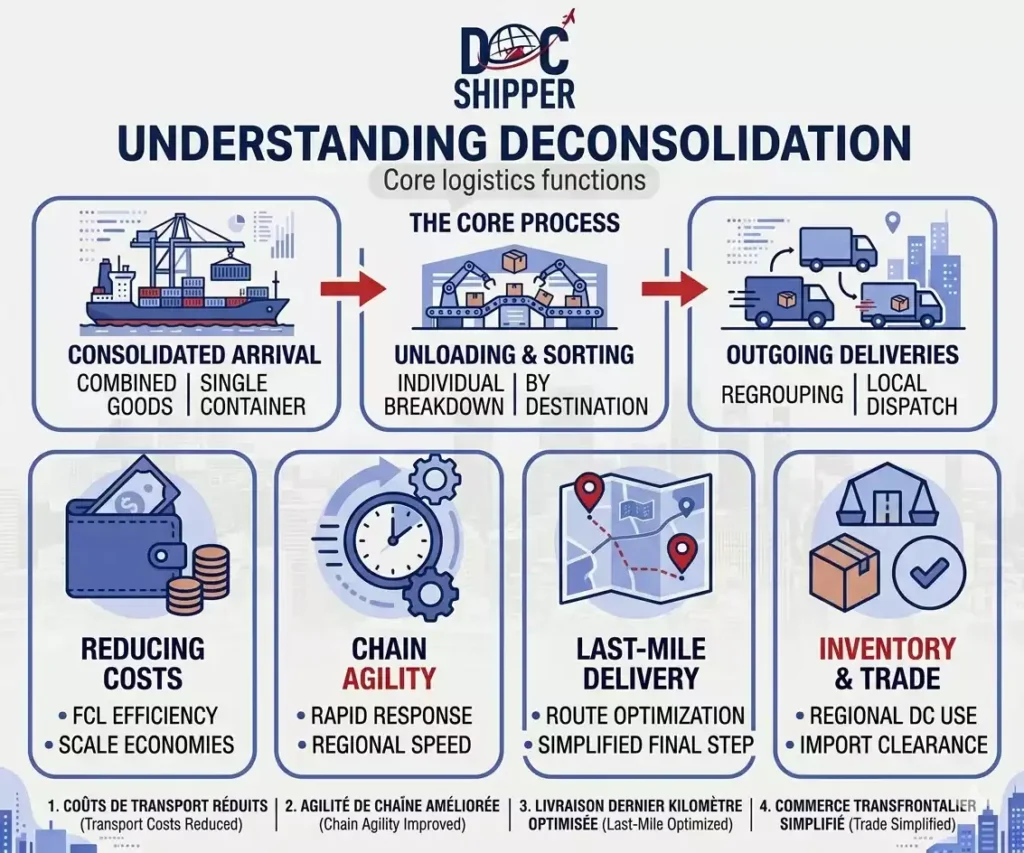
The deconsolidation point is a logistics facility where consolidated shipments are broken down into individual consignments for final delivery. This strategic node in the supply chain separates grouped cargo from multiple shippers, enabling efficient last-mile distribution. It serves as the critical transition between long-haul transportation and local delivery networks.
Introduction
Many importers struggle with understanding where and how their cargo transitions from bulk shipment to individual delivery. The confusion often stems from opacity in logistics processes between port arrival and final destination.
The deconsolidation point plays a pivotal role in international trade efficiency. It determines how quickly goods reach end customers after clearing customs. Without proper management at this facility, even expedited ocean freight loses its advantage.
Key characteristics of deconsolidation operations include:
- Cargo segregation: Physical separation of mixed shipments by final destination or consignee
- Documentation verification: Matching bills of lading with individual house waybills
- Inventory management: Tracking each consignment through scanning and warehouse systems
- Quality inspection: Damage assessment before forwarding to final recipients
- Distribution coordination: Scheduling onward transportation to multiple delivery points
Understanding Deconsolidation Operations
The deconsolidation process involves precise coordination between freight forwarders, customs brokers, and warehouse operators. When a master bill of lading arrives at the facility, it represents multiple house bills requiring separation.
This operation typically occurs at Container Freight Stations (CFS) near ports or airports. The facility receives full container loads (FCL) or air freight consolidations, then redistributes cargo as less-than-container-load shipments (LCL) or individual parcels.
Legal implications require strict adherence to customs regulations. Each separated consignment must maintain its customs declaration integrity. Authorities like U.S. Customs and Border Protection mandate accurate documentation at every deconsolidation stage.
The timing of deconsolidation significantly impacts supply chain velocity. Pre-clearance facilities allow customs processing before physical cargo separation, reducing dwell time. Post-clearance deconsolidation may delay distribution but offers flexibility for duty payment arrangements.
Technology integration transforms modern deconsolidation points. Warehouse Management Systems (WMS) automatically route cargo, print labels, and update stakeholders in real-time. At DocShipper, we leverage advanced tracking systems at deconsolidation facilities to provide clients with minute-by-minute visibility, ensuring no shipment gets misrouted during the separation process.
Security protocols at deconsolidation points involve video surveillance, restricted access zones, and chain-of-custody documentation. The Customs-Trade Partnership Against Terrorism (C-TPAT) certification requires enhanced security measures for facilities handling international cargo deconsolidation.
Practical Scenarios & Data
Consider a 40-foot container arriving from Shanghai with shipments for twelve different U.S. importers. The deconsolidation point in Los Angeles receives this container and performs the following breakdown:
| Consignee | Cargo Type | Volume (CBM) | Final Destination |
|---|---|---|---|
| Retailer A | Electronics | 8.5 | Phoenix, AZ |
| Distributor B | Apparel | 12.3 | Dallas, TX |
| Importer C | Home Goods | 6.7 | Seattle, WA |
| E-commerce D | Mixed Goods | 4.2 | Denver, CO |
The average processing time at deconsolidation facilities ranges from 24 to 72 hours, depending on customs clearance speed and documentation accuracy. Industry data shows that efficient deconsolidation reduces total transit time by 15-20% compared to multiple individual shipments.
Cost comparison analysis: Consolidating ten 2-CBM shipments into one container costs approximately $3,200 ocean freight plus $850 deconsolidation fees. Shipping the same ten shipments separately would total $8,500, representing a 45% cost savings through consolidation and deconsolidation strategy.
A real-world use case involves an Amazon seller importing inventory from Vietnam. The seller consolidates purchases from five manufacturers into a single container. Upon arrival at the Long Beach deconsolidation point:
- Day 1: Container arrives and is scheduled for destuffing within 8 hours
- Day 2: Physical deconsolidation occurs with real-time inventory scanning
- Day 3: Individual shipments are labeled and prepared for Amazon FBA centers across three states
- Day 4: Local carriers collect cargo for final delivery to fulfillment centers
Geographic considerations influence deconsolidation point selection. Facilities near major ports handle 70% of U.S. import deconsolidation, while inland facilities serve regional distribution strategies. Choosing the right location impacts total landed costs by up to 12%.
Conclusion
The deconsolidation point represents a critical logistics juncture where consolidated efficiency meets individualized distribution. Mastering this process reduces costs, accelerates delivery, and maintains cargo integrity throughout international supply chains.
Need expert guidance on optimizing your deconsolidation strategy? Contact DocShipper for customized logistics solutions tailored to your import requirements.
📚 Quiz
Test Your Knowledge: Deconsolidation Point
What is the primary function of a deconsolidation point in international logistics?
What is a common misconception about cargo dwell time at deconsolidation facilities?
A retailer receives a consolidated container with shipments from multiple suppliers destined for different fulfillment centers. Which scenario correctly applies deconsolidation principles?
🎯 Your Result
📞 Free Quote in 24hFAQ | Deconsolidation Point: Definition, Process & Concrete Examples
A deconsolidation point specifically breaks down consolidated international shipments into individual consignments immediately after customs clearance. Distribution centers handle inventory storage, order fulfillment, and regional distribution over longer timeframes. Deconsolidation focuses on cargo separation, while distribution centers manage ongoing inventory flow and customer orders.
Standard dwell time ranges from 24 to 72 hours. Express services can reduce this to 12-18 hours with pre-clearance arrangements. Delays occur when documentation is incomplete or customs holds are placed. Efficient forwarders coordinate timing to minimize storage fees, which typically begin after 48 hours of free time at the facility.
The freight forwarder typically includes deconsolidation fees in their comprehensive quote, passing costs to the shipper or consignee based on Incoterms. Fees range from $75 to $250 per house bill, depending on cargo volume and handling complexity. Some consolidators absorb these costs in their margin, while others itemize them separately on invoices.
Yes, bonded deconsolidation facilities allow cargo separation under customs supervision before formal clearance. This approach enables importers to expedite distribution of cleared items while resolving issues with specific consignments. However, it requires additional documentation and bonded warehouse certification, increasing operational complexity but improving supply chain flexibility.
Essential documents include the master bill of lading, individual house bills, commercial invoices, packing lists, and customs entry documentation. The facility requires arrival notices, delivery orders, and consignee authorization letters. Modern systems digitize these documents, but physical copies remain necessary for customs audits and dispute resolution.
Cargo insurance typically covers goods through the deconsolidation process, but coverage terms vary. Policies may limit liability during physical handling and temporary storage. Shippers should verify whether their marine cargo insurance extends through deconsolidation or requires supplemental warehouse coverage. DocShipper recommends reviewing certificate of insurance terms specific to cargo separation operations.
Most facilities handle standard containerized cargo without restrictions. Oversized or overweight items may require specialized equipment, incurring additional fees. Facilities typically accommodate cargo up to 40-foot containers and 28 metric tons per unit. Hazardous materials require certified deconsolidation facilities with proper permits and handling capabilities.
Facilities document pre-existing damage upon container arrival through exception reports. New damage during deconsolidation becomes the facility's liability under their warehouse legal liability insurance. Consignees must file claims within specified timeframes, typically 5-15 days. Video surveillance and witness statements support damage investigations at professional deconsolidation points.
Most facilities allow consignee inspections with advance notice and proper identification. Security protocols require visitor registration and escort supervision. Inspections typically occur during business hours and may incur administrative fees. This option benefits importers verifying cargo condition before final delivery or investigating potential damage claims.
Cross-docking involves direct transfer from inbound to outbound transportation without storage, while deconsolidation requires physical cargo separation and temporary warehousing. Cross-docking maintains shipment integrity, whereas deconsolidation breaks consolidated loads into individual consignments. Both reduce handling time, but deconsolidation addresses the specific needs of consolidated international shipments requiring customs clearance.
Warehouse Management Systems (WMS) automate cargo tracking, labeling, and routing. RFID technology enables real-time inventory visibility during separation. Automated sorting systems reduce manual handling errors. Transportation Management Systems (TMS) coordinate onward delivery scheduling. Leading facilities integrate these technologies with customs brokerage software for seamless documentation flow and accelerated processing times.
Pre-holiday periods (September-November) see volume increases of 40-60%, extending processing times and raising fees. Facilities implement surge pricing and extended operating hours during peak seasons. Importers should plan shipments to arrive off-peak or negotiate priority handling agreements. DocShipper recommends booking deconsolidation services 2-3 weeks in advance during high-volume periods to ensure capacity availability.
Need Help with
Logistics or Sourcing ?
First, we secure the right products from the right suppliers at the right price by managing the sourcing process from start to finish. Then, we simplify your shipping experience - from pickup to final delivery - ensuring any product, anywhere, is delivered at highly competitive prices.


Fill the Form
Prefer email? Send us your inquiry, and we’ll get back to you as soon as possible.
Contact us




