


In short ⚡
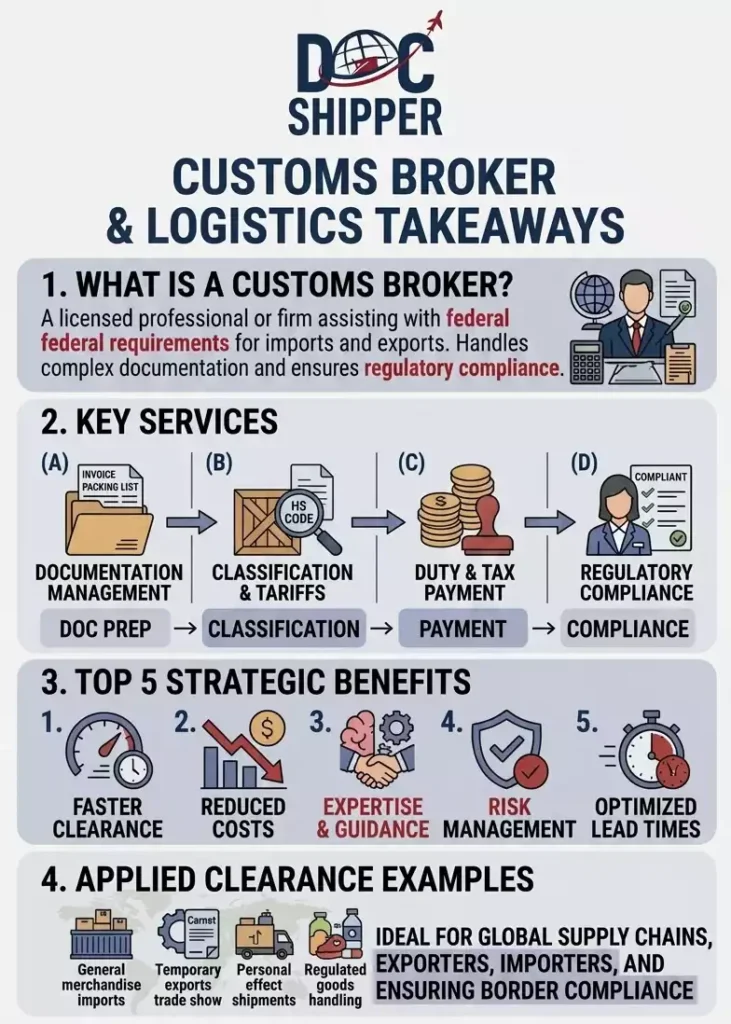
A customs broker is a licensed professional who facilitates international trade by preparing and submitting documentation required to clear goods through customs authorities. They ensure compliance with import/export regulations, calculate duties and taxes, and act as intermediaries between importers, exporters, and government agencies.
Introduction
Many businesses underestimate the complexity of customs clearance until their shipment gets detained at the border. Missing documentation, incorrect tariff classification, or non-compliance with regulations can result in costly delays, penalties, or even seizure of goods.
The customs broker plays a critical role in international logistics by bridging the gap between regulatory requirements and commercial operations. They possess specialized knowledge of customs laws, trade agreements, and documentation protocols that most companies lack in-house.
Key characteristics of customs brokers include:
- Licensed and regulated by national customs authorities
- Expert knowledge of Harmonized System (HS) codes and tariff classifications
- Ability to calculate duties, taxes, and fees accurately
- Direct electronic connectivity with customs systems (EDI, ABI, AES)
- Understanding of trade agreements (FTA, GSP, preferential origin rules)
Expertise & Responsibilities
Customs brokers must obtain official licensing through rigorous examination and continuous education. In the United States, candidates pass the U.S. Customs Broker License Exam administered by U.S. Customs and Border Protection. Similar certification systems exist in the EU, Canada, and other jurisdictions.
Their primary responsibilities extend beyond simple paperwork:
Tariff classification determines the correct HS code for each product, which directly impacts duty rates. Misclassification can lead to overpayment or underpayment of duties, both carrying financial and legal consequences.
Valuation compliance ensures declared values meet customs regulations. Brokers verify commercial invoices, apply appropriate valuation methods (transaction value, computed value), and identify potential transfer pricing issues.
Regulatory screening involves checking shipments against restricted party lists, export control regulations (EAR, ITAR), and sanctions programs. This prevents illegal shipments and protects companies from severe penalties.
Documentation preparation includes completing entry forms, certificates of origin, import licenses, and specialized permits (FDA, USDA, EPA). Each product category may require different documentation sets.
Duty optimization leverages trade agreements, bonded warehouses, foreign trade zones, and duty drawback programs to minimize costs legally. At DocShipper, our customs specialists systematically analyze these opportunities to reduce our clients’ landed costs.
Practical Examples & Data
Understanding the customs broker’s impact becomes clearer through concrete scenarios and comparative data.
Use Case: Electronics Import from China to USA
A company imports 5,000 units of wireless headphones valued at $50,000. The customs broker:
- Classifies the product under HS code 8518.30.20 (duty rate: 0% under normal trade relations)
- Prepares CBP Form 7501 (Entry Summary) with accurate product descriptions
- Coordinates FDA compliance for electronic products
- Files entry electronically via Automated Broker Interface (ABI)
- Arranges payment of Merchandise Processing Fee (0.3464% of value = $173.20)
Result: Clearance in 24-48 hours. Without proper brokerage, the shipment could face exam requests, adding 5-10 days and $500+ in storage fees.
Comparative Analysis: DIY vs. Professional Broker
| Aspect | Self-Clearance | Professional Broker |
|---|---|---|
| Processing Time | 5-15 days | 1-3 days |
| Error Rate | 15-25% | 2-5% |
| Penalty Risk | High (lack of knowledge) | Low (compliance expertise) |
| Cost per Entry | $0 (time investment) | $75-$200 |
| Duty Optimization | Rarely applied | Systematic analysis |
Industry Statistics
- Over 95% of U.S. commercial imports use licensed customs brokers
- Average broker fee ranges from $50 (simple entries) to $500+ (complex regulated goods)
- Incorrect classification accounts for 30% of customs audits and penalties
- Companies using brokers report 40% faster clearance times on average
- Duty savings through FTA utilization average 3-8% of shipment value
Conclusion
The customs broker serves as an essential partner in international trade, transforming complex regulatory requirements into streamlined clearance processes. Their expertise protects businesses from costly errors while optimizing duty expenditures.
Need assistance navigating customs regulations for your shipments? Contact DocShipper for expert brokerage services tailored to your supply chain needs.
📚 Quiz
Test Your Knowledge: Customs Broker
Q1 — What is the primary role of a customs broker?
Q2 — A company believes it can save money by skipping a customs broker and self-filing its import entries. Which statement best reflects reality?
Q3 — A U.S. importer regularly ships from five different countries and wants a single customs broker to handle all clearances. Is this possible?
🎯 Your Result
📞 Free Quote in 24hFAQ | Customs Broker: Definition, Role & Practical Examples
Customs brokers must pass a national licensing exam, maintain continuous bonds, and complete ongoing education. In the U.S., they obtain a CBP-issued license; in the EU, they follow member state requirements.
Fees typically range from $50 to $200 per entry for standard shipments. Complex entries involving multiple agencies, permits, or examinations may cost $300-$500 or more.
Yes, individuals and companies can self-file, but this requires in-depth knowledge of regulations, electronic filing systems, and significant time investment. Most commercial importers use brokers for efficiency and compliance.
A customs broker specializes in customs clearance and regulatory compliance. A freight forwarder arranges transportation and logistics. Many companies offer both services, but they require different expertise and licensing.
Standard clearances take 1-3 business days when documentation is complete. Shipments requiring physical examination or additional permits may take 5-10 days.
Typically: commercial invoice, packing list, bill of lading/airway bill, certificate of origin, and any required permits (FDA, USDA, etc.). Product-specific documentation varies by commodity.
Yes, many brokers facilitate both import and export processes, including AES filing, export licenses, and destination country documentation requirements.
Licensed brokers carry errors and omissions insurance. If their mistake causes penalties or additional duties, they are typically liable. Always verify their insurance coverage and licensing status.
Yes, through proper tariff classification, FTA utilization, duty drawback programs, and foreign trade zone strategies. Brokers identify legitimate cost-saving opportunities within legal frameworks.
Verify their license status, check references, assess their technology capabilities (electronic filing systems), and ensure they have experience with your specific product categories and trade lanes.
A continuous bond covers all import entries for one year, required for importers making multiple shipments. Brokers arrange these bonds, typically costing $400-$600 annually for importers with under $50,000 in annual duties.
Yes, customs brokers are licensed by national authorities. International shipments require brokers licensed in each destination country, though many brokerage networks offer global coverage through partnerships.
Need Help with
Logistics or Sourcing ?
First, we secure the right products from the right suppliers at the right price by managing the sourcing process from start to finish. Then, we simplify your shipping experience - from pickup to final delivery - ensuring any product, anywhere, is delivered at highly competitive prices.


Fill the Form
Prefer email? Send us your inquiry, and we’ll get back to you as soon as possible.
Contact us




