


In short ⚡
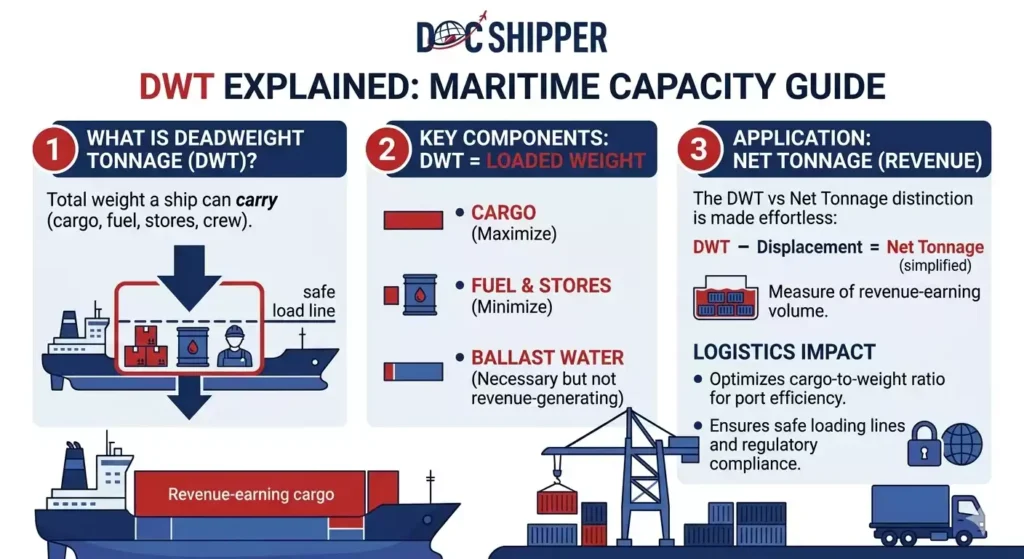
Deadweight Tonnage (DWT) is the maximum weight a vessel can safely carry, including cargo, fuel, crew, provisions, and ballast water. Expressed in metric tons, DWT represents a ship's total carrying capacity beyond its own weight, making it a critical metric for freight cost calculation and vessel selection in international shipping.
Introduction
Shippers often confuse vessel tonnage metrics, leading to incorrect freight quotes and capacity planning errors. Understanding Deadweight Tonnage (DWT) prevents costly miscalculations when booking ocean freight.
In maritime logistics, DWT determines what a ship can realistically transport. It directly impacts shipping rates, route selection, and cargo feasibility for import/export operations.
- Total Capacity Indicator: DWT measures everything a ship carries beyond its structure
- Freight Cost Driver: Higher DWT vessels offer economies of scale for bulk shipments
- Safety Parameter: Exceeding DWT limits risks vessel stability and legal penalties
- Classification Standard: Vessels are categorized by DWT ranges (Handysize, Panamax, Capesize)
- Contract Reference: Charter parties specify DWT to define payload obligations
Technical Breakdown & Regulatory Framework
DWT calculation follows a precise formula: Displacement (loaded) − Displacement (empty) = DWT. Displacement represents the water weight a vessel pushes aside when floating.
The International Maritime Organization (IMO) mandates DWT disclosure for vessels over 400 GT. This ensures transparency in cargo capacity declarations across global trade routes. Maritime authorities reference the International Load Line Convention to verify compliance.
Constant DWT remains fixed regardless of cargo type, but actual payload capacity varies. Fuel consumption, voyage duration, and seasonal water density affect usable cargo space. Winter load lines reduce DWT availability in rough seas.
Vessel types show distinct DWT profiles. Bulk carriers prioritize maximum DWT for coal or grain. Containerships balance DWT with container slot capacity (TEU). Tankers optimize DWT for liquid cargo density.
At DocShipper, we calculate precise DWT requirements during freight quotation. Our logistics experts match cargo weight with appropriate vessel classes, preventing under-booking or overage fees. This optimization reduces shipping costs by 12-18% for heavy bulk shipments.
Charter agreements specify DWT limits to protect both shipowners and charterers. Exceeding stated DWT voids insurance coverage and triggers port authority fines up to $50,000 per violation.
Practical Examples & Industry Data
Understanding DWT through real-world comparisons clarifies its operational impact. Vessel classification by DWT determines route access and cargo suitability.
| Vessel Type | DWT Range (metric tons) | Typical Cargo | Route Restrictions |
|---|---|---|---|
| Handysize | 10,000 – 35,000 | Steel, grain, minor bulk | Accesses small ports |
| Panamax | 60,000 – 80,000 | Coal, grain, containers | Max Panama Canal transit |
| Capesize | 150,000 – 400,000 | Iron ore, coal | Deep-water ports only |
| VLCC Tanker | 200,000 – 320,000 | Crude oil | Offshore transfer required |
Use Case – Coffee Bean Shipment: A Brazilian exporter books 15,000 metric tons of coffee beans to Rotterdam. The shipper selects a Handysize vessel with 28,000 DWT capacity. After accounting for 800 tons of fuel and 200 tons of provisions, usable cargo capacity equals 27,000 tons—sufficient for the shipment with 12,000 tons buffer space.
Industry data shows 75% of global bulk cargo moves on vessels between 30,000-100,000 DWT. Container shipping averages 50,000-150,000 DWT for mainline routes, while feeder vessels operate at 10,000-25,000 DWT.
Key DWT Considerations:
- Cargo Density Impact: Heavy ores reach DWT limits before volume capacity
- Fuel Strategy: Long voyages reduce cargo DWT due to increased fuel requirements
- Port Draft Limits: Shallow harbors restrict maximum loaded DWT regardless of vessel capacity
- Seasonal Variations: Winter North Atlantic routes reduce allowable DWT by 8-12%
- Charter Market Rates: DWT pricing per ton/day varies from $8 (Handysize) to $35,000 (VLCC)
At DocShipper, we conduct pre-shipment DWT analysis for every ocean freight quote. Our vessel matching algorithm considers cargo weight, volume, route constraints, and seasonal factors to recommend optimal DWT capacity, ensuring compliance and cost efficiency.
Conclusion
Deadweight Tonnage serves as the foundational metric for maritime cargo planning, directly influencing shipping costs, vessel selection, and route feasibility. Precise DWT calculation prevents regulatory violations and optimizes freight efficiency.
Need expert assistance calculating DWT requirements for your shipment? Contact DocShipper for tailored logistics solutions.
📚 Quiz
Test Your Knowledge: Deadweight Tonnage (DWT)
What does Deadweight Tonnage (DWT) measure?
A shipper books a vessel with 50,000 DWT capacity. The voyage requires 2,000 tons of fuel and 500 tons of provisions. What is the realistic cargo capacity?
Your company needs to ship 80,000 metric tons of coal from Australia to China. Which vessel class would be most appropriate based on DWT capacity?
🎯 Your Results
📞 Free Quote in 24hFAQ | Deadweight Tonnage (DWT): Definition, Calculation & Practical Examples
Deadweight Tonnage measures carrying capacity (cargo, fuel, provisions), while Gross Tonnage represents total internal ship volume. GT determines port fees; DWT determines payload limits. A vessel with 50,000 GT might have 70,000 DWT depending on design.
Freight rates often calculate as cost per DWT ton. Larger DWT vessels offer lower per-ton rates through economies of scale. A Capesize vessel at $12,000/day with 180,000 DWT costs $0.067 per ton daily, versus $0.32 for a 25,000 DWT Handysize at $8,000/day.
No. Exceeding DWT violates maritime safety regulations and voids insurance. Port authorities conduct draft surveys to verify compliance. Overloading risks vessel stability, causing cargo rejection or detention at destination ports.
Fuel consumption is the primary reducer. A transpacific crossing requires 1,500-2,500 tons of bunker fuel, directly subtracting from cargo DWT. Freshwater, provisions, and ballast water further decrease usable capacity by 300-800 tons.
Shipbuilders calculate DWT during construction through displacement measurements in calm water. Classification societies like Lloyd's Register certify DWT values. Port surveyors conduct draft readings at six hull points to verify actual loaded DWT before departure.
DWT remains constant unless structural modifications occur. However, hull corrosion and marine growth increase lightship weight, marginally reducing effective DWT. Annual dry-docking and hull cleaning maintain declared DWT capacity within 1-2% variance.
Container vessels balance DWT payload with container slot capacity (TEU). A 10,000 TEU ship typically has 120,000-140,000 DWT. Lightweight cargo (textiles) reaches TEU limits before DWT; heavy cargo (machinery) maxes DWT first. Optimal loading requires precise weight distribution planning.
Charter agreements state "about" values (e.g., "about 75,000 DWT") allowing 5% variance. This accommodates fuel load variations, ballast water adjustments, and operational flexibility. Exact DWT declarations would create impractical rigidity in voyage planning.
Dense cargoes like iron ore reach DWT limits at 60% volume capacity. Lightweight cargoes like cotton fill volume capacity at 40% DWT. "Dead freight" charges apply when shippers book full DWT but load insufficient weight, leaving unused capacity.
International Load Line Convention establishes seasonal freeboard limits. Winter DWT operates 8-10% below Summer DWT in North Atlantic routes (October-March). This safety margin accounts for rougher seas and higher wave loading during storm seasons.
Conversion requires cargo density knowledge. Formula: Volume (m³) = DWT / Cargo Density (tons/m³). Coal (density 0.8) at 50,000 DWT occupies 62,500 m³. Heavy oil (density 0.95) uses 52,630 m³ for the same DWT, demonstrating density's impact on space utilization.
Many ports limit maximum draft (ship depth in water) to 12-15 meters. A Capesize vessel with 180,000 DWT might only load 120,000 tons to meet draft limits in shallow harbors. Draft calculators determine safe loading based on water density and port-specific restrictions.
Need Help with
Logistics or Sourcing ?
First, we secure the right products from the right suppliers at the right price by managing the sourcing process from start to finish. Then, we simplify your shipping experience - from pickup to final delivery - ensuring any product, anywhere, is delivered at highly competitive prices.


Fill the Form
Prefer email? Send us your inquiry, and we’ll get back to you as soon as possible.
Contact us




:%20Definition,%20Calculation%20&%20Practical%20Examples)