


In short ⚡
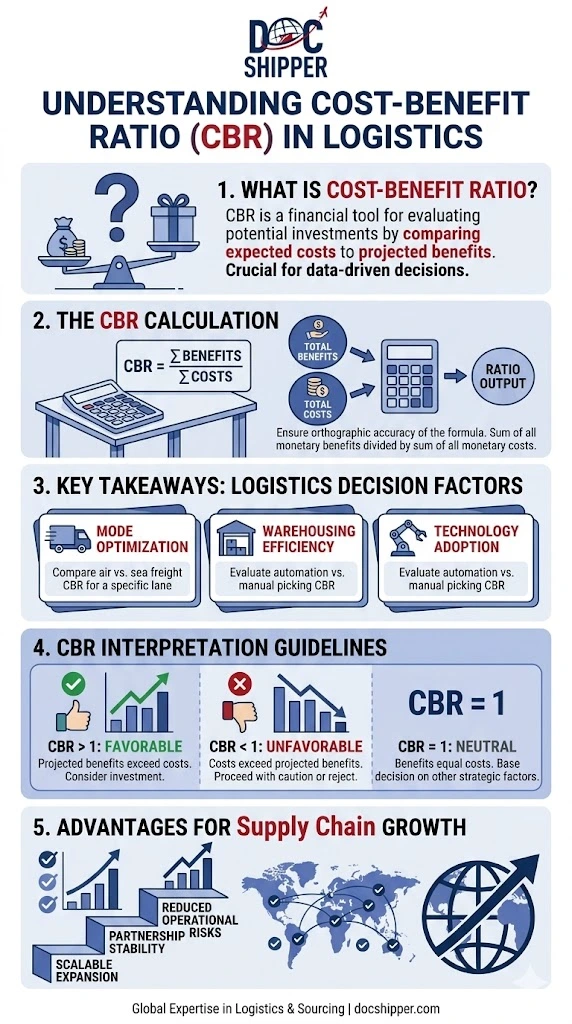
The Cost-Benefit Ratio (CBR) is a financial metric that compares the total costs of a logistics operation to its expected benefits, expressed as a ratio. A CBR below 1.0 indicates benefits exceed costs, making the investment financially viable. This tool enables companies to objectively evaluate shipping routes, warehouse locations, or technology investments in international trade.
Introduction
Many businesses struggle to justify logistics expenditures without quantifiable evidence. Should you invest in air freight despite higher costs? Is warehouse automation worth the capital outlay? The Cost-Benefit Ratio eliminates guesswork by providing objective financial clarity.
In international logistics, where margins are tight and risks high, the CBR serves as a critical decision-making compass. It transforms complex trade-offs into measurable outcomes, enabling stakeholders to compare competing strategies with precision.
Key characteristics of the Cost-Benefit Ratio include:
- Quantitative objectivity: Removes subjective bias from investment decisions
- Comparative power: Enables side-by-side evaluation of multiple logistics scenarios
- Time-value integration: Accounts for both immediate and long-term financial impacts
- Risk visibility: Exposes hidden costs like customs delays or inventory obsolescence
- Stakeholder alignment: Provides common language for finance, operations, and procurement teams
In-Depth Analysis & Strategic Applications
The calculation methodology divides total costs by total benefits over a defined period. Total costs encompass direct expenses (freight, duties, handling) plus indirect factors (working capital tied in transit, insurance, compliance fees). Benefits include revenue gains, cost savings, risk mitigation value, and competitive advantages.
The interpretation threshold is critical: a ratio below 1.0 signals positive return, while values above 1.0 indicate costs outweigh benefits. However, context matters—strategic investments like market entry may justify ratios slightly above 1.0 temporarily if long-term benefits materialize.
In regulatory compliance contexts, the CBR helps justify investments in customs modernization or trade compliance software. According to the World Customs Organization, companies implementing Authorized Economic Operator (AEO) programs often achieve CBRs of 0.6-0.8 within 18 months through faster clearances and reduced inspections.
The temporal dimension requires careful handling. Short-term analyses (quarterly) may miss benefits like supplier relationship improvements or brand reputation gains. Industry best practice recommends 12-36 month evaluation windows for logistics infrastructure decisions.
Advanced applications include sensitivity analysis, where variables like fuel costs or currency fluctuations are stress-tested. At DocShipper, we systematically apply CBR modeling to route optimization projects, ensuring clients see the full financial picture before committing to new shipping lanes or consolidation strategies.
Practical Examples & Data-Driven Scenarios
Consider a manufacturer evaluating sea freight versus air freight for electronics shipments from Shenzhen to Rotterdam:
| Factor | Sea Freight | Air Freight |
|---|---|---|
| Direct Transport Cost | $8,500 | $22,000 |
| Transit Time | 35 days | 4 days |
| Inventory Holding Cost | $6,200 (35 days @ $177/day) | $708 (4 days @ $177/day) |
| Obsolescence Risk | $3,400 (2.5% product value) | $400 (0.3% product value) |
| Total Costs | $18,100 | $23,108 |
| Revenue (Same Period) | $45,000 | $52,000 (faster market entry) |
| Cost-Benefit Ratio | 0.40 | 0.44 |
Both options show favorable ratios, but sea freight delivers slightly better value. However, if time-to-market generates an additional $12,000 in revenue for air freight, the CBR improves to 0.36, making it the superior choice.
Warehouse automation case study: A logistics provider investing $280,000 in automated sorting equipment projects annual benefits of $420,000 (labor savings, error reduction, throughput increase). The first-year CBR is 0.67, improving to 0.18 by year three as fixed costs amortize.
Customs broker comparison: Company A charges $150 per shipment with 95% first-time clearance rate. Company B charges $120 but achieves only 78% clearance rate, generating $85 average delay costs per failed clearance. Effective cost for Company B becomes $138.70, yielding a CBR of 0.92 versus Company A’s 0.79 when measured against time-savings benefits.
Multi-modal route optimization: Combining rail (China-Europe) with short-sea shipping reduces CBR from 0.58 (pure ocean) to 0.51 by cutting 9 days transit while adding only 8% to freight costs—critical for perishable goods where each day costs 1.2% of cargo value.
At DocShipper, we’ve observed that clients applying CBR analysis to carrier negotiations achieve 12-18% better contract terms by quantifying the total value proposition beyond headline freight rates.
Conclusion
The Cost-Benefit Ratio transforms logistics decision-making from intuition-based to evidence-driven, revealing the true financial impact of every operational choice. By accounting for both visible costs and hidden factors like time value and risk exposure, it empowers businesses to optimize international supply chains with confidence.
Need expert guidance on applying CBR analysis to your logistics strategy? Contact DocShipper for customized financial modeling and route optimization services.
📚 Quizz
Test Your Knowledge: Cost-Benefit Ratio
Q1 — What does a Cost-Benefit Ratio (CBR) below 1.0 indicate?
Q2 — A company calculates a CBR of 1.05 for a new market entry strategy. Should this investment be automatically rejected?
Q3 — A manufacturer ships electronics from Shenzhen to Rotterdam. Sea freight costs $18,100 total with $45,000 in revenue (CBR: 0.40). Air freight costs $23,108 total but generates $64,000 in revenue due to faster market entry. What is the air freight CBR, and which option is superior?
🎯 Your Result
📞 Free Quote in 24hFAQ | Cost-Benefit Ratio: Definition, Calculation & Practical Examples
Ratios below 0.70 are considered excellent, 0.70-0.90 good, and 0.90-1.0 acceptable depending on strategic value. Ratios above 1.0 require strong justification like market entry or regulatory compliance.
Assign monetary proxies: brand reputation gains = customer acquisition cost savings, supplier relationship improvements = reduced procurement premiums, risk mitigation = insurance cost equivalents or historical loss data.
CBR compares costs to benefits directly (ratio format), while ROI measures percentage return. Use CBR for comparing multiple options; use ROI for evaluating single investments against hurdle rates.
Match the analysis period to asset lifespan: 12-24 months for service contracts, 3-5 years for equipment, 5-10 years for infrastructure. Always use consistent periods when comparing alternatives.
Use forward exchange rates for future cash flows or hedge costs as part of total expenses. Sensitivity analysis should test ±10% currency swings for international projects.
Yes, if inventory holding costs are low and products aren't time-sensitive. Sea freight often wins for bulk commodities, raw materials, or seasonal goods with predictable demand cycles.
Customs brokerage fees, demurrage charges, currency conversion costs, quality inspection expenses, document handling, and working capital tied up during transit frequently get overlooked.
Compare total costs (rent, labor, utilities, taxes) against benefits (reduced delivery times, lower freight costs, market proximity). Include one-time setup costs amortized over facility lifespan.
Increasingly yes—carbon taxes, sustainability reporting requirements, and customer preferences create measurable financial impacts. Quantify via carbon pricing ($50-100/ton CO2e) or regulatory compliance costs.
Quarterly for volatile markets (fuel-dependent routes), annually for stable operations. Trigger immediate recalculation when costs change >15% or new alternatives emerge.
Quantifies total value beyond rates—on-time performance worth 2-4% of cargo value, claims handling efficiency, technology integration costs. Strong CBR data supports 8-15% better negotiated terms.
Absolutely. Calculate LCL per-unit costs plus consolidation delays versus FCL fixed costs and faster transit. Break-even typically occurs at 60-75% container utilization, but CBR reveals the precise threshold for your cargo profile.
Need Help with
Logistics or Sourcing ?
First, we secure the right products from the right suppliers at the right price by managing the sourcing process from start to finish. Then, we simplify your shipping experience - from pickup to final delivery - ensuring any product, anywhere, is delivered at highly competitive prices.


Fill the Form
Prefer email? Send us your inquiry, and we’ll get back to you as soon as possible.
Contact us




