


In short ⚡
A Container Freight Station (CFS) is a specialized warehouse facility where Less than Container Load (LCL) shipments are consolidated into full containers for export or deconsolidated upon import. Located near ports or inland transport hubs, CFS facilities handle cargo stuffing, unstuffing, temporary storage, customs clearance, and documentation—serving as critical nodes in the international logistics chain for shippers unable to fill entire containers.
Introduction
Many small and medium-sized importers face a common dilemma: their cargo volume doesn’t justify booking an entire 20-foot or 40-foot container. Shipping partial loads directly results in excessive costs and logistical complications. This is where Container Freight Stations become essential.
In international trade, Container Freight Stations bridge the gap between small-volume shippers and container shipping lines. They enable cost-effective ocean freight by consolidating multiple consignments from different shippers into single containers, or conversely, breaking down imported containers into individual shipments for distribution.
Key characteristics of CFS facilities include:
- Strategic location near seaports, airports, or inland container depots (ICDs)
- Consolidation services combining LCL cargo from multiple shippers
- Deconsolidation operations separating mixed containers into individual consignments
- Customs examination areas for inspection and clearance procedures
- Temporary storage facilities for cargo awaiting onward transportation
- Documentation processing including bills of lading, packing lists, and customs declarations
CFS Operations & Expertise
Understanding how Container Freight Stations function reveals their critical role in supply chain efficiency. These facilities operate under strict regulatory frameworks and employ specialized processes to ensure cargo integrity and compliance.
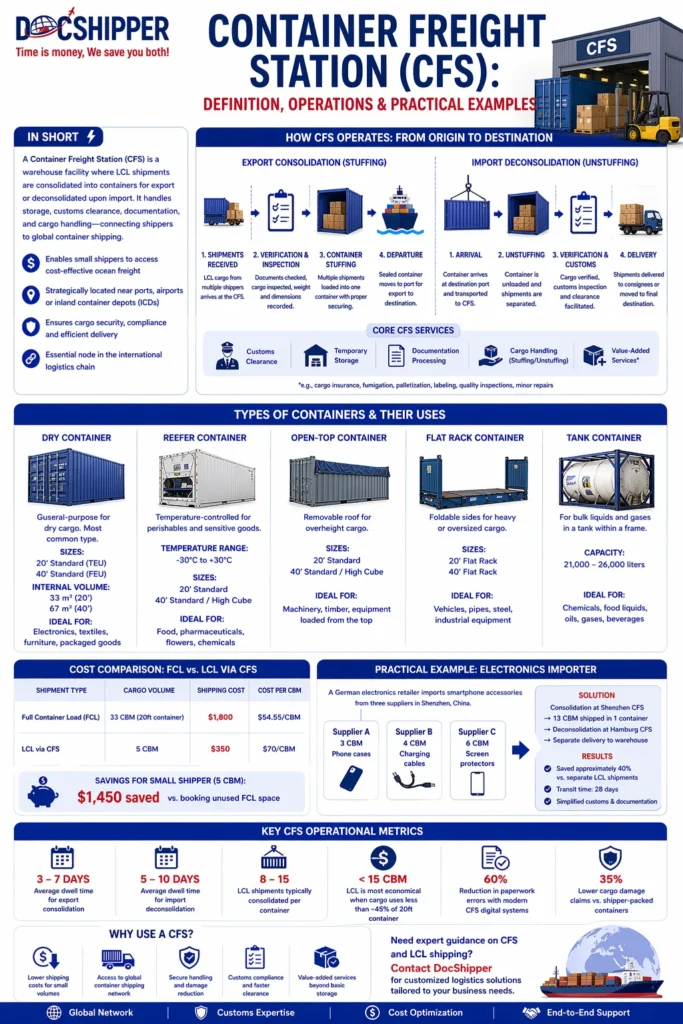
Consolidation process begins when freight forwarders deliver LCL shipments to the CFS. Trained personnel verify documentation, inspect cargo condition, and measure dimensions and weight. Multiple consignments destined for the same port are then systematically loaded into a single container—a process called “stuffing.” Proper weight distribution and securing techniques prevent cargo damage during ocean transit.
Deconsolidation operations occur upon container arrival at the destination port. CFS workers “unstuff” containers, separating individual shipments according to bills of lading. Each consignment undergoes verification against shipping documents, physical inspection for damage, and preparation for customs clearance. This meticulous process ensures accurate delivery to final consignees.
Customs clearance facilitation represents a core CFS function. Most facilities maintain designated examination areas where customs officers conduct inspections without disrupting port operations. The CFS coordinates documentation submission, duty payment processing, and release authorizations. According to World Customs Organization standards, proper CFS procedures significantly reduce clearance times and border compliance costs.
Storage and inventory management systems track cargo from receipt through final delivery. Modern CFS facilities employ warehouse management software (WMS) providing real-time visibility of shipment status, storage location, and handling history. This transparency prevents misplacement and enables quick retrieval when clearance completes.
Value-added services distinguish advanced CFS operations. These include cargo insurance, fumigation, palletization, labeling, quality inspections, and even minor repairs. At DocShipper, we leverage CFS partnerships to provide comprehensive logistics solutions, ensuring our clients’ cargo receives proper handling at every consolidation point throughout the international journey.
Practical Examples & Data
Real-world scenarios demonstrate how Container Freight Stations create tangible value for international shippers. Cost comparisons and operational data reveal the economic advantages of CFS utilization.
Cost Comparison: FCL vs. LCL via CFS
| Shipment Type | Cargo Volume | Shipping Cost | Cost per CBM |
|---|---|---|---|
| Full Container Load (FCL) | 33 CBM (20ft container) | $1,800 | $54.55/CBM |
| LCL via CFS | 5 CBM | $350 | $70/CBM |
| Savings for small shipper | 5 CBM | $1,450 saved | vs. booking unused FCL space |
This comparison illustrates why small-volume shippers benefit from CFS consolidation. While the per-unit rate appears higher for LCL, the total expenditure remains significantly lower than paying for unused container capacity.
Use Case: Electronics Importer in Germany
A German electronics retailer imports smartphone accessories from three different manufacturers in Shenzhen, China. Individual shipment volumes:
- Supplier A: 3 CBM (phone cases)
- Supplier B: 4 CBM (charging cables)
- Supplier C: 6 CBM (screen protectors)
Solution: The freight forwarder consolidates all three shipments at a Shenzhen CFS facility. Total volume of 13 CBM ships in one container to Hamburg port. At Hamburg CFS, the container undergoes deconsolidation, with each supplier’s goods cleared separately and delivered to the retailer’s warehouse.
Results: The importer saved approximately 40% compared to booking three separate LCL shipments. Transit time remained consistent at 28 days, and consolidated documentation simplified customs processing.
Key Operational Metrics
- Average CFS dwell time: 3-7 days for export consolidation; 5-10 days for import deconsolidation
- Consolidation ratio: Typical CFS combines 8-15 separate LCL shipments per container
- Cost efficiency threshold: LCL becomes economical when cargo occupies less than 15 CBM (approximately 45% of a 20ft container)
- Documentation processing: Modern CFS facilities reduce paperwork errors by 60% through digital systems
- Damage reduction: Professional CFS stuffing decreases cargo damage claims by approximately 35% versus shipper-packed containers
Conclusion
Container Freight Stations serve as indispensable infrastructure in global trade, enabling small and medium enterprises to access container shipping economies without requiring full container volumes. Their consolidation, deconsolidation, and value-added services optimize costs while maintaining cargo security and regulatory compliance.
Need assistance navigating CFS procedures or optimizing your LCL shipping strategy? Contact DocShipper for expert guidance tailored to your international logistics requirements.
📚 Quiz
Test Your Knowledge: Container Freight Station (CFS)
1. What is the primary purpose of a Container Freight Station (CFS)?
2. A shipper has 5 CBM of cargo to send from Shanghai to Rotterdam. The cost via LCL through a CFS is $70/CBM, while booking a full 20ft container costs $1,800 ($54.55/CBM). Which statement is correct?
3. Under FOB Incoterms, a German importer receives goods consolidated at a CFS in Shenzhen. Who is responsible for paying the destination CFS charges in Hamburg?
🎯 Your Result
📞 Free Quote in 24hFAQ | Container Freight Station (CFS): Definition, Operations & Practical Examples
CFS (Container Freight Station) handles LCL cargo consolidation and deconsolidation, while CY (Container Yard) stores full containers for FCL shipments. CFS involves cargo handling inside facilities; CY manages sealed containers in outdoor storage areas.
Export cargo remains 2-5 days during consolidation. Import cargo stays 5-10 days awaiting customs clearance and consignee pickup. Extended storage incurs demurrage charges after free time periods expire.
Payment responsibility depends on Incoterms. Under FOB, the buyer pays destination CFS fees. Under CIF or DDP, the seller covers origin CFS charges. Freight forwarders typically invoice these separately from ocean freight.
Yes, most CFS facilities allow consignees to inspect cargo before final acceptance. Advance appointment scheduling is required. Some facilities charge nominal inspection fees for access to examination areas.
Essential documents include commercial invoice, packing list, bill of lading, certificate of origin, and import license (if applicable). Additional requirements vary by product category and destination country regulations.
Consolidation adds 2-4 days to total transit time compared to FCL direct shipments. However, cost savings typically justify this minor delay for small-volume shippers without time-critical cargo.
Many CFS operations hold bonded warehouse licenses, allowing duty-deferred storage. This enables importers to delay customs duty payment until goods leave the facility, improving cash flow management.
CFS operators maintain liability insurance covering cargo damage during handling. File claims immediately with photographic evidence. Freight forwarders assist with documentation and recovery processes against CFS liability policies.
Only licensed CFS facilities with specialized certifications handle dangerous goods. Strict segregation rules, trained personnel, and emergency response capabilities are mandatory. Additional handling fees apply for IMDG-classified cargo.
Charges typically include handling fees (per CBM or weight), storage (daily rate after free time), documentation fees, and examination charges. Rates vary by location, cargo type, and service level agreements.
Stuffing refers to loading consolidated LCL cargo into containers at origin CFS. Unstuffing means unloading and separating mixed cargo at destination CFS. Both processes require careful documentation matching and physical verification.
Major international ports maintain multiple CFS operators. Smaller ports may have limited facilities or require cargo transfer to nearby ICDs. Freight forwarders select optimal CFS locations based on routing efficiency and cost factors.
Need Help with
Logistics or Sourcing ?
First, we secure the right products from the right suppliers at the right price by managing the sourcing process from start to finish. Then, we simplify your shipping experience - from pickup to final delivery - ensuring any product, anywhere, is delivered at highly competitive prices.


Fill the Form
Prefer email? Send us your inquiry, and we’ll get back to you as soon as possible.
Contact us




:%20Definition%20&%20Guide%20in%202026)