


In short ⚡
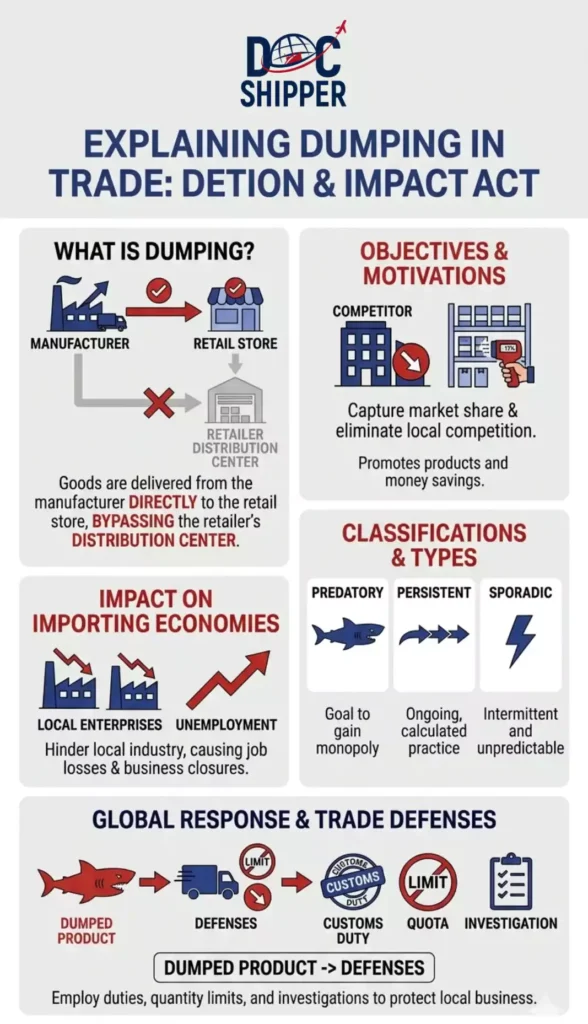
Dumping is the practice of exporting goods at prices lower than their domestic market value or production cost to gain market share abroad. This anti-competitive strategy distorts international trade, harms local industries, and often triggers protective measures like anti-dumping duties imposed by importing countries.Introduction
Many importers face sudden price collapses from foreign suppliers that seem too good to be true. Often, they are. These artificially low prices may signal dumping—a deliberate strategy to eliminate competition and dominate markets.
Dumping creates unfair advantages in global trade. It undermines domestic producers, distorts pricing mechanisms, and can lead to long-term monopolistic control. Understanding dumping is essential for compliance, risk management, and strategic sourcing.
- Price discrimination: Selling abroad cheaper than at home
- Below-cost pricing: Exporting below production costs
- Market predation: Temporary losses to capture market share
- Trade remedies: Anti-dumping duties imposed by affected countries
- WTO regulations: Governed by the Anti-Dumping Agreement
Mechanisms & Legal Framework
Dumping occurs when export prices fall below normal value—typically the domestic selling price in the exporter’s market. When no comparable domestic price exists, authorities calculate normal value using production costs plus reasonable profit margins.
The margin of dumping measures the price difference between export and normal value. If this margin exceeds de minimis thresholds (usually 2%), and causes material injury to domestic industry, importing nations can initiate investigations.
Anti-dumping investigations follow strict procedures. Authorities examine pricing data, production costs, and market impact. Investigations typically last 12-18 months. Provisional duties may apply during this period.
The WTO Anti-Dumping Agreement establishes global rules. It requires proof of dumping, injury, and causal link. Countries must demonstrate that dumping directly harms their domestic producers.
Remedial measures include anti-dumping duties calculated to offset the dumping margin. These duties can remain in force for five years, with possible extensions after sunset reviews. Some cases result in price undertakings where exporters agree to raise prices.
At DocShipper, we monitor anti-dumping developments across jurisdictions to help clients avoid unexpected duty assessments and maintain compliant sourcing strategies.
Real-World Cases & Data
Dumping affects multiple industries globally. Steel, solar panels, chemicals, and textiles face frequent anti-dumping actions. Understanding these patterns helps importers assess supplier risk and cost structures.
| Product Sector | Common Origin | Typical Dumping Margin | Average Duty Rate |
|---|---|---|---|
| Steel Products | China, India | 15-80% | 25-200% |
| Solar Panels | China, Taiwan | 18-50% | 30-250% |
| Chemicals | China, South Korea | 10-45% | 15-120% |
| Textiles | Bangladesh, Vietnam | 8-35% | 12-80% |
Case Study: European Steel Safeguards
In 2018, the EU imposed anti-dumping duties up to 73.7% on certain Chinese steel imports. A European manufacturer importing cold-rolled steel saw costs increase by €180 per ton. Companies without alternative sourcing faced immediate margin compression.
Key Data Points:
- Global anti-dumping investigations increased 12% from 2020-2023
- China remains the most frequent target (35% of all cases)
- Average investigation duration: 14.3 months
- Duties typically range from 15% to 250% depending on violation severity
- Approximately 40% of investigations result in definitive measures
Importers must conduct due diligence on supplier pricing. Prices significantly below market averages warrant investigation. Sudden price drops from established suppliers may indicate dumping risk or impending regulatory action.
Conclusion
Dumping represents a critical risk in international sourcing. Understanding pricing mechanisms, legal frameworks, and case precedents protects businesses from unexpected duties and supply chain disruptions.
Need expert guidance on anti-dumping compliance or alternative sourcing strategies? Contact DocShipper for tailored logistics solutions.
📚 Quiz
Test Your Knowledge: Dumping
Q1 — What is the core definition of dumping in international trade?
Q2 — At what minimum dumping margin can importing countries initiate an anti-dumping investigation under WTO rules?
Q3 — A European manufacturer notices that a Chinese steel supplier has suddenly dropped its export prices by 40% below the domestic Chinese market price. What is the most likely correct interpretation?
🎯 Your Result
📞 Free Quote in 24hFAQ | Dumping: Definition, Impact & Real-World Examples in International Trade
Need Help with
Logistics or Sourcing ?
First, we secure the right products from the right suppliers at the right price by managing the sourcing process from start to finish. Then, we simplify your shipping experience - from pickup to final delivery - ensuring any product, anywhere, is delivered at highly competitive prices.


Fill the Form
Prefer email? Send us your inquiry, and we’ll get back to you as soon as possible.
Contact us




