


In short ⚡
Configure to Order (CTO) and Package to Order (PTO) are manufacturing strategies where products are customized or packaged based on specific customer requirements after order placement. CTO involves assembling components into unique configurations, while PTO focuses on bundling pre-manufactured items into tailored packages, enabling mass customization with reduced lead times.
Introduction
In international trade and supply chain management, the ability to balance customization with efficiency determines competitive advantage. Many businesses struggle with the dilemma: manufacture standardized products and risk losing customers seeking personalization, or offer full customization and face prohibitive costs and delays.
Configure to Order and Package to Order strategies solve this challenge by postponing final product differentiation until customer specifications are known. This approach has become essential in electronics, automotive, pharmaceuticals, and technology sectors where customer expectations for tailored solutions continue rising.
Key characteristics of CTO and PTO strategies include:
- Postponement principle: Delaying final assembly or packaging until order confirmation reduces inventory risk
- Modular design: Products engineered with interchangeable components enable rapid configuration
- Reduced lead times: Pre-manufactured modules allow faster delivery than full make-to-order approaches
- Inventory optimization: Stocking components rather than finished goods decreases working capital requirements
- Mass customization: Balances economies of scale with individual customer requirements
Understanding these strategies is crucial for import/export operations, as they directly impact customs documentation, inventory valuation, and supply chain coordination across borders.
Technical Mechanisms & Strategic Implementation
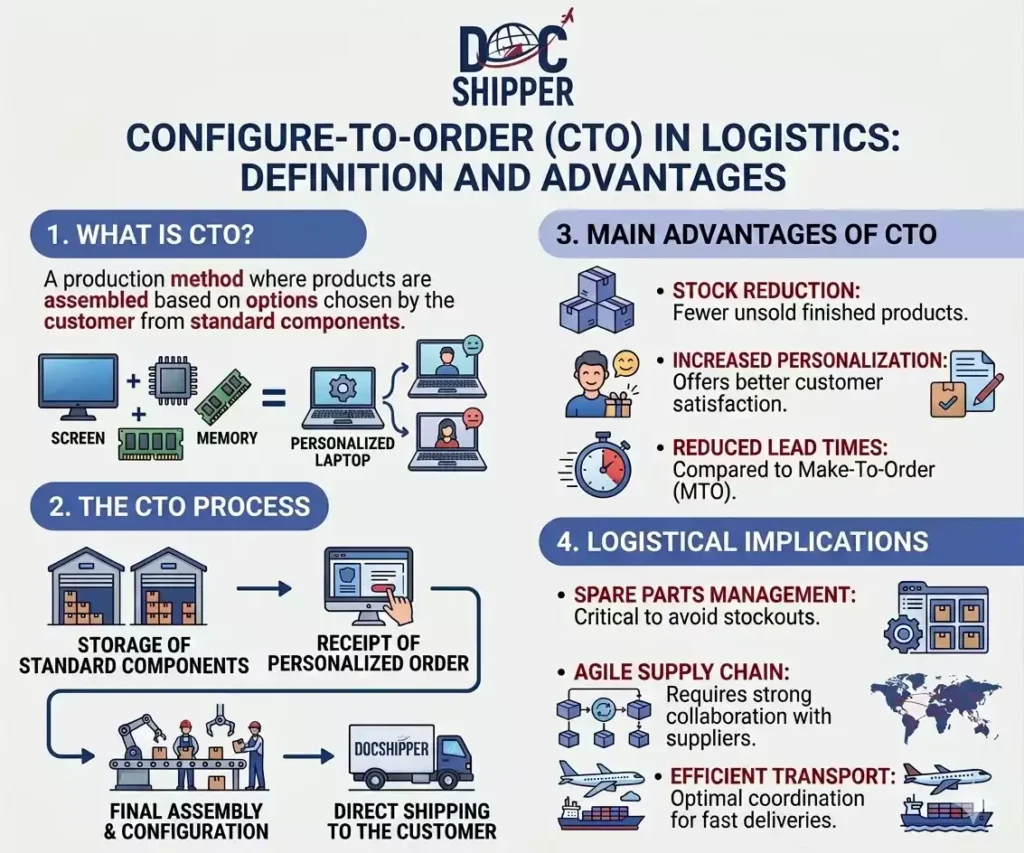
The fundamental difference between CTO and PTO lies in the degree of transformation. Configure to Order involves actual assembly or manufacturing activities—selecting components from inventory and combining them according to customer specifications. Package to Order requires minimal transformation, primarily bundling existing products with accessories, documentation, or software.
In CTO operations, manufacturers maintain an inventory of base modules and optional components. When an order arrives, the production system retrieves the bill of materials (BOM) corresponding to the customer’s configuration. Assembly occurs in dedicated configuration cells or flexible manufacturing lines. Computer manufacturers exemplify this approach: a customer selects processor speed, memory capacity, storage type, and graphics capabilities. The manufacturer then assembles these components into the specified configuration.
The postponement strategy underpins both approaches. By delaying product differentiation, companies reduce the risk of obsolete inventory while maintaining responsiveness. This principle proves particularly valuable in industries with short product lifecycles or volatile demand patterns. At DocShipper, we frequently assist clients in optimizing their postponement strategies by coordinating component shipments to regional distribution centers where final configuration occurs closer to end markets.
PTO strategies require sophisticated kitting operations. Distribution centers receive bulk shipments of individual products, then create customized packages based on order specifications. Pharmaceutical companies use PTO extensively when assembling market-specific medication kits with localized labeling, dosage instructions, and regulatory inserts. The base medication remains identical across markets, but packaging varies by destination country requirements.
From a customs and trade compliance perspective, CTO and PTO create specific challenges. The tariff classification of configured or packaged products may differ from individual components. According to World Customs Organization (WCO) guidelines, products assembled from components may require different HS codes than the constituent parts. This affects duty calculations, origin determinations, and free trade agreement eligibility. Companies must carefully document transformation activities to substantiate value-added claims for preferential tariff treatment.
The inventory accounting implications also differ significantly. CTO operations typically maintain component inventory until assembly, recognizing finished goods only after configuration. PTO operations may hold both individual items and common packaging materials, combining them upon order. These distinctions affect customs valuations, particularly when determining transaction values for import declarations. For comprehensive guidance on customs valuation methods, the World Trade Organization provides detailed resources at WTO Customs Valuation.
Practical Examples & Comparative Data
Understanding the practical application of CTO and PTO strategies requires examining real-world scenarios across different industries. The following comparative analysis illustrates key operational differences:
| Criteria | Configure to Order (CTO) | Package to Order (PTO) |
|---|---|---|
| Manufacturing Complexity | High – requires assembly/integration | Low – bundling and labeling only |
| Lead Time | 3-7 days typical | 1-3 days typical |
| Inventory Investment | Moderate – component-level stock | Higher – finished goods inventory |
| Customization Degree | High – functional variations | Moderate – packaging/bundling variations |
| Typical Industries | Computers, automotive, industrial equipment | Pharmaceuticals, cosmetics, software |
Use Case 1: Electronics Manufacturer (CTO)
A laptop manufacturer receives an order for 500 units with specific configurations: Intel i7 processor, 16GB RAM, 512GB SSD, and integrated graphics. The company maintains component inventory at its Asian manufacturing facility. Upon order confirmation, the production line assembles units within 5 days. The configured laptops ship directly to the European distribution center. At DocShipper, we coordinate such shipments by managing component sourcing, quality inspections at the assembly facility, and consolidated freight forwarding to minimize transit times.
Use Case 2: Pharmaceutical Distributor (PTO)
A pharmaceutical company supplies medication to 15 European countries. The active pharmaceutical ingredient remains identical, but each market requires specific packaging: multilingual inserts, country-specific dosage information, and regulatory compliance labels. The company ships bulk medication to a central European warehouse, then creates market-specific packages upon receiving country orders. This PTO approach reduces inventory by 40% compared to maintaining separate finished goods for each market.
Cost-Benefit Analysis:
- Inventory reduction: CTO strategies typically reduce finished goods inventory by 30-50% compared to make-to-stock approaches
- Obsolescence mitigation: Component-level inventory in CTO reduces write-offs by 25-35% in fast-changing technology sectors
- Customer satisfaction: Both strategies improve order fulfillment accuracy to 98%+ versus 85-90% for forecast-based production
- Working capital efficiency: PTO operations can decrease working capital requirements by 20-30% through inventory consolidation
- Market responsiveness: Configuration flexibility allows 2-3x faster response to market trend changes
For international operations, these strategies offer additional advantages. Shipping components or base products in bulk achieves better freight rates than multiple small shipments of configured products. Customs clearance becomes more predictable with standardized component classifications. Regional configuration centers enable compliance with local content requirements for preferential trade agreements.
Conclusion
Configure to Order and Package to Order represent strategic approaches that reconcile the competing demands of customization and efficiency in modern supply chains. By postponing final product differentiation, companies achieve mass customization benefits while maintaining operational agility and cost control essential for competitive international trade.
Need expert assistance implementing CTO or PTO strategies in your international supply chain? Contact DocShipper for tailored logistics solutions that optimize your configuration and packaging operations across global markets.
📚 Quiz
Configure to Order (CTO) & Package to Order (PTO)
Q1 — What is the core principle shared by both Configure to Order (CTO) and Package to Order (PTO) strategies?
Q2 — A company ships bulk medication to a central European warehouse, then creates country-specific packages with localized labels and inserts only when country orders arrive. Which strategy does this describe?
Q3 — From a customs and trade compliance perspective, why must companies carefully document CTO and PTO transformation activities?
🎯 Your Result
📞 Free Quote in 24hFAQ | Configure to Order (CTO) & Package to Order (PTO): Definition, Process & Practical Examples
Configure to Order uses pre-manufactured modules assembled per customer specifications, while Make to Order manufactures products from raw materials after order receipt. CTO offers faster delivery through component inventory, whereas MTO provides greater customization but longer lead times.
Configured products may receive different HS codes than individual components. Customs authorities evaluate the essential character of the assembled product, potentially affecting duty rates and origin determinations. Proper documentation of assembly activities is crucial for compliance.
Yes, PTO is particularly accessible for small businesses. It requires minimal infrastructure—primarily warehouse space and kitting capabilities. E-commerce businesses frequently use PTO to offer product bundles without maintaining separate inventory for each combination.
Enterprise Resource Planning (ERP) systems with advanced product configuration modules work best. These systems manage complex bills of materials, track component availability, and coordinate production scheduling based on order configurations. Cloud-based solutions now make this accessible to mid-sized companies.
Warranty terms typically remain unchanged, but documentation becomes critical. Companies must maintain detailed configuration records to support warranty claims. Traceability of components used in specific configurations helps identify defect patterns and manage recalls efficiently.
CTO introduces variability that complicates quality assurance. Each configuration represents a unique combination requiring verification. Automated testing protocols and modular quality checkpoints at component level help maintain consistency across diverse configurations.
Postponement concentrates inventory at generic component level, reducing exposure to demand forecast errors. If market preferences shift, companies can reconfigure components into different end products without obsolete inventory write-offs, improving financial resilience.
Absolutely. Many companies use hybrid approaches—configuring core products through CTO, then applying PTO for market-specific packaging. Computer manufacturers often configure hardware via CTO, then use PTO to add region-specific software, documentation, and power adapters.
Additive manufacturing is revolutionizing CTO by enabling on-demand production of customized components. Instead of maintaining physical component inventory, companies can digitally store designs and print components as needed, further reducing inventory while expanding configuration options.
FTAs often require minimum local content percentages for preferential tariffs. CTO operations at regional hubs can help meet these requirements by performing substantial transformation. Proper documentation of assembly activities and component origins is essential for claiming FTA benefits.
Key metrics include configuration accuracy rate, average configuration lead time, inventory turnover ratio, obsolescence rate, order fulfillment cycle time, and customer satisfaction scores. Successful operations typically achieve 98%+ configuration accuracy with 3-5 day lead times.
CTO reduces waste by producing only ordered configurations, eliminating unsold inventory disposal. Component-level inventory optimization decreases packaging waste. Modular design facilitates repair and upgrades, extending product lifecycles and supporting circular economy principles.
Need Help with
Logistics or Sourcing ?
First, we secure the right products from the right suppliers at the right price by managing the sourcing process from start to finish. Then, we simplify your shipping experience - from pickup to final delivery - ensuring any product, anywhere, is delivered at highly competitive prices.


Fill the Form
Prefer email? Send us your inquiry, and we’ll get back to you as soon as possible.
Contact us




%20&%20Package%20to%20Order%20(PTO):%20Definition,%20Process%20&%20Practical%20Examples)