


In short ⚡
Containerization is the standardized method of transporting goods in large, uniform metal boxes (containers) that can be seamlessly transferred between ships, trucks, and trains without unpacking the cargo. This revolutionary logistics system dramatically reduces handling time, minimizes cargo damage, and enables global intermodal transportation efficiency.Introduction
Before containerization, international shipping was chaotic. Cargo arrived in barrels, crates, and sacks, requiring armies of dock workers and weeks of loading time. A single ship could take 10 days to unload manually.
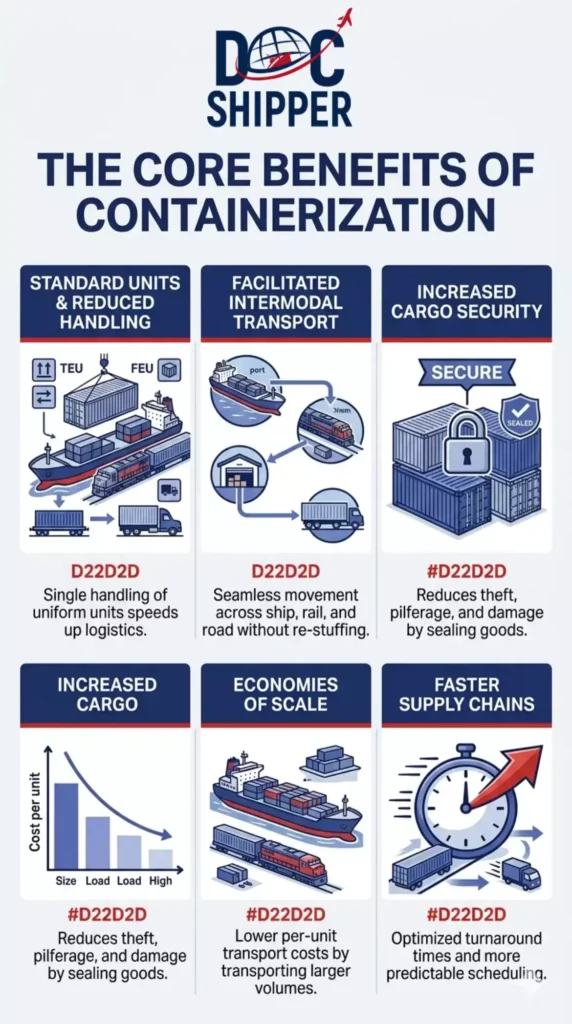
Today, containerization forms the backbone of global trade. Over 90% of non-bulk cargo worldwide moves in containers. This standardization transformed logistics from a labor-intensive bottleneck into a streamlined, predictable system.
Key characteristics of modern containerization:
- Standardized dimensions – ISO containers come in fixed sizes (20ft, 40ft, 45ft)
- Intermodal compatibility – seamless transfer across sea, rail, and road transport
- Stackability – containers stack vertically on ships and storage yards
- Security – sealed units reduce theft and tampering during transit
- Weather protection – enclosed steel structures shield cargo from elements
Technical Framework & Industry Standards
The International Organization for Standardization (ISO) established container specifications in 1968. The most common unit is the Twenty-foot Equivalent Unit (TEU), measuring 20 feet long, 8 feet wide, and 8.5 feet high.
Container types serve different cargo needs. Dry containers handle general merchandise. Reefer containers maintain temperature control for perishables. Open-top containers accommodate oversized machinery. Tank containers transport liquids and chemicals. Flat rack containers carry heavy equipment that exceeds standard dimensions.
The Container Safety Convention (CSC) mandates structural integrity requirements. Every container displays a CSC plate verifying it passed safety inspections. This plate includes manufacturing date, maximum gross weight, and certification authority.
Customs procedures simplified dramatically with containerization. The Customs Convention on Containers (CCC) allows sealed containers to cross borders without inspection at every checkpoint. Authorities can verify contents at destination ports using advanced scanning technology.
At DocShipper, we verify container seals and CSC certifications systematically before loading to prevent customs delays and ensure cargo security throughout the supply chain.
Modern container tracking uses GPS-enabled smart containers that transmit real-time location data. The ISO 18185 standard defines electronic seal specifications for enhanced security monitoring during international transit.
Cost Analysis & Real-World Applications
Containerization delivers measurable economic advantages. Before standardization, cargo handling costs represented 40-50% of total shipping expenses. Today, that figure dropped to 10-15%.
| Metric | Pre-Container Era | Modern Container System |
|---|---|---|
| Loading/Unloading Time | 7-10 days per ship | 24-48 hours per ship |
| Cargo Damage Rate | 25-30% | 2-5% |
| Labor Required | 300-500 workers per ship | 15-20 crane operators |
| Cost per Ton-Mile | $8-12 | $0.50-1.50 |
| Port Turnaround | 2-3 weeks | 1-2 days |
Use Case: Electronics Import from Asia to Europe
A European retailer imports smartphones from Shenzhen to Rotterdam. The shipment fills one 40ft container (68 cubic meters). Traditional break-bulk shipping would require manual handling at origin, transshipment ports, and destination.
With containerization, the sealed container loads once at the factory, travels 11,000 nautical miles by sea, transfers to rail at Rotterdam, and reaches the distribution center without reopening. Total transit time: 28 days. Cost: €3,200. Damage rate: under 1%.
The same shipment using pre-container methods would take 45-60 days, cost €8,500-11,000, and experience 15-20% damage or loss from multiple handling points.
Key efficiency metrics containerization enables:
- Ship capacity increased from 10,000 to 24,000+ TEU on mega-vessels
- Port automation reduced labor costs by 60-70%
- Intermodal transfers happen in under 15 minutes with modern equipment
- Insurance premiums dropped 40% due to reduced cargo damage
- Carbon emissions per ton-mile decreased by 35% through optimized vessel design
Conclusion
Containerization revolutionized global commerce by standardizing cargo transport, reducing costs by 80%, and enabling just-in-time supply chains. This system remains the foundation of modern international trade.
Need expert guidance on container shipping, customs clearance, or multimodal logistics? Contact DocShipper for comprehensive freight forwarding solutions.
📚 Quiz
Test Your Knowledge: Containerization
Q1 — What is the core definition of containerization in international logistics?
Q2 — A common misconception about containerization is that it only applies to sea freight. Is this correct?
Q3 — A European retailer ships smartphones from Shenzhen to Rotterdam in a sealed 40ft container. At Rotterdam, the goods need to reach an inland distribution center. What does containerization allow in this scenario?
🎯 Your Result
📞 Free Quote in 24hFAQ | Containerization: Definition, Benefits & Practical Examples
The most common sizes are 20ft (TEU) and 40ft (FEU) containers. Specialized 45ft high-cube containers provide extra volume for lightweight cargo. All follow ISO 668 dimensional standards.
A standard 40ft container holds approximately 67-68 cubic meters and supports up to 28,000 kg payload. Actual capacity depends on cargo density and weight distribution requirements.
FCL (Full Container Load) means one shipper uses the entire container. LCL (Less than Container Load) consolidates multiple shippers' cargo into one container, reducing costs for smaller shipments.
Containers typically serve 12-15 years in marine transport. After retirement from ocean service, they're repurposed for storage, construction, or modified into housing units for another 10-20 years.
Yes. Most carriers provide online tracking using the container number. Advanced systems offer GPS monitoring, temperature alerts for reefers, and estimated arrival notifications throughout the journey.
Essential documents include Bill of Lading, Commercial Invoice, Packing List, Certificate of Origin, and Container Packing Certificate. Specific cargo may require additional permits or safety certifications.
Specialized gantry cranes lift containers from ships to chassis or rail cars. Modern automated terminals use robotic systems that move 40+ containers per hour with minimal human intervention.
Carriers inspect containers before loading. Damage discovered at destination triggers insurance claims. Marine cargo insurance covers losses, with compensation based on declared cargo value and policy terms.
Yes. The SOLAS VGM (Verified Gross Mass) regulation requires weighing all containers before loading. Maximum gross weight is typically 30,480 kg for 20ft and 40ft containers, including tare weight.
Standardization enables automated handling, reduces labor needs, minimizes cargo damage, speeds port operations, and allows intermodal transfers without unpacking. These efficiencies cut per-unit transport costs by 75-85%.
Yes, but with strict regulations. IMDG Code classifies dangerous goods into nine categories. Hazmat containers require special placarding, segregation rules, and documentation to ensure safe maritime transport.
Demurrage charges apply when containers remain at the port beyond free time. Detention fees occur when containers stay outside the port past the allowed period. Both incentivize timely cargo pickup.
Need Help with
Logistics or Sourcing ?
First, we secure the right products from the right suppliers at the right price by managing the sourcing process from start to finish. Then, we simplify your shipping experience - from pickup to final delivery - ensuring any product, anywhere, is delivered at highly competitive prices.


Fill the Form
Prefer email? Send us your inquiry, and we’ll get back to you as soon as possible.
Contact us




