


In short ⚡
Continuous Improvement is a systematic, ongoing approach to enhancing processes, products, and services through incremental changes. This methodology, rooted in lean management principles, aims to eliminate waste, reduce errors, and optimize operational efficiency in logistics and international trade operations.Introduction
Many logistics companies struggle with stagnant processes that drain profitability and customer satisfaction. Shipment delays, documentation errors, and inefficient warehouse operations often stem from the absence of a structured improvement culture.
Continuous Improvement addresses these challenges by embedding optimization into daily operations. In international freight forwarding, this philosophy transforms reactive problem-solving into proactive excellence. At DocShipper, we integrate continuous improvement principles across our customs clearance, warehousing, and transport operations to deliver measurable value to clients.
Key characteristics of effective continuous improvement programs include:
- Employee engagement at all organizational levels
- Data-driven decision making based on measurable KPIs
- Incremental changes rather than disruptive overhauls
- Systematic problem identification through root cause analysis
- Standardization of successful improvements across operations
Methodologies & Core Principles
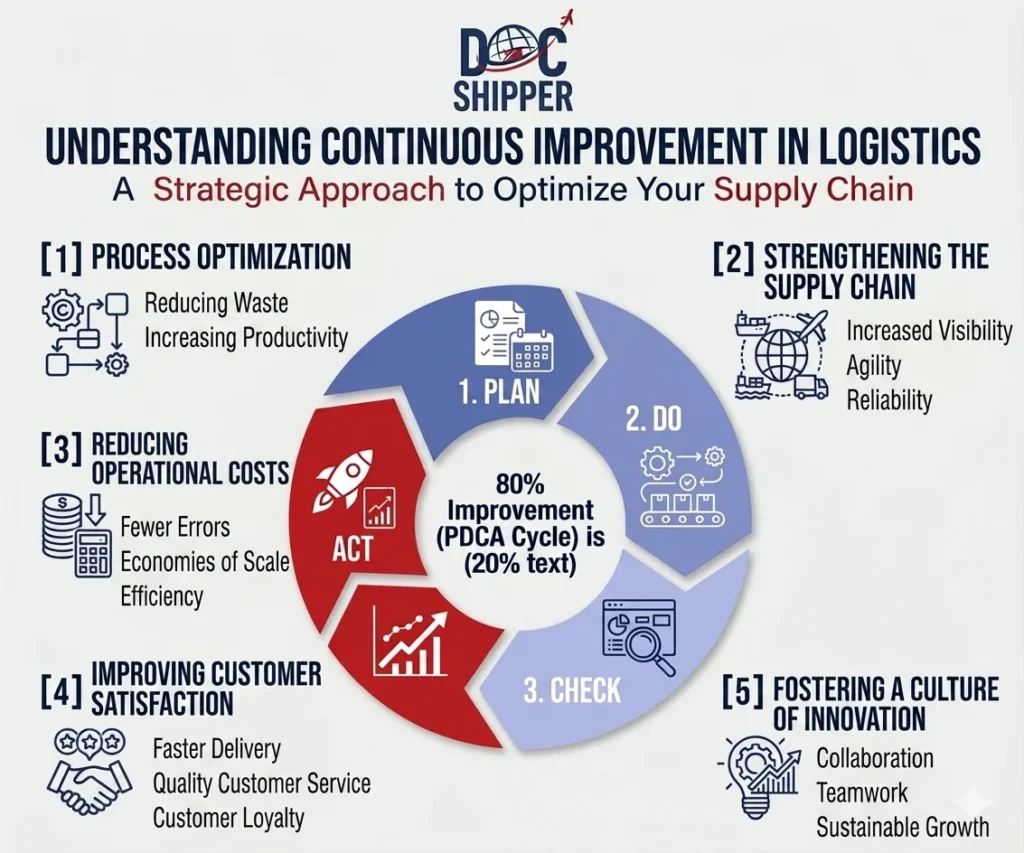
Several proven frameworks guide continuous improvement initiatives in logistics environments. The PDCA cycle (Plan-Do-Check-Act) provides a foundational structure for testing and implementing changes. Organizations plan modifications, execute them on a small scale, check results against objectives, and act to standardize or adjust accordingly.
Kaizen, the Japanese philosophy meaning “change for better,” emphasizes small, daily improvements involving every team member. In freight forwarding, this might involve warehouse staff suggesting layout modifications that reduce picking time by 15 seconds per order—seemingly minor changes that compound into significant efficiency gains.
The Six Sigma methodology focuses on reducing process variation and defects to near-perfection levels (3.4 defects per million opportunities). Logistics companies apply Six Sigma tools like DMAIC (Define-Measure-Analyze-Improve-Control) to systematically address recurring issues such as incorrect customs declarations or damaged cargo incidents.
Lean principles target waste elimination across seven categories: overproduction, waiting time, transportation, excess processing, inventory, motion, and defects. At DocShipper, we regularly audit our documentation workflows to identify and eliminate redundant approval steps that delay shipment processing.
The 5 Whys technique drills down to root causes by repeatedly asking “why” a problem occurs. When a customs clearance delay happens, this method might reveal that the underlying issue isn’t staff error but inadequate training on new regulatory requirements—a systemic problem requiring a different solution.
According to the ISO 9001 quality management standard, organizations must demonstrate commitment to continual improvement as a core principle. This international framework provides structured guidelines that logistics companies can adopt to formalize their improvement processes and achieve certification.
Implementation Examples & Data
Real-world applications demonstrate the tangible benefits of continuous improvement in logistics operations. Consider these comparative scenarios:
| Metric | Before Implementation | After 12 Months | Improvement |
|---|---|---|---|
| Customs Clearance Time | 4.2 days average | 2.8 days average | 33% reduction |
| Documentation Errors | 8.5% error rate | 2.1% error rate | 75% reduction |
| Warehouse Picking Accuracy | 94.3% | 98.7% | 4.4% increase |
| Client Satisfaction Score | 7.2/10 | 8.9/10 | 24% increase |
| Operational Cost per Shipment | $127 | $104 | 18% reduction |
Use Case: Container Dwell Time Reduction
A European importer faced chronic delays in container release from port terminals, averaging 6.5 days of dwell time and incurring $1,200 in demurrage charges per container. By implementing continuous improvement practices, the team identified three root causes: incomplete pre-arrival documentation (42% of delays), miscommunication with customs brokers (31%), and inefficient appointment scheduling (27%).
The improvement initiative introduced standardized document checklists, automated broker notifications 72 hours before arrival, and a centralized appointment booking system. Within four months, average dwell time dropped to 2.3 days, reducing demurrage costs by 68% and freeing working capital previously tied up in delayed inventory.
Key Implementation Success Factors:
- Leadership commitment: Senior management must visibly support improvement initiatives with resources and recognition
- Measurable objectives: Define specific, quantifiable targets (e.g., “reduce processing time by 20%” rather than “improve efficiency”)
- Cross-functional teams: Include perspectives from operations, sales, and customer service to identify comprehensive solutions
- Regular review cycles: Conduct monthly performance assessments to track progress and adjust strategies
- Technology integration: Leverage digital tools for data collection, analysis, and process automation
DocShipper applies these principles systematically across our service portfolio, from initial quotation accuracy to final delivery confirmation. Our continuous improvement committee meets bi-weekly to review operational data and implement client-driven enhancements.
Conclusion
Continuous improvement transforms logistics operations from reactive firefighting to proactive excellence. By embedding systematic optimization into daily workflows, companies achieve measurable gains in efficiency, quality, and customer satisfaction while maintaining competitive advantage in dynamic international markets.
Need support implementing continuous improvement in your supply chain operations? Contact DocShipper to discuss how our expertise can optimize your logistics processes.
📚 Quiz
Test Your Knowledge: Continuous Improvement
Q1 — Which of the following best defines Continuous Improvement in a logistics context?
Q2 — A logistics manager uses the "5 Whys" technique after a customs clearance delay and discovers the root cause is inadequate staff training on new regulations. What does this reveal about Continuous Improvement?
Q3 — A European importer reduced container dwell time from 6.5 days to 2.3 days by introducing standardized document checklists, automated broker notifications, and centralized appointment booking. Which Continuous Improvement principle does this scenario best illustrate?
🎯 Your Result
📞 Free Quote in 24hFAQ | Continuous Improvement: Definition, Methods & Concrete Examples
Continuous improvement focuses on incremental, ongoing enhancements to existing processes, while business transformation involves fundamental, large-scale changes to organizational structure or business models. The former is evolutionary; the latter is revolutionary.
Initial results often appear within 3-6 months for focused projects, though sustained cultural change requires 12-18 months. Quick wins build momentum, while deeper systemic improvements develop over extended periods with consistent application.
Absolutely. Smaller organizations often implement improvements faster due to reduced bureaucracy and closer team communication. Starting with simple tools like daily huddles and problem-solving boards requires minimal investment while delivering measurable benefits.
Essential KPIs include on-time delivery rate, order accuracy, processing time per shipment, cost per unit handled, customer complaint frequency, and employee suggestion implementation rate. Select 5-7 metrics aligned with strategic priorities.
Recognition systems, visible results tracking, dedicated time for improvement activities, and empowerment to implement suggestions sustain engagement. Celebrating small wins and connecting improvements to personal job satisfaction reinforces participation.
Yes, ISO 9001:2015 explicitly requires organizations to demonstrate continual improvement. Many companies integrate their improvement methodologies directly into quality management systems, using ISO frameworks to structure their optimization efforts.
Technology enables data collection, analysis, and visualization that inform improvement decisions. Warehouse management systems, transportation management platforms, and business intelligence tools provide real-time insights that manual processes cannot match efficiently.
Apply impact-effort matrix analysis: prioritize high-impact, low-effort improvements for quick wins, then address high-impact, high-effort projects. Consider customer pain points, cost drivers, and safety concerns when establishing priorities.
Yes, by eliminating waste and process inefficiencies rather than cutting corners. Improved accuracy reduces rework costs, better scheduling optimizes resource utilization, and standardization decreases training time—all enhancing quality while reducing expenses.
Resistance to change, lack of leadership support, insufficient training, competing priorities, and failure to standardize successful improvements are frequent barriers. Addressing these requires cultural development, clear communication, and persistent management commitment.
Systematic review of documentation accuracy, harmonized code classification consistency, broker communication protocols, and regulatory compliance procedures identifies optimization opportunities. Standardized checklists and automated validation reduce clearance delays and penalty risks.
Both are interconnected. Internal process improvements directly impact customer experience through faster service, fewer errors, and better communication. Effective programs balance operational efficiency gains with measurable customer satisfaction enhancements.
Need Help with
Logistics or Sourcing ?
First, we secure the right products from the right suppliers at the right price by managing the sourcing process from start to finish. Then, we simplify your shipping experience - from pickup to final delivery - ensuring any product, anywhere, is delivered at highly competitive prices.


Fill the Form
Prefer email? Send us your inquiry, and we’ll get back to you as soon as possible.
Contact us




