


In short ⚡
Clearance is the customs authorization process allowing goods to legally enter or exit a country's territory. It involves document verification, duties calculation, regulatory compliance checks, and final release by customs authorities. This mandatory procedure ensures merchandise meets all import/export regulations before crossing international borders.Introduction
Many importers confuse clearance with simple paperwork, underestimating its complexity. This misconception leads to costly delays, fines, or even shipment seizures.
In international logistics, clearance represents the critical gateway between transportation and delivery. Without proper authorization, goods remain immobilized at borders, generating storage fees and disrupting supply chains.
Understanding clearance is essential because it directly impacts:
- Delivery timelines – Delays can extend from days to weeks
- Total landed costs – Duties, taxes, and penalties add up quickly
- Regulatory compliance – Non-compliance risks legal consequences
- Product market access – Certain goods require specific certifications
- Business reputation – Repeated customs issues damage credibility
Clearance Process & Regulatory Framework
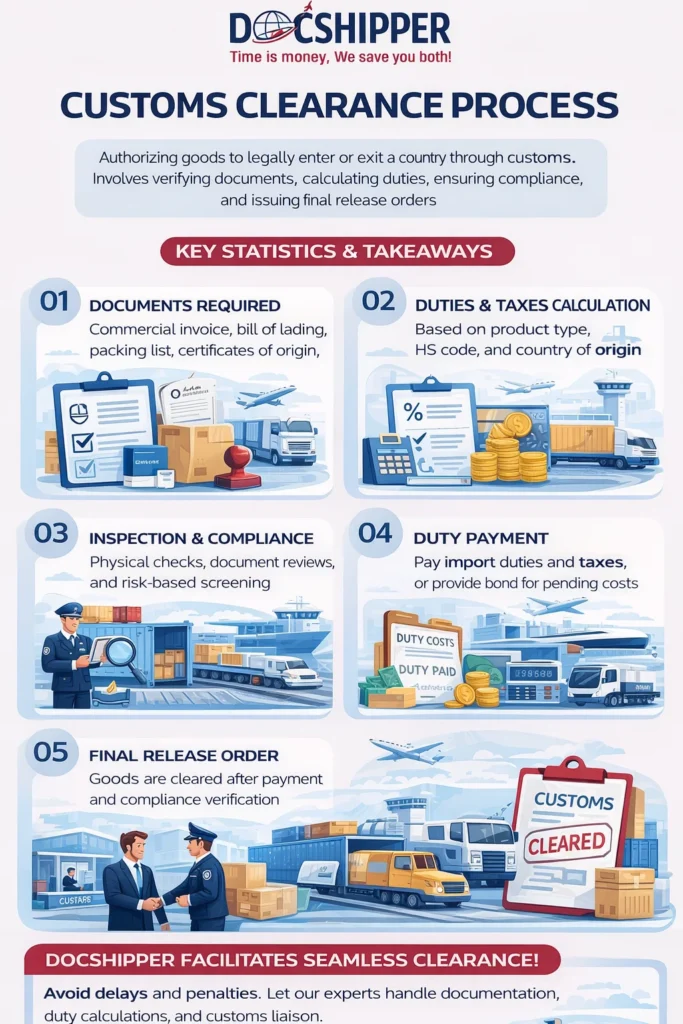
The clearance process follows a structured sequence managed by customs authorities. Each step requires specific documentation and compliance verification.
Pre-arrival documentation forms the foundation. Importers must submit commercial invoices, packing lists, bills of lading, and certificates of origin before goods arrive. Electronic systems like the EU’s Import Control System (ICS) mandate advance cargo declarations.
Classification and valuation determine applicable duties. Customs brokers assign HS codes (Harmonized System) to merchandise, establishing tariff rates. Valuation follows WTO guidelines, typically based on transaction value plus freight and insurance costs.
Duty and tax calculation applies established rates to declared values. Import duties vary by product category and country of origin. VAT, excise taxes, and anti-dumping duties may apply additionally. At DocShipper, we calculate these costs upfront to prevent budget surprises for our clients.
Physical inspection protocols vary by risk assessment. Customs may conduct red channel (physical examination), yellow channel (document review), or green channel (automatic clearance) procedures. X-ray scanning and sampling occur for high-risk shipments.
Release authorization concludes the process. After payment confirmation and compliance verification, customs issue release orders. Goods then transfer to domestic logistics networks. DocShipper coordinates directly with customs authorities to expedite this final stage, ensuring seamless handover to final delivery.
Practical Examples & Data
Real-world clearance scenarios illustrate the process complexity and cost implications across different product categories and trade lanes.
Comparative Clearance Timeline Analysis
| Trade Lane | Average Clearance Time | Documentation Required | Typical Duty Rate |
|---|---|---|---|
| China → USA (Electronics) | 2-4 days | Commercial invoice, ISF, FCC compliance | 0-2.5% |
| Vietnam → EU (Textiles) | 3-5 days | EUR.1, REACH declaration, invoice | 8-12% |
| India → UK (Pharmaceuticals) | 5-10 days | MHRA license, GMP certificate, invoice | 0% (with license) |
| Brazil → Canada (Food Products) | 7-14 days | CFIA permit, phytosanitary cert, invoice | 5-18% |
Use Case: Electronics Import Clearance
A European retailer imports 500 smartphones from China (HS code 8517.12). Shipment value: €50,000 FOB. The clearance breakdown includes:
- Customs duty: 0% (MFN rate for smartphones)
- VAT: €10,500 (21% on CIF value including freight €2,500)
- Clearance processing: €250 (broker fees)
- Total landed cost: €63,250
- Processing time: 48 hours (green channel clearance)
Key Clearance Cost Factors
- Product classification accuracy – Incorrect HS codes trigger audits and penalties
- Documentation completeness – Missing certificates cause immediate rejections
- Valuation transparency – Under-declared values result in fines up to 40%
- Origin certification – Preferential trade agreements reduce duties significantly
- Advance preparation – Pre-clearance programs cut processing time by 60%
Conclusion
Clearance represents the regulatory checkpoint determining whether international shipments enter commerce or face rejection. Mastering this process reduces costs, accelerates delivery, and ensures compliance across global supply chains.
Need expert guidance navigating customs clearance complexities? Contact DocShipper for comprehensive customs brokerage services tailored to your import/export needs.
📚 Quiz
Test Your Knowledge: Customs Clearance
Q1 — What is customs clearance?
Q2 — A shipment is routed through the "green channel" during customs inspection. What does this mean?
Q3 — A European retailer imports smartphones from China under DDP (Delivered Duty Paid) terms. Who is responsible for paying customs duties and taxes at clearance?
🎯 Your Result
📞 Free Quote in 24hFAQ | Clearance: Definition, Process & Practical Examples
Essential documents include commercial invoice, packing list, bill of lading or airway bill, certificate of origin, and product-specific certifications (safety, health, environmental). Electronic customs declarations are also required in most jurisdictions.
Standard clearance ranges from 1-5 business days depending on country, product type, and documentation accuracy. Express clearance programs reduce this to hours, while complex shipments requiring physical inspection may extend to 2 weeks.
The importer of record legally bears responsibility for all duties, taxes, and fees. In DDP (Delivered Duty Paid) shipments, the seller covers these costs. Under DDU terms, the buyer pays upon clearance.
Yes, self-clearance is legally permitted in most countries. However, it requires understanding tariff classifications, valuation methods, and regulatory compliance. Most businesses use licensed customs brokers to ensure accuracy and efficiency.
Rejected shipments face three options: correction and resubmission, voluntary abandonment, or forced exportation back to origin. Storage fees accumulate daily during resolution. Serious violations may result in seizure and destruction.
Duties apply as percentages of CIF value (Cost, Insurance, Freight). Rates vary by HS code classification and country of origin. Free trade agreements may reduce or eliminate duties for qualifying goods.
Customs clearance is the government authorization process. Customs brokerage is the professional service managing this process on behalf of importers, including documentation preparation, classification, duty payment, and regulatory compliance.
No. Customs use risk-based selection systems. Low-risk shipments receive automated clearance (green channel), while high-risk cargo undergoes physical examination (red channel). Random inspections occur across all risk categories.
Submit accurate documentation in advance, use trusted trader programs (AEO, C-TPAT), classify products correctly, maintain transparent valuation, and work with experienced customs brokers who understand local procedures.
Penalties range from monetary fines (typically 10-40% of shipment value) to criminal prosecution for fraud. Common violations include misclassification, undervaluation, false origin declarations, and prohibited goods smuggling.
VAT paid at import is generally recoverable for VAT-registered businesses through periodic tax returns. The refund process and timeline vary by jurisdiction, typically requiring proper documentation and compliance with local accounting standards.
Pre-clearance allows customs processing before goods physically arrive. Importers submit documentation electronically in advance, enabling immediate release upon arrival. This reduces dwell time significantly and is available through authorized economic operator programs.
Need Help with
Logistics or Sourcing ?
First, we secure the right products from the right suppliers at the right price by managing the sourcing process from start to finish. Then, we simplify your shipping experience - from pickup to final delivery - ensuring any product, anywhere, is delivered at highly competitive prices.


Fill the Form
Prefer email? Send us your inquiry, and we’ll get back to you as soon as possible.
Contact us




