


In short ⚡
A commodity is a raw material or primary agricultural product that can be bought, sold, or traded in standardized quantities on global markets. These goods are interchangeable with others of the same type, possess uniform quality regardless of producer, and serve as fundamental inputs for manufacturing, energy production, or consumption. Commodities form the backbone of international trade and supply chain operations.
Introduction
Many importers struggle to differentiate between commodities and manufactured goods, leading to misclassification errors that impact customs duties, insurance coverage, and logistics planning. Understanding commodity characteristics is essential for proper documentation and compliance in international shipping.
Commodities represent the foundation of global trade flows. Unlike branded products, their value derives from universal market prices rather than brand differentiation. This standardization enables efficient trading on commodity exchanges and simplifies procurement processes across borders.
Key characteristics of commodities include:
- Fungibility: One unit is interchangeable with another of the same grade
- Standardized grading: Quality assessed through industry-accepted classification systems
- Price transparency: Values determined by supply-demand dynamics on public exchanges
- Bulk transportation: Typically shipped in large, unpackaged quantities
- Contract specifications: Traded using standardized futures contracts with defined delivery terms
Classification & Trading Mechanisms
Commodities divide into four primary categories based on their origin and application. Energy commodities include crude oil, natural gas, coal, and uranium—materials powering industrial operations and transportation networks. Metal commodities encompass both precious metals (gold, silver, platinum) and industrial metals (copper, aluminum, steel) used in manufacturing and construction.
Agricultural commodities consist of food products (wheat, corn, soybeans, coffee) and livestock (cattle, pork). These goods face seasonal price fluctuations and require specialized storage conditions. Environmental commodities represent a newer category, including carbon credits and renewable energy certificates traded to meet regulatory requirements.
Trading occurs primarily through two mechanisms. Spot markets facilitate immediate delivery at current market prices, suitable for urgent procurement needs. Futures contracts lock in prices for future delivery dates, enabling buyers and sellers to hedge against price volatility—a critical risk management tool for importers.
Regulatory frameworks governing commodity trade vary by jurisdiction. The U.S. Commodity Futures Trading Commission (CFTC) oversees derivatives markets, while the European Union enforces strict sustainability standards through its Corporate Sustainability Due Diligence Directive. Customs authorities classify commodities using the Harmonized System (HS) codes, determining applicable tariffs and import restrictions.
At DocShipper, we assist clients in accurately classifying commodity shipments to ensure compliance with customs regulations and optimize duty payments. Our expertise in documentation prevents costly delays at border crossings.
Practical Examples & Market Data
Understanding commodity pricing dynamics helps importers make informed procurement decisions. Consider the following comparative scenarios:
| Commodity Type | Typical Unit | Price Volatility | Storage Requirements |
|---|---|---|---|
| Crude Oil (WTI) | Barrel (42 gallons) | High (±20-30% annually) | Temperature-controlled tanks |
| Copper Cathode | Metric ton | Moderate (±15% annually) | Dry warehouse, corrosion prevention |
| Wheat (Hard Red Winter) | Bushel (60 lbs) | Moderate (seasonal variation) | Climate-controlled silos |
| Gold (London Fix) | Troy ounce | Low (±10% annually) | Secure vaults, minimal conditions |
Use Case: Coffee Bean Import Optimization
A European roaster imports 500 metric tons of Arabica coffee beans annually from Colombia. By analyzing ICE Futures pricing patterns, the company identifies that prices typically drop 12-18% during harvest months (October-December). Implementing a hedging strategy using futures contracts, they lock in favorable rates six months ahead, saving approximately €45,000 annually while ensuring supply continuity.
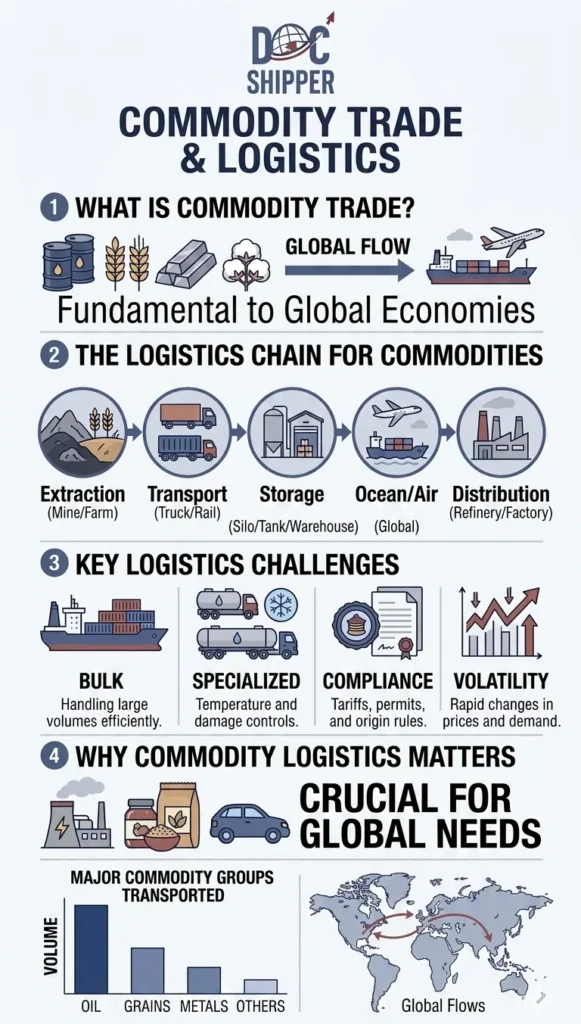
Critical factors influencing commodity logistics include:
- Quality degradation risks: Agricultural commodities require rapid transit to prevent spoilage
- Packaging specifications: Bulk shipments demand specialized containers (tankers, hoppers, break-bulk vessels)
- Insurance valuation: Coverage based on declared commodity grade and current market value
- Origin certification: Certificates of origin required for preferential tariff treatment under trade agreements
- Sustainability documentation: Increasing demand for traceability proving ethical sourcing practices
Conclusion
Commodities remain the lifeblood of international commerce, requiring specialized knowledge in classification, pricing mechanisms, and logistics handling. Proper management of commodity shipments directly impacts cost efficiency and regulatory compliance.
Need expert guidance on commodity import procedures or supply chain optimization? Contact DocShipper for tailored solutions that streamline your global trade operations.
📚 Quiz
Test Your Knowledge: Commodity
Q1 — Which of the following best defines a commodity in international trade?
Q2 — A common misconception about commodities is that their price is set by the individual producer. What actually determines commodity prices?
Q3 — A European roaster wants to protect its budget against rising Arabica coffee prices over the next six months. Which approach best applies commodity trading mechanisms to solve this problem?
🎯 Your Result
📞 Free Quote in 24hFAQ | Commodity: Definition, Classification & Practical Examples
Commodities are raw or minimally processed materials with standardized quality grades, while manufactured products undergo significant transformation and carry brand differentiation. Commodities trade based on universal specifications rather than producer identity.
Futures contracts lock in purchase prices for future delivery dates, allowing buyers to hedge against market fluctuations. This financial instrument provides budget certainty and protects profit margins when commodity prices rise unexpectedly.
Yes. Commodities typically fall under earlier chapters of the Harmonized System (Chapters 1-27 for raw materials), while processed goods occupy later chapters. Accurate classification affects duty rates and import licensing requirements.
Essential documents include commercial invoices, bills of lading, certificates of origin, quality inspection certificates, phytosanitary certificates (for agricultural goods), and fumigation certificates when applicable. Specific requirements vary by commodity type and destination country.
Some commodities adapt to containerized shipping (bagged grains, palletized metals), but many require specialized equipment like ISO tank containers for liquids, open-top containers for ores, or refrigerated containers for perishable agricultural products.
Independent inspection agencies conduct pre-shipment surveys, taking samples for laboratory analysis. Certificates issued by organizations like SGS or Bureau Veritas confirm compliance with contract specifications and serve as evidence for insurance claims if quality disputes arise.
Primary risks include price fluctuations during transit, physical damage or contamination, regulatory changes affecting import eligibility, and force majeure events disrupting supply chains. Comprehensive marine cargo insurance and contractual protections mitigate these exposures.
Pricing terms vary. FOB (Free On Board) excludes freight and insurance, while CIF (Cost, Insurance, Freight) includes delivery to the destination port. Importers must clarify Incoterms to accurately calculate total landed costs.
Regulations like the EU Deforestation Regulation demand proof that agricultural commodities originate from non-deforested land. Importers must maintain traceability documentation and conduct due diligence to avoid penalties and reputational damage.
Exchanges like the Chicago Mercantile Exchange and London Metal Exchange provide transparent price discovery, standardized contracts, and clearinghouse services that reduce counterparty risk. They enable efficient hedging and facilitate international trade financing.
Yes, though minimum order quantities often require significant capital. Smaller importers can participate through commodity pools, cooperative purchasing arrangements, or by partnering with freight forwarders who consolidate shipments to achieve economies of scale.
Since most commodities price in U.S. dollars, importers using other currencies face exchange rate risk. Currency hedging instruments like forward contracts or options protect against adverse movements between contract signing and payment dates.
Need Help with
Logistics or Sourcing ?
First, we secure the right products from the right suppliers at the right price by managing the sourcing process from start to finish. Then, we simplify your shipping experience - from pickup to final delivery - ensuring any product, anywhere, is delivered at highly competitive prices.


Fill the Form
Prefer email? Send us your inquiry, and we’ll get back to you as soon as possible.
Contact us




