AAR (Against All Risks): Definition & Coverage in 2026
admin
7 Min
Published on March 4, 2026
Updated on March 23, 2026
In short ⚡
AAR (Against All Risks) is a comprehensive marine insurance clause covering loss or damage to cargo from external causes during transit, excluding only explicitly listed exclusions such as inherent vice, delay, or insolvency. This clause provides the broadest protection available for international shipments.
Introduction
Many importers and exporters struggle to understand which marine insurance coverage truly protects their cargo. The confusion between AAR, FPA, and WA clauses can lead to costly gaps in protection.
The AAR clause represents the gold standard in marine cargo insurance. It covers virtually all physical loss or damage from external causes throughout the international supply chain.
Key characteristics of AAR coverage include:
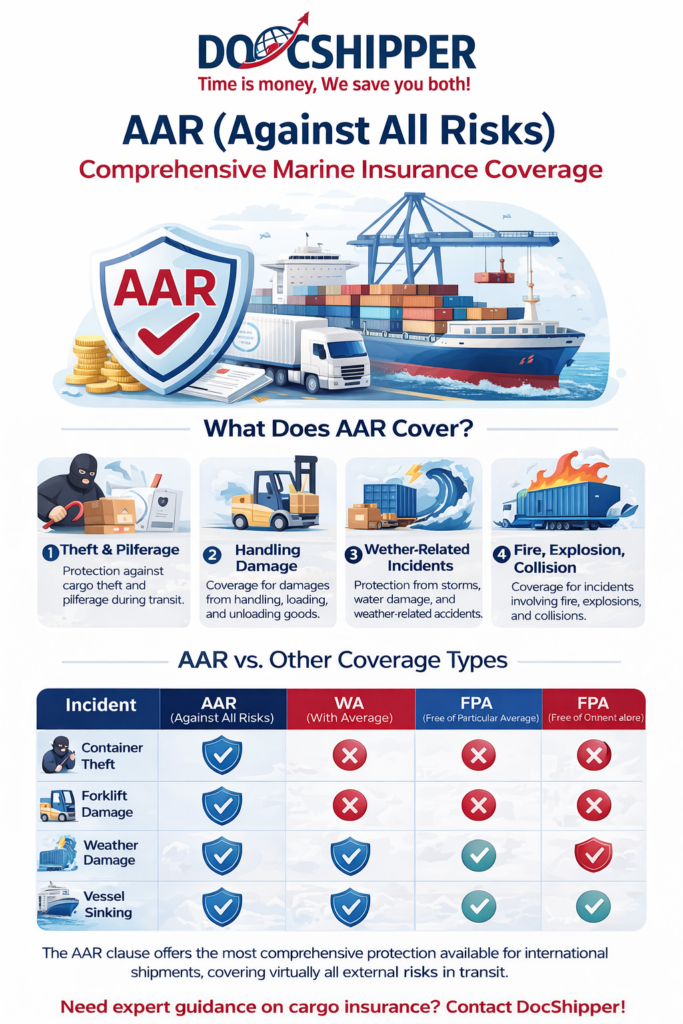
Protectionagainst theft, pilferage, and non-delivery
Coverage for damage from handling, loading, and unloading
Protection during transshipment and storage in transit
Protection from fire, explosion, and collision incidents
Understanding AAR coverage is essential for managing risk in international trade operations.
In-Depth Analysis & Expert Insights
The AAR clause operates on an “all risks” principle, meaning it covers all fortuitous losses except those specifically excluded. This inverts the traditional insurance model where only named perils are covered.
Standard exclusionsunder AAR include willful misconduct, ordinary leakage, inherent vice, delay (even if caused by an insured peril), insolvency of carriers, and war risks (unless separately endorsed).
The Institute Cargo Clauses (A), established by the Institute of London Underwriters, represent the international standard for AAR coverage. These clauses are recognized globally and referenced in the ICC Incoterms.
Claims procedures require immediate notification to insurers, preservation of damaged goods for survey, and comprehensive documentation including commercial invoices, packing lists, and survey reports.
At DocShipper, we systematically verify that our clients’ AAR policies include appropriate territorial scope and duration extensions, particularly for shipments involving multiple transshipments or extended warehousing periods.
The premium calculation for AAR coverage considers cargo value, nature of goods, packaging quality, route, vessel type, and claims history. Premiums typically range from 0.1% to 1.5% of insured value.
Practical Examples & Case Studies
Understanding AAR coverage through real-world scenarios helps clarify its practical application and value proposition.
Comparative Coverage Analysis
Incident Type
AAR Coverage
WA Coverage
FPA Coverage
Container theft at port
✓ Covered
✗ Excluded
✗ Excluded
Forklift damage during loading
✓ Covered
✗ Excluded
✗ Excluded
Water damage from storm
✓ Covered
✓ Covered
✗ Partial only
Vessel sinking (total loss)
✓ Covered
✓ Covered
✓ Covered
Inherent vice (natural decay)
✗ Excluded
✗ Excluded
✗ Excluded
Case Study: Electronics Shipment
Scenario: A company ships $500,000 worth of consumer electronics from Shenzhen to Rotterdam via Singapore transshipment.
AAR Premium: 0.35% = $1,750
Incident: During container transfer in Singapore, a forklift punctures the container, exposing goods to tropical rain. Damage assessment: $87,000.
Outcome with AAR: Full claim paid within 45 days after survey and documentation. Net loss: $1,750 (premium only).
Outcome without AAR: Carrier liability limited to $500 per package under Hague-Visby Rules. Actual recovery: ~$12,000. Net loss: $75,000.
This demonstrates the critical value proposition of AAR coverage for high-value cargo exposed to multiple handling points.
DocShipper Platform
Optimize Your Global Logistics with Cutting-Edge Solutions
Enhance efficiency, cut costs, and gain 24/7 visibility over your entire supply chain.
Cut your shipping costs and maximize your margins
Manage sourcing, freight, & customs on one platform
The AAR clause provides the most comprehensive protection available for international cargo, covering virtually all external risks during transit. For businesses shipping valuable or sensitive goods, this coverage is essential risk management.
Need expert guidance on cargo insurance for your shipments? Contact DocShipper for personalized advice on protecting your international trade operations.
📚 Quiz
Test Your Knowledge: AAR (Against All Risks)
Q1. What is the core principle behind an AAR (Against All Risks) marine insurance clause?
Q2. A shipment of fresh produce is delayed at port due to a vessel breakdown, causing the goods to spoil. Would an AAR policy cover this loss?
Q3. A company ships electronics from Shenzhen to Rotterdam. During transshipment in Singapore, a forklift punctures the container and rain damages $87,000 worth of goods. Which statement best describes the outcome under AAR coverage?
AAR covers all risks except specific exclusions, while FPA (Free from Particular Average) only covers total losses and major casualties. AAR provides significantly broader protection for partial losses and theft.
Standard AAR excludes war, strikes, riots, and civil commotion. These require separate endorsements under Institute War Clauses and Institute Strikes Clauses for additional premium.
Yes, AAR typically costs 50-200% more than WA coverage and 100-300% more than FPA, but provides substantially broader protection. Premium differences depend on cargo type and route.
Essential documents include the insurance certificate, commercial invoice, packing list, bill of lading, survey report, photos of damage, and correspondence with carriers regarding liability.
No. Damage resulting from inadequate or unsuitable packaging is considered inherent vice and is excluded from AAR coverage. Proper packaging is the shipper's responsibility.
Standard AAR coverage extends from warehouse to warehouse, typically 60 days after discharge at final port. Extended storage requires additional premium and specific endorsements.
No. Marine insurance must be arranged before the goods are at risk. Post-shipment insurance is not available, as this would violate the principle of insurable interest.
AAR is the general principle; ICC(A) is the specific standardized wording used internationally. ICC(A) represents the modern implementation of AAR coverage with clearly defined terms.
No. Delay is specifically excluded even if caused by an insured peril. Consequential losses from late delivery, including market depreciation or contract penalties, are not covered.
Insured value typically includes CIF value plus 10% for anticipated profit. This ensures adequate coverage for replacement costs and business interruption without constituting over-insurance.
Some high-risk cargoes require specialized clauses: livestock, perishables with short shelf life, and certain hazardous materials may face restrictions or require modified coverage terms.
The insurance principle of subrogation applies. The insurer pays the claim, then pursues recovery from the liable carrier. The insured cannot profit by collecting twice for the same loss.
Ask us anything!
Need Help with Logistics or Sourcing ?
First, we secure the right products from the right suppliers at the right price by managing the sourcing process from start to finish. Then, we simplify your shipping experience - from pickup to final delivery - ensuring any product, anywhere, is delivered at highly competitive prices.
Live Chat
Get instant assistance from our team—just click and start chatting!


 over your entire supply chain.




:%20Definition%20&%20Coverage%20in%202026)