


In short ⚡
Aboard is a shipping and logistics term indicating that goods or passengers have been loaded onto a vessel, aircraft, or vehicle. In international trade, it confirms physical possession by the carrier, triggering critical documentation like the Bill of Lading and marking the transfer of risk from shipper to carrier.Introduction
Confusion often arises between “shipped” and “aboard” in international logistics. While “shipped” can mean goods are in transit, aboard specifically confirms physical loading onto the transport mode. This distinction is critical for insurance coverage, liability determination, and payment triggers in Letters of Credit.
In global supply chains, the “aboard” status represents a pivotal moment. It marks the transition from warehouse custody to carrier responsibility. For importers and exporters, understanding this moment prevents disputes over damaged goods, delayed shipments, and payment releases.
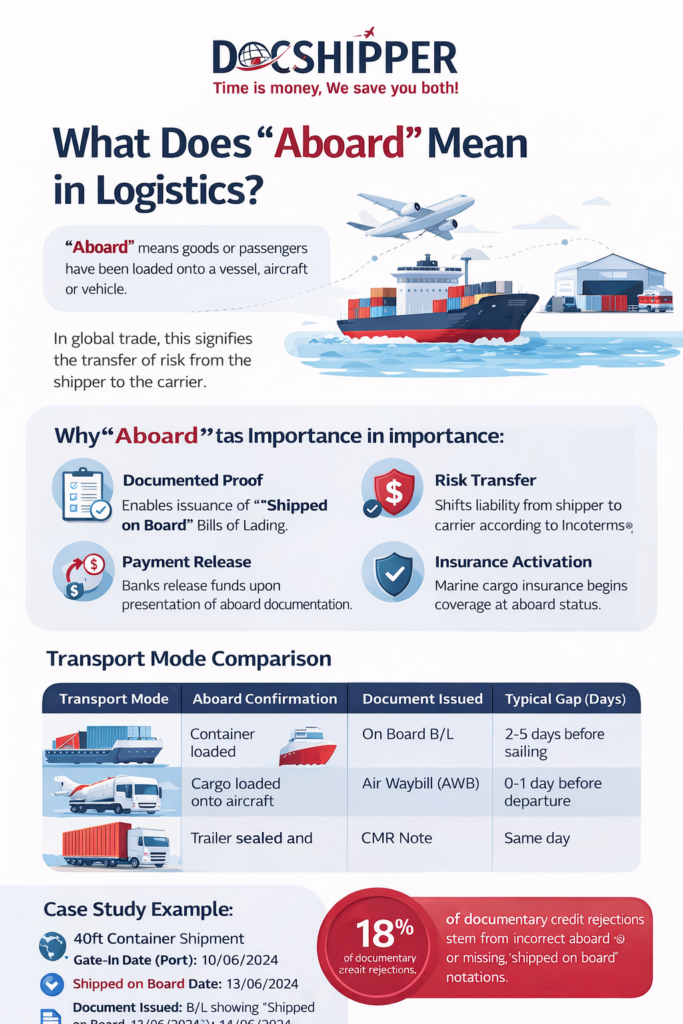
Key characteristics of “aboard” status include:
- Physical confirmation – Goods are verifiably on the vessel or aircraft
- Documentation trigger – Enables issuance of “shipped on board” Bills of Lading
- Risk transfer point – Liability shifts according to Incoterms (FOB, CFR, CIF)
- Payment activation – Banks release funds upon presentation of aboard documentation
- Insurance validity – Marine cargo insurance typically activates at this point
Technical & Legal Implications
The “aboard” notation carries significant legal weight in international commerce. Under the Hague-Visby Rules and Rotterdam Rules, the carrier’s responsibility begins when goods are taken aboard. This moment determines who bears loss or damage during transit.
In documentary credit operations, banks require an On Board Bill of Lading showing the aboard date. This document proves the carrier received the goods and commits to delivery. Without this confirmation, payment under Letters of Credit may be refused, causing severe cash flow disruptions.
The aboard date differs from the booking date or ETD (Estimated Time of Departure). Containers may arrive at the terminal days before actual loading. Only when physically placed on the vessel does the “aboard” status apply. This distinction affects freight calculations, demurrage charges, and contractual obligations.
Incoterms 2020 directly reference the aboard moment. Under FOB (Free On Board), the seller’s responsibility ends when goods cross the ship’s rail. For CIF (Cost, Insurance, Freight), the seller must arrange insurance from the aboard point. Misunderstanding this timing creates liability gaps.
Electronic Bills of Lading (eBL) platforms now digitize aboard notifications. Systems like WAVE, essDOCS, and Bolero provide blockchain-verified timestamps of loading. At DocShipper, we integrate these digital confirmations into our tracking systems, ensuring clients receive real-time aboard status updates across all shipment modes.
According to the International Chamber of Commerce, proper aboard documentation reduces trade finance disputes by up to 40%. This underscores why freight forwarders meticulously verify loading confirmations before issuing transport documents.
Practical Examples & Data
Understanding aboard status becomes clearer through real-world scenarios. Consider a textile exporter in Bangladesh shipping to France. The containers arrive at Chittagong port on March 1st. The vessel departs March 5th. The aboard date is March 4th when containers are physically loaded. This date appears on the Bill of Lading and triggers the 30-day payment term in the sales contract.
Air freight operates similarly but with tighter timelines. An electronics shipment from Shenzhen to Los Angeles may be trucked to the airport on Monday, but the flight departs Wednesday. The Airway Bill shows the aboard date as Wednesday when cargo is loaded onto the aircraft. This two-day gap affects transit time calculations and delivery commitments.
| Transport Mode | Aboard Confirmation | Document Issued | Typical Gap (Days) |
|---|---|---|---|
| Ocean Freight | Container loaded on vessel | On Board B/L | 2-5 days before sailing |
| Air Freight | Cargo loaded on aircraft | Air Waybill (AWB) | 0-1 day before departure |
| Rail Freight | Wagon coupling confirmed | Rail Consignment Note | 1-2 days before departure |
| Truck (FTL) | Trailer sealed and departed | CMR Note | Same day |
Case Study: A machinery manufacturer ships a 40ft container from Hamburg to Shanghai. The container is gated-in at the terminal on June 10th. The vessel’s cut-off is June 12th, but actual loading occurs June 13th due to terminal congestion. The Bill of Lading shows “Shipped on Board: 13/06/2024.” The buyer’s bank releases payment on June 14th upon receiving this document. If the exporter had used the gate-in date, the payment would have been delayed pending correct documentation.
Industry data shows that 18% of documentary credit rejections stem from incorrect aboard dates or missing “shipped on board” notations. At DocShipper, we verify loading confirmations with carrier APIs before releasing shipping documents, reducing client rejection rates to below 2%.
For consolidated shipments (LCL), the aboard moment applies when the entire container is loaded, not when individual consignments enter the container. This creates complexity for multiple shippers sharing space. Freight forwarders issue House Bills of Lading with the master container’s aboard date, ensuring all parties reference the same loading timestamp.
Conclusion
The “aboard” status is far more than administrative notation—it’s the legal and financial hinge point in international shipping. Proper verification of this moment protects against payment disputes, insurance gaps, and liability confusion.
Need expert guidance on shipping documentation or cargo tracking? Contact DocShipper for comprehensive logistics support tailored to your trade requirements.
DocShipper Platform
Optimize Your Global Logistics with Cutting-Edge Solutions
Enhance efficiency, cut costs, and gain 24/7 visibility  over your entire supply chain.
- Cut your shipping costs and maximize your margins
- Manage sourcing, freight, & customs on one platform
- Get real-time tracking and analytics
📚 Quiz
Test Your Knowledge: Aboard
Q1 — What does "aboard" specifically confirm in international logistics?
Q2 — A container arrives at the terminal on June 10th, but is only loaded onto the vessel on June 13th. Which date appears on the Bill of Lading as the "aboard" date?
Q3 — Under FOB (Free On Board) Incoterms 2020, what happens at the "aboard" moment?
🎯 Your Result
📞 Free Quote in 24hFAQ | Aboard: Definition, Usage & Practical Examples in Logistics
Need Help with Logistics or Sourcing ?
First, we secure the right products from the right suppliers at the right price by managing the sourcing process from start to finish. Then, we simplify your shipping experience - from pickup to final delivery - ensuring any product, anywhere, is delivered at highly competitive prices.


Fill the Form
Prefer email? Send us your inquiry, and we’ll get back to you as soon as possible.
Contact us


