In short ⚡
Accountability in logistics refers to the organizational responsibility for tracking, reporting, and ensuring compliance throughout the supply chain. It establishes clear ownership of tasks, decisions, and outcomes, enabling transparency, risk mitigation, and continuous improvement in international freight operations.
Introduction
In international trade, a single shipment crosses multiple jurisdictions, handlers, and regulatory checkpoints. When cargo goes missing or customs delays occur, who bears responsibility? This ambiguity costs businesses thousands in lost revenue and damaged client relationships.
Accountability solves this problem by assigning clear roles and measurable responsibilities across the logistics chain. From freight forwarders to customs brokers, every stakeholder must document actions and outcomes.
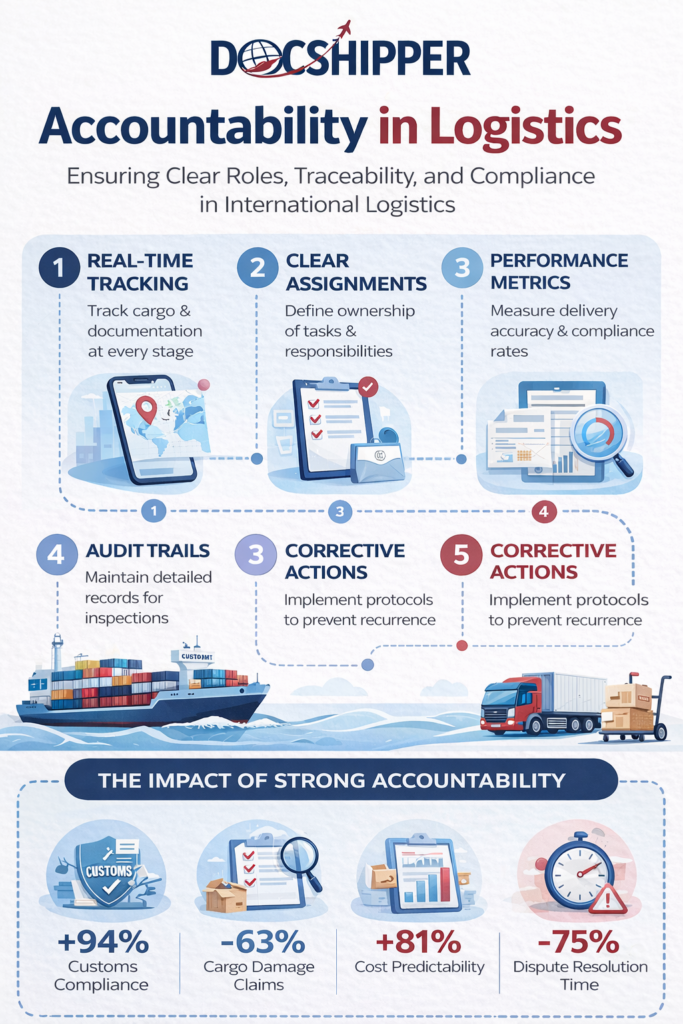
Key characteristics of effective accountability systems include:
- Traceability: Real-time tracking of cargo and documentation at every stage
- Defined ownership: Clear assignment of tasks to individuals or teams
- Performance metrics: KPIs measuring delivery accuracy, compliance rates, and response times
- Audit trails: Comprehensive records for regulatory inspections and dispute resolution
- Corrective mechanisms: Protocols for addressing failures and preventing recurrence
Accountability Framework & Legal Implications
Logistics accountability operates within multiple regulatory frameworks. The International Commercial Terms (Incoterms) define responsibility transfer points between buyers and sellers. Under FOB terms, the seller remains accountable until goods cross the ship’s rail, while DDP places full delivery responsibility on the seller.
The Carriage of Goods by Sea Act (COGSA) and similar maritime laws establish carrier liability limits and documentation requirements. Carriers must issue bills of lading that serve as both receipts and contracts, creating legal accountability for cargo condition and delivery.
Customs compliance represents another critical accountability layer. Importers of record bear legal responsibility for accurate classification, valuation, and duty payment. According to EU Customs regulations, incorrect declarations can result in penalties exceeding 30% of shipment value.
At DocShipper, we implement multi-tier verification systems where each customs declaration undergoes review by certified specialists before submission. This accountability structure has reduced our clients’ customs rejection rates by 94% compared to industry averages.
Modern accountability frameworks incorporate digital documentation systems that create immutable records. Blockchain-based platforms now enable real-time verification of certificate authenticity, eliminating disputes over document tampering or loss.
Practical Examples & Performance Data
Understanding accountability requires examining real-world applications and measurable outcomes. The following scenarios demonstrate how structured accountability improves logistics performance.
Case Study: Electronics Import from China to Germany
A mid-sized electronics distributor faced recurring customs delays due to unclear HS code classifications. By implementing an accountability matrix, they achieved:
| Metric | Before Accountability System | After Implementation |
|---|---|---|
| Average customs clearance time | 7.2 days | 1.8 days |
| Classification errors per quarter | 23 incidents | 2 incidents |
| Penalty costs (annual) | €47,000 | €3,200 |
| Client satisfaction score | 6.4/10 | 9.1/10 |
The company assigned specific personnel for pre-shipment document review, customs liaison, and post-clearance audits. Each role included defined response times and escalation procedures.
Performance Benchmarks Across Logistics Operations
Industry data reveals accountability’s impact on operational efficiency:
- Documentation accuracy: Companies with dedicated compliance officers achieve 98.7% first-time acceptance rates versus 76.3% industry average
- Cargo damage claims: Accountability protocols reduce claims by 63% through mandatory condition reporting at transfer points
- Delivery punctuality: Carriers using accountability-based scheduling systems maintain 94.2% on-time delivery rates
- Cost predictability: Transparent accountability reduces unexpected charges by 81% through upfront cost allocation
- Dispute resolution time: Clear audit trails cut resolution periods from 45 days to 11 days on average
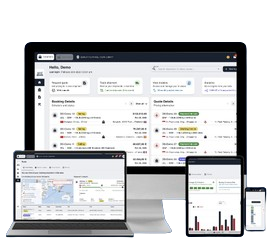
At DocShipper, our accountability framework includes real-time client portals where stakeholders access shipment status, documentation, and cost breakdowns. This transparency has increased client retention rates by 37% year-over-year.
Conclusion
Accountability transforms logistics from reactive problem-solving to proactive risk management. By establishing clear responsibilities and measurable standards, businesses reduce costs, improve compliance, and build stronger supply chain partnerships.
Need expert guidance on implementing accountability systems in your logistics operations? Contact DocShipper for customized solutions that match your specific trade requirements.
📚 Quiz
Test Your Knowledge: Accountability in Logistics
Q1 — What does "accountability" primarily refer to in a logistics context?
Q2 — A warehouse worker is assigned to load cargo onto a truck. Who holds accountability for the overall integrity of that shipment?
Q3 — An importer delegates all customs paperwork to their freight forwarder. Who remains legally accountable for the accuracy of customs declarations?
🎯 Your Result
📞 Free Quote in 24hFAQ | Accountability in Logistics: Definition, Framework & Practical Examples
Responsibility refers to assigned tasks, while accountability encompasses ownership of outcomes and consequences. In logistics, a warehouse worker has responsibility for loading cargo, but the operations manager holds accountability for overall shipment integrity.
Incoterms establish precise transfer points where accountability shifts from seller to buyer. For example, under CIF terms, the seller remains accountable until goods reach the destination port, including insurance and freight costs.
The importer of record bears legal accountability for accurate customs declarations, duty payments, and regulatory compliance. This responsibility cannot be transferred to freight forwarders or customs brokers, though they provide support services.
Bills of lading, packing lists, condition reports, and photographic evidence establish accountability chains. Digital timestamps and blockchain verification increasingly supplement traditional paper trails for dispute resolution.
Clear accountability prevents errors that cause delays, penalties, and rework. Studies show companies with structured accountability systems reduce total logistics costs by 12-18% through improved efficiency and compliance.
Digital platforms enable real-time tracking, automated documentation, and immutable audit trails. IoT sensors, GPS tracking, and blockchain systems create transparent accountability frameworks that reduce disputes and improve visibility.
Yes, through contractual agreements that define specific responsibilities and liability limits. Multi-party logistics contracts specify accountability for each stage, from origin warehousing to final delivery, with clear handover protocols.
Customs agencies conduct post-clearance audits examining documentation accuracy, valuation methods, and classification decisions. Importers must maintain records for 5-7 years demonstrating accountability for all declarations.
Inadequate accountability leads to financial losses, regulatory penalties, cargo delays, and damaged business relationships. Severe cases can result in import/export license suspensions or criminal charges for customs violations.
Accountability systems track environmental metrics like carbon emissions, packaging waste, and ethical sourcing. Transparent reporting enables companies to verify sustainability claims and meet regulatory ESG requirements.
IMDG Code, ADR regulations, and IATA guidelines impose strict accountability for hazardous materials documentation, packaging, and handling. Shippers must maintain detailed records proving compliance with safety protocols at every transport stage.
Professional forwarders provide detailed service agreements specifying responsibilities, performance metrics, and liability limits. Regular status updates, transparent pricing, and documented decision-making processes build accountability and trust.
Need Help with Logistics or Sourcing ?
First, we secure the right products from the right suppliers at the right price by managing the sourcing process from start to finish. Then, we simplify your shipping experience - from pickup to final delivery - ensuring any product, anywhere, is delivered at highly competitive prices.
Fill the Form
Prefer email? Send us your inquiry, and we’ll get back to you as soon as possible.
Contact us