In short ⚡
Accounts Payable (A/P) represents the outstanding debts a company owes to its suppliers and creditors for goods or services received but not yet paid for. This short-term liability appears on the balance sheet and directly impacts cash flow management, working capital, and supplier relationships in international trade operations.Introduction
Many businesses struggle with cash flow bottlenecks caused by poor management of what they owe suppliers. In international logistics, where payment terms span multiple currencies and jurisdictions, Accounts Payable becomes a critical control point.
Efficient A/P management ensures timely payments, maintains supplier trust, and optimizes working capital. For companies importing goods, tracking A/P accurately prevents delays, late fees, and damaged business relationships.
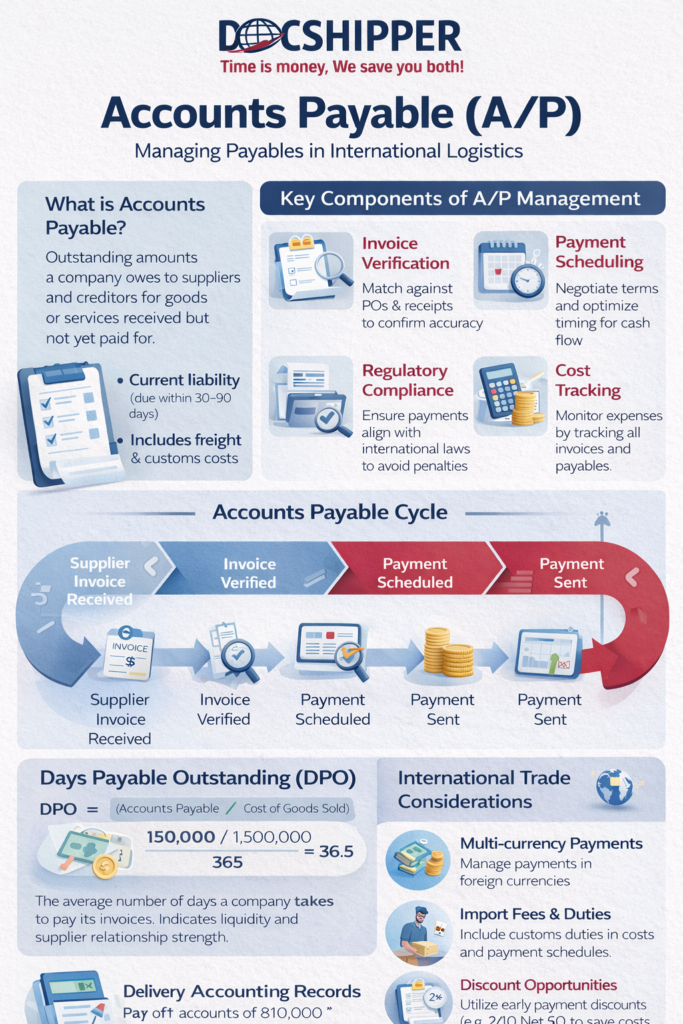
Key characteristics of Accounts Payable include:
- Current liability: Typically due within 30-90 days
- Non-interest bearing: Unless payment terms are violated
- Recorded on accrual basis: When goods/services are received, not when paid
- Includes freight, customs, and logistics costs: In international trade contexts
- Directly affects Days Payable Outstanding (DPO): A key liquidity metric
Understanding Accounts Payable: Mechanisms & Best Practices
Accounts Payable operates through a systematic cycle. When a company receives an invoice from a supplier, the finance team records it as a liability. The amount remains in A/P until the payment is processed, at which point it reduces both A/P and cash balances.
In international logistics, A/P includes multiple cost layers: product costs, freight charges, customs duties, and handling fees. Each invoice must be matched against purchase orders and receiving documents—a process called three-way matching.
The payment terms negotiated with suppliers directly impact cash flow. Common terms include Net 30 (payment due in 30 days) or 2/10 Net 30 (2% discount if paid within 10 days, otherwise due in 30). Strategic use of payment terms preserves working capital while maintaining supplier goodwill.
Regulatory compliance is crucial. According to EU Late Payment Directive, businesses must pay invoices within agreed terms or face interest charges. Similar regulations exist globally, making A/P management a legal imperative.
At DocShipper, we integrate A/P tracking into our freight management systems, ensuring clients maintain visibility over all logistics-related payables across multiple suppliers and service providers simultaneously.
The Accounts Payable Turnover Ratio measures how quickly a company pays its suppliers. It’s calculated as: Total Supplier Purchases ÷ Average Accounts Payable. A higher ratio indicates faster payment cycles, while a lower ratio suggests extended payment terms or potential liquidity issues.
Concrete Examples & Financial Data
Consider a European importer purchasing electronics from Asia. The company receives goods worth €100,000 with payment terms of Net 60. Additional costs include:
| Cost Component | Amount (€) | Payment Term |
|---|---|---|
| Product Cost | 100,000 | Net 60 |
| Ocean Freight | 8,500 | Net 30 |
| Customs Duties | 12,000 | Due on Import |
| Warehousing | 3,200 | Net 15 |
| Total A/P | 123,700 | — |
This company must strategically manage multiple payment deadlines. Customs duties require immediate payment to release goods. Warehousing fees are due in 15 days. Freight follows in 30 days, while the main product invoice allows 60 days.
Days Payable Outstanding (DPO) calculation for this scenario:
If the company’s annual cost of goods sold is €1,500,000 and average A/P is €150,000:
DPO = (Average A/P ÷ COGS) × 365 = (150,000 ÷ 1,500,000) × 365 = 36.5 days
This means the company takes approximately 37 days to pay suppliers on average. Industry benchmarks vary, but 30-45 days is common in international trade.
A practical scenario: A company negotiating early payment discounts (2/10 Net 30) on a €50,000 invoice could save €1,000 by paying within 10 days. The annualized return on this discount is approximately 36%, making it financially advantageous if cash flow permits.
DocShipper clients typically manage 15-40 concurrent A/P entries across freight forwarders, customs brokers, and suppliers. Our centralized dashboard consolidates these obligations, preventing missed payments and optimizing cash deployment.
Conclusion
Accounts Payable is more than an accounting entry—it’s a strategic tool for managing liquidity, supplier relationships, and operational efficiency in international logistics. Proper A/P management prevents costly delays and strengthens supply chain partnerships.
Need assistance managing complex international payables across multiple suppliers and service providers? Contact DocShipper for integrated freight and financial coordination solutions.
DocShipper Platform
Cut logistics costs. Not corners.
See exactly where your logistics costs are bleeding — and how to fix it. Book your expert demo.
📚 Quiz
Test Your Knowledge: Accounts Payable (A/P)
Q1 — What does Accounts Payable (A/P) represent on a company's balance sheet?
Q2 — A company receives a supplier invoice on January 1st but won't pay until January 30th. Under accrual accounting, when should this amount be recorded in Accounts Payable?
Q3 — A European importer receives a €50,000 invoice with terms "2/10 Net 30." The company has sufficient cash reserves. What is the most financially advantageous course of action?
🎯 Your Result
📞 Free Quote in 24hFAQ | Accounts Payable (A/P): Definition, Calculation & Concrete Examples
Accounts Payable represents money your company owes to suppliers, while Accounts Receivable is money owed to your company by customers. A/P is a liability; A/R is an asset on the balance sheet.
A/P directly impacts cash flow by delaying cash outflows. Longer payment terms preserve cash, but must be balanced against supplier relationships and potential early payment discounts that could save money.
Common terms include Net 30, Net 60, or 2/10 Net 30. In international trade, Letters of Credit and prepayment terms are also used, especially for new supplier relationships or high-value shipments.
The formula is: Total Supplier Purchases ÷ Average Accounts Payable. This ratio indicates how many times per period a company pays off its average payables balance, reflecting payment efficiency.
Three-way matching requires: the purchase order (PO), the supplier invoice, and the goods receipt note. All three must align in terms of quantities, prices, and descriptions before payment approval.
Yes, A/P in international trade includes all unpaid obligations: product costs, freight charges, customs duties, insurance, warehousing fees, and handling charges. Each is tracked separately until paid.
Late payments can result in interest charges, damaged supplier relationships, reduced credit terms, and potential supply disruptions. In the EU, late payment legislation mandates statutory interest on overdue invoices.
When A/P is denominated in foreign currency, exchange rate changes between invoice date and payment date create gains or losses. Companies use hedging strategies or currency clauses to manage this risk.
DPO measures the average number of days a company takes to pay suppliers. It's calculated as: (Average A/P ÷ Cost of Goods Sold) × 365. Higher DPO indicates longer payment cycles.
Not necessarily. While extended terms preserve cash, early payment discounts often provide better returns than alternative investments. Additionally, timely payments strengthen supplier relationships and may secure better pricing or priority service.
Automated systems reduce manual entry errors, accelerate invoice processing, enable early payment discount capture, improve cash flow forecasting, and provide real-time visibility into outstanding obligations across multiple suppliers.
A/P is a key component of the cash conversion cycle. Optimizing payment timing—balancing cash preservation with supplier relationships—directly improves working capital efficiency and reduces financing needs.
Need Help with
Logistics or Sourcing ?
First, we secure the right products from the right suppliers at the right price by managing the sourcing process from start to finish. Then, we simplify your shipping experience - from pickup to final delivery - ensuring any product, anywhere, is delivered at highly competitive prices.


Fill the Form
Prefer email? Send us your inquiry, and we’ll get back to you as soon as possible.
Contact us