In short ⚡
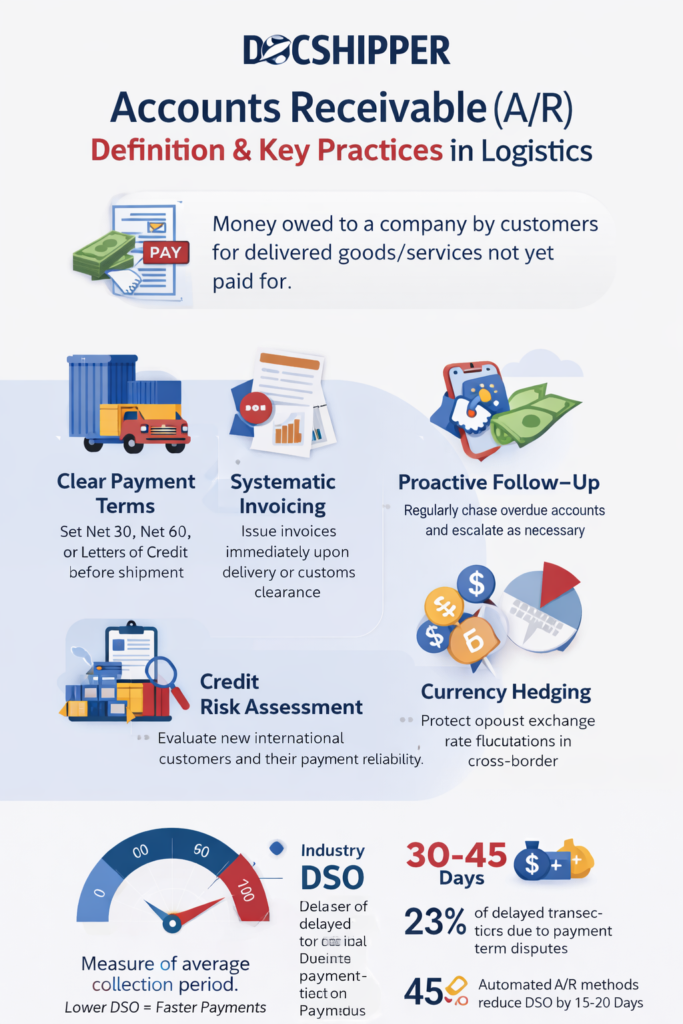
Accounts Receivable (A/R) represents money owed to a company by its customers for goods or services delivered but not yet paid. In international logistics, effective A/R management ensures cash flow stability, reduces payment delays, and minimizes financial risks associated with cross-border transactions.
Introduction
Many importers and exporters struggle with delayed payments that disrupt operations and strain supplier relationships. In international trade, where transactions involve multiple currencies, extended shipping times, and complex payment terms, managing accounts receivable becomes critical to business survival.
Accounts receivable directly impacts working capital availability. Poor A/R management can force companies to seek expensive short-term financing or miss growth opportunities due to cash constraints.
Key characteristics of effective A/R management in logistics include:
- Clear payment terms established before shipment (Net 30, Net 60, Letter of Credit)
- Systematic invoicing immediately upon delivery or customs clearance
- Proactive follow-up on overdue accounts with escalation procedures
- Credit risk assessment for new international customers
- Currency hedging strategies to protect against exchange rate fluctuations
Understanding A/R Mechanisms & Best Practices
The accounts receivable cycle begins when a sales invoice is issued and ends when payment is received and reconciled. In international logistics, this cycle typically extends 30 to 90 days, depending on negotiated terms and destination country practices.
Days Sales Outstanding (DSO) measures the average collection period. Calculate DSO by dividing accounts receivable by average daily sales. A DSO of 45 days means customers take 45 days on average to pay invoices. Industry benchmarks vary, but logistics companies typically target 30-45 days.
Aging reports categorize receivables by time outstanding (0-30 days, 31-60 days, 61-90 days, 90+ days). These reports identify problematic accounts requiring immediate attention. Receivables over 90 days often require collection agencies or legal action.
Credit policies establish customer payment capabilities before extending credit. For international clients, this includes reviewing financial statements, trade references, and credit insurance options. Payment guarantees like Letters of Credit reduce risk but increase transaction costs.
Documentation accuracy prevents payment disputes. Commercial invoices must match Bills of Lading, packing lists, and purchase orders exactly. Discrepancies give customers justification to delay payment pending resolution. At DocShipper, we systematically verify all documentation alignment before invoicing to prevent payment delays and maintain client cash flow predictability.
According to U.S. International Trade Administration, payment term disputes account for 23% of delayed international transactions, highlighting the importance of clear A/R protocols.
Concrete Examples & Financial Data
Consider a freight forwarder handling $500,000 monthly in shipments with Net 60 payment terms. If customers consistently pay in 75 days instead of 60, the company carries an additional $125,000 in outstanding receivables, tying up working capital that could fund new operations.
| Payment Term | Average DSO | Cash Flow Impact | Risk Level |
|---|---|---|---|
| Prepayment | 0 days | Optimal | None |
| Net 30 | 35-40 days | Good | Low |
| Net 60 | 65-75 days | Moderate | Medium |
| Net 90 | 95-110 days | Strained | High |
| Open Account | 120+ days | Critical | Very High |
Use Case: European Importer
A German company imports electronics from China worth €200,000 quarterly on Net 45 terms. Their supplier offers a 2% discount for payment within 10 days. By paying early, they save €4,000 annually (€200,000 × 4 quarters × 2%), equivalent to an annualized return of 36.5% on accelerated payment.
Key A/R optimization metrics:
- Collection Effectiveness Index (CEI): Target above 85% indicates efficient collections
- Bad Debt Ratio: Should remain below 2% of total receivables in logistics
- Average Days Delinquent (ADD): Measures overdue payment severity; aim for under 10 days
- Receivables Turnover Ratio: Higher ratios (8-12x annually) indicate faster cash conversion
- Disputed Invoice Rate: Keep below 5% through accurate documentation
Industry data shows companies with automated A/R systems reduce DSO by 15-20 days compared to manual processes. Electronic invoicing and payment reminders improve collection rates by 30% while reducing administrative costs by 40%.
Conclusion
Accounts receivable management directly determines cash flow health and operational capacity in international logistics. Implementing structured credit policies, leveraging technology for tracking, and maintaining documentation accuracy transforms A/R from a passive accounting function into a strategic competitive advantage.
Need expert guidance on optimizing your international payment processes? Contact DocShipper for customized logistics and financial flow management solutions.
DocShipper Platform
One platform. Your entire supply chain
Sourcing, freight, customs & documents — all centralised, all visible, 24/7.
📚 Quiz
Test Your Knowledge: Accounts Receivable (A/R)
Q1 — What does Accounts Receivable (A/R) represent on a company's balance sheet?
Q2 — A freight forwarder has Net 60 payment terms, but customers consistently pay in 75 days. What is the most direct consequence of this gap?
Q3 — A German importer receives an invoice for €50,000 with terms "2/10 Net 45." They pay on Day 8. Which statement best describes the outcome?
🎯 Your Result
📞 Free Quote in 24hFAQ | Accounts Receivable (A/R): Definition, Calculation & Concrete Examples
Accounts receivable represents money customers owe you, while accounts payable is money you owe suppliers. A/R is an asset on your balance sheet; A/P is a liability.
Letters of Credit guarantee payment upon document presentation, effectively eliminating A/R risk. Banks pay immediately once shipping documents meet L/C terms, converting receivables to cash within days rather than weeks.
Freight forwarders typically maintain DSO between 35-50 days. Companies exceeding 60 days often face cash flow challenges requiring credit line expansion or factoring services.
Yes, if the discount cost is less than your capital cost. A 2/10 Net 30 term (2% discount for 10-day payment) costs approximately 36% annualized but accelerates cash flow significantly.
Receivables denominated in foreign currencies expose you to exchange rate risk. A 5% currency depreciation between invoice and payment dates directly reduces revenue by 5%. Hedging strategies mitigate this risk.
Well-managed logistics companies maintain bad debt ratios below 1.5%. International transactions average 2-3% due to increased complexity and enforcement challenges across jurisdictions.
Engage collections when receivables exceed 120 days past due and internal efforts fail. Agencies typically charge 25-40% of recovered amounts but often collect otherwise unrecoverable debts.
Divide annual net credit sales by average accounts receivable. A ratio of 10 means you collect your entire receivable base 10 times yearly, indicating efficient 36-day collection cycles.
Ensure commercial invoices, Bills of Lading, packing lists, certificates of origin, and purchase orders align perfectly. Discrepancies between documents account for 40% of payment delays in cross-border transactions.
Yes, through factoring or invoice discounting. Factors purchase receivables at 80-95% of face value, providing immediate cash. Costs range from 1-5% monthly depending on customer creditworthiness and invoice age.
Credit insurance covers losses from customer non-payment due to insolvency or protracted default. Policies typically cover 85-95% of invoice value, costing 0.2-1% of insured receivables annually.
Track DSO, aging report percentages (especially 60+ day category), collection effectiveness index, and disputed invoice count. Weekly monitoring enables rapid intervention before minor issues become major cash flow problems.
Need Help with
Logistics or Sourcing ?
First, we secure the right products from the right suppliers at the right price by managing the sourcing process from start to finish. Then, we simplify your shipping experience - from pickup to final delivery - ensuring any product, anywhere, is delivered at highly competitive prices.


Fill the Form
Prefer email? Send us your inquiry, and we’ll get back to you as soon as possible.
Contact us