In short ⚡
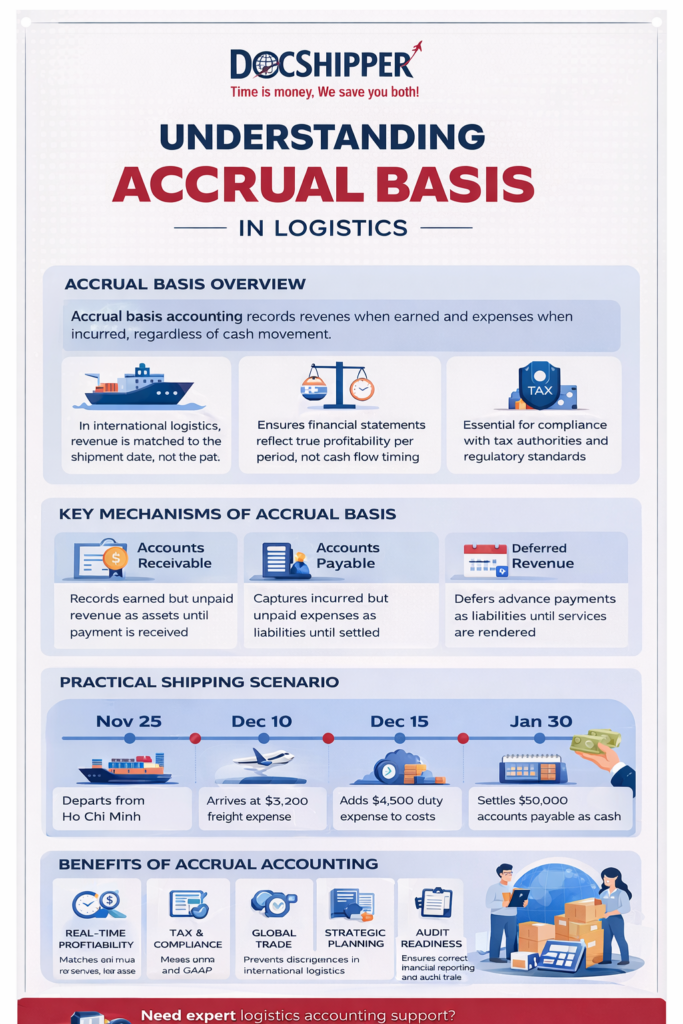
Accrual basis is an accounting method that records revenues when earned and expenses when incurred, regardless of cash movement. This approach provides accurate financial visibility by matching income with corresponding costs during the same period, essential for international logistics operations.
Introduction
Many importers struggle to understand why their bank balance differs from reported profits. This confusion stems from mixing cash flow with actual business performance. In international trade, where shipments span weeks and payment terms extend months, timing discrepancies create financial blind spots.
The accrual basis method solves this by aligning revenue recognition with service delivery. When a container leaves Shanghai, the transaction is recorded immediately—not when payment arrives 60 days later. This precision matters critically for customs compliance, tax reporting, and strategic planning.
- Revenue recognition occurs when goods ship or services complete
- Expenses match the period they support, not payment dates
- Financial statements reflect economic reality, not cash timing
- Mandatory for companies exceeding regulatory thresholds in most jurisdictions
- Enables accurate profitability analysis per shipment or client
Technical Framework & Regulatory Context
The matching principle forms the foundation of accrual accounting. Revenue from a December shipment appears in December’s books, even if the client pays in February. Simultaneously, freight charges, customs duties, and warehouse fees for that shipment are recorded in December—creating an accurate profit picture.
Under IFRS (International Financial Reporting Standards) and GAAP (Generally Accepted Accounting Principles), accrual basis is mandatory for publicly traded companies and most medium-to-large enterprises. The IAS 1 standard specifically requires accrual accounting except for cash flow statements.
Three core mechanisms drive this method:
Accounts Receivable tracks earned but unpaid revenue. When DocShipper completes a customs clearance service, we record the invoice immediately as receivable, providing real-time visibility into outstanding client obligations regardless of payment schedules.
Accounts Payable captures incurred but unpaid expenses. Container detention fees accrued during transit appear as liabilities when incurred, not when the shipping line invoices weeks later. This prevents artificial profit inflation during high-activity periods.
Deferred Revenue handles advance payments. A client prepaying for three months of warehousing creates a liability, not immediate income. Revenue recognition occurs monthly as services are delivered, ensuring compliance with revenue recognition standards like IFRS 15.
Regulatory implications extend beyond accounting standards. Tax authorities in most countries require accrual reporting for VAT calculations and corporate income tax. The timing differences between cash and accrual methods can shift tax liabilities between fiscal years, making proper implementation essential for compliance.
Practical Applications & Data Examples
Consider a textile importer ordering $50,000 worth of fabric from Vietnam in November. The shipment departs November 25, arrives December 10, clears customs December 15, and payment occurs January 30. Under accrual basis, the transaction timeline looks like this:
| Date | Event | Accounting Entry | Impact |
|---|---|---|---|
| Nov 25 | Goods ship from Ho Chi Minh | Inventory +$50,000 / Payable +$50,000 | Asset and liability recorded |
| Dec 10 | Arrival at destination port | Freight expense +$3,200 | December P&L reflects cost |
| Dec 15 | Customs clearance completed | Duty expense +$4,500 | Full landed cost established |
| Jan 30 | Payment to supplier | Payable -$50,000 / Cash -$50,000 | No P&L impact—liability settled |
This example demonstrates how accrual timing creates accurate monthly financial statements. December shows the true cost of goods and services consumed, while January reflects only cash movement. Without accrual accounting, December would appear artificially profitable, and January would show a false loss.
Use Case: Freight Forwarder Operations
A freight forwarder handles 200 shipments monthly with an average value of $8,000 per shipment. Payment terms average 45 days. On December 31, the company has:
- Completed services worth $1,600,000 (200 shipments × $8,000)
- Received cash payments of $1,120,000 (140 shipments from prior months)
- Outstanding receivables of $480,000 (60 current shipments unpaid)
- Incurred carrier costs of $1,200,000 (paid and unpaid combined)
Under cash basis, December revenue appears as $1,120,000 with distorted profitability. Under accrual basis, December shows $1,600,000 revenue matched against $1,200,000 costs—revealing the true $400,000 gross margin and 25% profit margin.
At DocShipper, we implement accrual accounting across all service lines to provide clients with transparent cost breakdowns. When we arrange a multimodal shipment involving ocean freight, trucking, and warehousing, each component is recorded when the service occurs—not when invoices are issued or paid. This approach enables precise project profitability analysis and supports informed decision-making for repeat shipments.
Conclusion
Accrual basis accounting transforms financial visibility in international logistics by aligning revenue and expenses with actual business activity. This method provides the accuracy essential for regulatory compliance, strategic planning, and operational efficiency in global trade.
Need expert guidance on financial management for your import/export operations? Contact DocShipper for comprehensive logistics and compliance support.
DocShipper Platform
Cut logistics costs. Not corners.
See exactly where your logistics costs are bleeding — and how to fix it. Book your expert demo.

📚 Quiz
Test Your Knowledge: Accrual Basis
Q1 — What is the core principle of accrual basis accounting?
Q2 — A client prepays for three months of warehousing services. Under accrual basis, how should this payment be initially recorded?
Q3 — A freight forwarder completes $1,600,000 worth of services in December but has only received $1,120,000 in cash payments. What does accrual basis report as December revenue?
🎯 Your Result
📞 Free Quote in 24hFAQ | Accrual Basis: Definition, Calculation & Practical Examples
Accrual basis records transactions when they occur, while cash basis records them when money changes hands. Accrual provides accurate period performance; cash basis shows liquidity position.
Most jurisdictions require accrual accounting for companies exceeding revenue thresholds (typically $1-5 million annually), publicly traded firms, and businesses with inventory. Tax regulations often mandate accrual for VAT-registered entities.
Customs duties are recorded as expenses when goods clear customs, not when duties are paid. This timing aligns duty costs with inventory acquisition, providing accurate landed cost calculations for pricing decisions.
Small businesses below regulatory thresholds may use cash basis for simplicity. However, accrual basis provides better financial insights for operations with extended payment terms or significant receivables, even when not mandatory.
Prepaid freight creates a current asset (prepaid expense) when paid. The expense is recognized when the shipment occurs or services are consumed, matching costs with the periods they benefit.
Accrued expenses related to cancelled shipments are reversed or adjusted. If cancellation fees apply, those are recorded as actual expenses. Proper documentation ensures accurate financial reporting of the cancellation impact.
Accrual timing can shift taxable income between fiscal years compared to cash basis. Revenue earned in December but paid in January appears in different tax years, affecting quarterly tax payments and year-end planning.
Under accrual accounting, demurrage charges are recorded daily as they accrue during container detention, not when the shipping line issues an invoice. This provides real-time visibility into mounting costs.
Commission revenue is recognized when the underlying service completes—typically when goods are delivered or cleared customs. This matches revenue recognition with the earning process, regardless of payment timing from carriers or clients.
Yes. Accrual basis matches all route-specific costs (freight, handling, duties, delays) with corresponding revenue in the same period, revealing true profitability per lane. This enables data-driven decisions about route optimization and pricing adjustments.
Enterprise systems like SAP, Oracle, and specialized freight software (Cargowise, Magaya) automate accrual entries. QuickBooks and Xero serve smaller operations. Integration with customs and carrier systems ensures accurate, timely transaction recording.
Revenue and expenses are recorded at the exchange rate on the transaction date. Subsequent currency movements create unrealized gains or losses on receivables/payables, recognized when positions settle or at period-end through revaluation entries.
Need Help with
Logistics or Sourcing ?
First, we secure the right products from the right suppliers at the right price by managing the sourcing process from start to finish. Then, we simplify your shipping experience - from pickup to final delivery - ensuring any product, anywhere, is delivered at highly competitive prices.


Fill the Form
Prefer email? Send us your inquiry, and we’ll get back to you as soon as possible.
Contact us