
In short ⚡
Advanced Planning and Scheduling (APS) is a software-based system that optimizes production planning, resource allocation, and delivery scheduling across the entire supply chain. It uses real-time data and complex algorithms to synchronize demand forecasting, inventory management, and manufacturing capacity, ensuring maximum efficiency while minimizing costs and delays.Introduction
Many logistics managers struggle with production delays, inventory bottlenecks, and missed delivery windows. Traditional planning methods often fail to adapt to real-time disruptions or market fluctuations. This is where Advanced Planning and Scheduling becomes critical.
APS systems bridge the gap between strategic planning and operational execution. They enable businesses to respond dynamically to changes in demand, supply constraints, or transportation issues. In international trade and import/export operations, this capability directly impacts customer satisfaction and profitability.
- Real-time synchronization between demand forecasts and production capacity
- Multi-site coordination across global manufacturing and distribution networks
- Constraint-based optimization considering materials, labor, equipment, and transportation
- What-if scenario modeling for risk assessment and contingency planning
- Integration capabilities with ERP, WMS, and TMS systems for seamless data flow
In-Depth Understanding & Technical Expertise
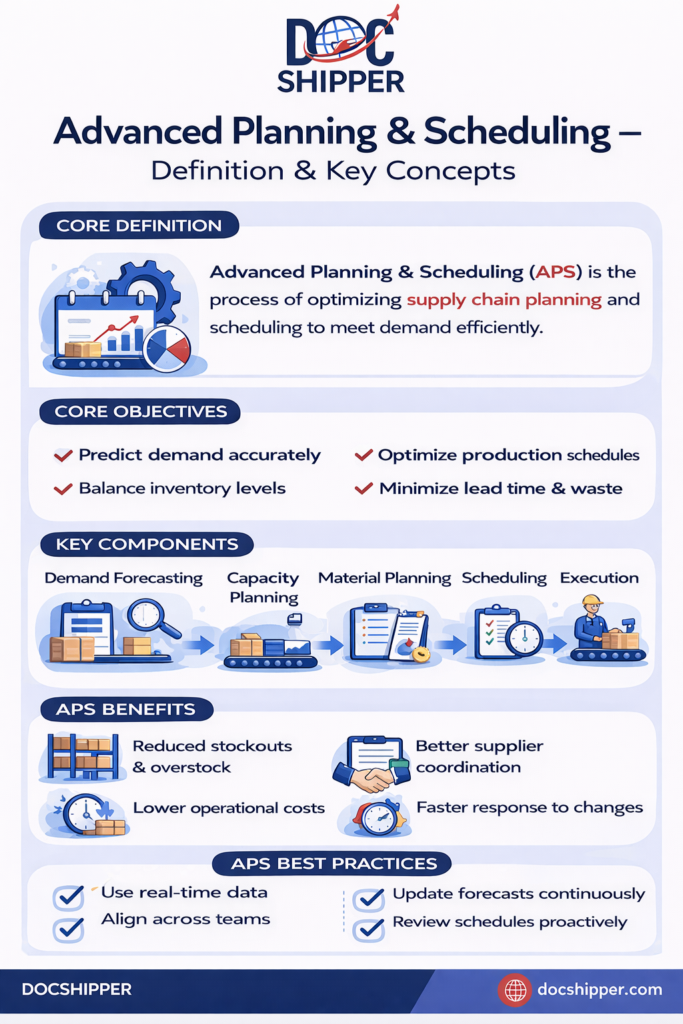
APS systems operate through several interconnected modules that work together to create an optimized plan. The demand planning module analyzes historical data, market trends, and sales forecasts to predict future requirements. This feeds into the master production scheduling component, which determines what to produce, when, and in what quantities.
The material requirements planning (MRP) function calculates raw material needs based on production schedules, while the capacity planning module ensures that manufacturing resources can meet demand without overloading equipment or labor. Finally, the scheduling engine assigns specific tasks to machines and personnel, considering constraints like setup times, maintenance windows, and shift patterns.
From a regulatory perspective, APS systems help companies comply with international trade requirements. According to World Trade Organization guidelines, accurate production and delivery scheduling is essential for meeting customs deadlines and avoiding penalties. The system tracks lead times, documents production dates, and generates compliance reports automatically.
The mathematical foundation of APS relies on linear programming, constraint satisfaction algorithms, and heuristic optimization techniques. These methods evaluate millions of possible scheduling combinations to find the most efficient solution. The system considers variables like transportation costs, inventory holding expenses, overtime rates, and penalty fees for late deliveries.
At DocShipper, we integrate APS data into our logistics coordination process to ensure that shipments align perfectly with production schedules, eliminating warehouse congestion and reducing demurrage charges.
A critical distinction exists between APS and traditional ERP systems. While ERP manages transactional data and business processes, APS focuses specifically on optimization and constraint resolution. Modern implementations often combine both, with APS providing the planning intelligence and ERP handling execution and documentation.
Concrete Examples & Performance Data
Industry benchmarks demonstrate the tangible impact of APS implementation. Companies typically experience significant improvements across multiple performance indicators within the first year of deployment.
| Performance Metric | Before APS | After APS | Improvement |
|---|---|---|---|
| On-Time Delivery Rate | 72% | 94% | +22% |
| Inventory Turnover Ratio | 4.2 | 6.8 | +62% |
| Production Lead Time | 18 days | 11 days | -39% |
| Planning Cycle Time | 5 days | 4 hours | -97% |
| Excess Inventory Costs | $2.4M/year | $0.9M/year | -63% |
Use Case: Automotive Parts Manufacturer
A European automotive supplier with three production facilities implemented APS to coordinate component manufacturing for just-in-time delivery to assembly plants. The system integrated demand signals from five major automakers, synchronized production across facilities in Germany, Poland, and Spain, and optimized transportation routing.
Results after 12 months: stockouts reduced by 81%, emergency freight costs decreased by $1.2M annually, and production capacity utilization improved from 68% to 89%. The company avoided €450,000 in late delivery penalties and reduced safety stock requirements by 35%.
Key Implementation Factors:
- Data quality: APS effectiveness depends on accurate master data for lead times, capacities, and bill of materials
- Change management: Teams require training to interpret APS recommendations and override when necessary
- System integration: Seamless data exchange with existing ERP, MES, and logistics platforms is essential
- Continuous calibration: Algorithms need regular tuning based on actual performance versus planned outcomes
- Scalability considerations: Cloud-based APS solutions offer flexibility for growing operations and seasonal demand fluctuations
DocShipper Platform
Optimize Your Global Logistics with Cutting-Edge Solutions
Enhance efficiency, cut costs, and gain 24/7 visibility 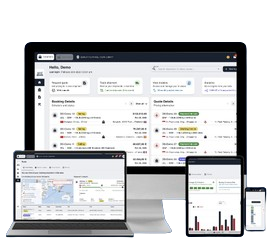 over your entire supply chain.
- Cut your shipping costs and maximize your margins
- Manage sourcing, freight, & customs on one platform
- Get real-time tracking and analytics
Conclusion
Advanced Planning and Scheduling represents a fundamental shift from reactive to proactive supply chain management. By leveraging real-time data and sophisticated optimization algorithms, APS enables companies to meet customer commitments while controlling costs and maximizing resource efficiency.
Need expert guidance on integrating APS with your international logistics operations? Contact DocShipper for personalized consultation on optimizing your supply chain planning.
📚 Quiz
Test Your Knowledge: Advanced Planning and Scheduling (APS)
Q1 — What is the primary purpose of an Advanced Planning and Scheduling (APS) system?
Q2 — A common misconception is that APS systems replace human planners entirely. What is the correct interpretation?
Q3 — A European automotive supplier implements APS across three production facilities. Which outcome best reflects a realistic APS-driven improvement?
🎯 Your Result
📞 Free Quote in 24hFAQ | Advanced Planning and Scheduling (APS): Definition, Calculation & Concrete Examples
ERP systems manage transactional data and business processes, while APS focuses specifically on optimization, constraint resolution, and predictive planning using advanced algorithms to create feasible schedules.
Implementation duration varies from 3 to 12 months depending on company size, system complexity, and integration requirements. Phased rollouts starting with pilot facilities often yield faster value realization.
Yes, cloud-based APS solutions now offer scalable options for SMEs. Companies with multiple production constraints, variable demand, or complex product portfolios see significant benefits regardless of size.
Essential inputs include demand forecasts, bill of materials, routing information, resource capacities, inventory levels, supplier lead times, transportation schedules, and constraint parameters like setup times and maintenance windows.
Modern APS systems feature dynamic replanning capabilities that automatically recalculate schedules when disruptions occur. Users can run what-if scenarios to evaluate alternative responses before committing to changes.
Most organizations achieve positive ROI within 12 to 18 months through reduced inventory costs, improved on-time delivery, lower expediting expenses, and better capacity utilization. Complex implementations may require 24 months.
No, APS augments human decision-making rather than replacing it. Planners focus on strategic decisions, exception management, and validating system recommendations while APS handles computational complexity and routine optimization.
APS coordinates multi-site production, synchronizes with global transportation schedules, accounts for customs clearance times, manages currency and regulatory variations, and optimizes inventory positioning across international distribution networks.
Manufacturing sectors with complex production processes see maximum benefit: automotive, aerospace, electronics, pharmaceuticals, consumer goods, and food processing. Any industry with capacity constraints and variable demand gains advantages.
Yes, modern APS platforms offer standard integration protocols with WMS, TMS, and MES systems. Real-time data exchange ensures that production schedules align with warehouse capacity and transportation availability.
Common obstacles include data quality issues, resistance to process changes, inadequate training, unrealistic expectations about automation capabilities, and insufficient executive sponsorship. Successful implementations address these proactively through change management programs.
Planning frequency depends on demand volatility and production cycle times. High-volume operations may replan daily or even hourly, while make-to-order environments might update weekly. Most systems support both scheduled and event-triggered replanning.
Need Help with
Logistics or Sourcing ?
First, we secure the right products from the right suppliers at the right price by managing the sourcing process from start to finish. Then, we simplify your shipping experience - from pickup to final delivery - ensuring any product, anywhere, is delivered at highly competitive prices.


Fill the Form
Prefer email? Send us your inquiry, and we’ll get back to you as soon as possible.
Contact us