


In short ⚡
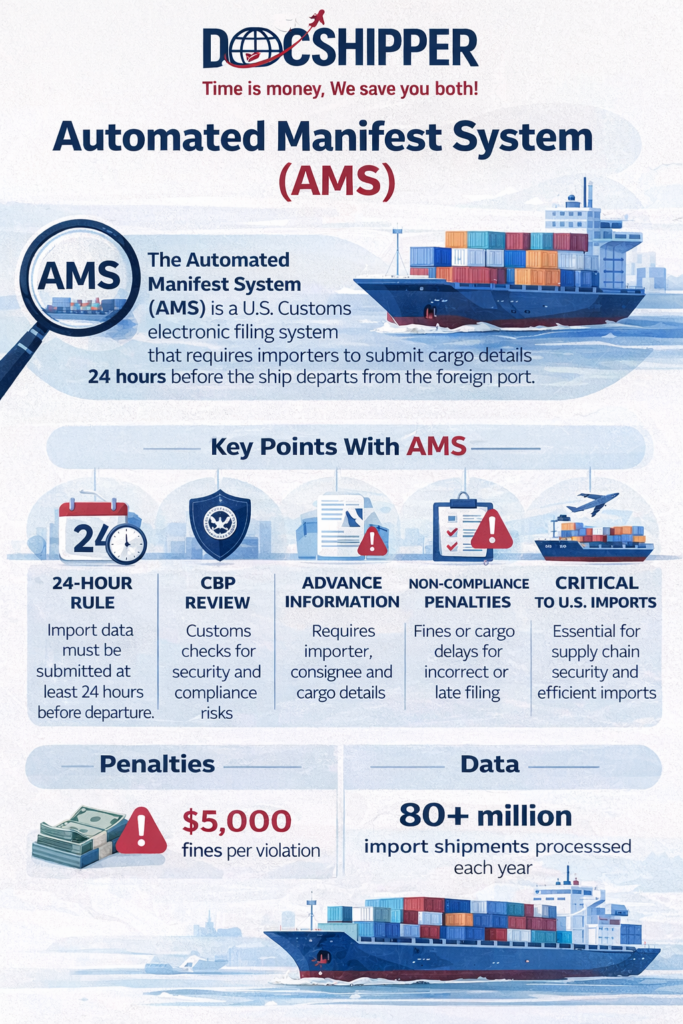
AMS (Automated Manifest System) is a U.S. Customs and Border Protection electronic system requiring carriers and freight forwarders to transmit detailed cargo information 24 hours before vessel loading. This pre-arrival screening mechanism enables CBP to assess security risks and expedite customs clearance for compliant shipments entering American ports.Introduction
Many importers discover AMS compliance issues only when their cargo faces unexpected port holds, resulting in demurrage charges exceeding thousands of dollars daily. This mandatory filing requirement represents a critical checkpoint in U.S.-bound international shipments, yet remains poorly understood outside specialized logistics circles.
The Automated Manifest System emerged from post-9/11 security legislation, transforming how cargo enters American territory. Every container, pallet, or parcel destined for U.S. ports must pass through this digital gateway before physical arrival.
Key characteristics of AMS filing include:
- 24-hour advance rule: Complete cargo details must reach CBP before vessel departure from foreign ports
- Multi-party responsibility: Ocean carriers, NVOCCs, and freight forwarders share filing obligations
- Granular data requirements: Shipper details, consignee information, commodity descriptions, and HS codes
- Automated risk assessment: CBP algorithms instantly flag high-risk shipments for inspection
- Penalty structure: Non-compliance triggers fines from $5,000 per violation plus cargo detention
Technical Requirements & Compliance Framework
The AMS operates through Automated Commercial Environment (ACE), CBP’s centralized trade processing platform. Carriers must obtain a Standard Carrier Alpha Code (SCAC) and establish electronic data interchange connections with CBP systems before transmitting manifests.
Filing requirements vary by transportation mode. Ocean shipments demand submission 24 hours pre-loading, while air cargo follows separate protocols under the Air Cargo Advance Screening (ACAS) program. Rail and truck shipments adhere to distinct timelines based on border crossing points.
The manifest must contain House Bill of Lading numbers linking master bills to individual shipments. Each entry requires precise commodity descriptions—generic terms like “general cargo” trigger automatic rejections. Harmonized System codes must match product descriptions exactly, as discrepancies activate inspection protocols.
ISF (Importer Security Filing) complements AMS by requiring importers to submit additional data elements 24 hours before loading. This “10+2” rule mandates manufacturer details, consolidator information, and container stuffing locations. At DocShipper, we synchronize AMS and ISF filings to ensure seamless compliance across both regulatory frameworks.
CBP employs Automated Targeting System (ATS) algorithms analyzing AMS data against intelligence databases. Shipments matching risk parameters receive “Do Not Load” instructions or mandatory examination orders. The system cross-references shipper histories, trade patterns, and security watch lists within milliseconds of data receipt.
Official regulations governing AMS appear in 19 CFR Part 4 and Part 113, administered by U.S. Customs and Border Protection under Department of Homeland Security authority.
Practical Examples & Data Analysis
Consider a textile importer shipping 500 cartons of cotton shirts from Bangladesh to Los Angeles. The ocean carrier files the AMS manifest 26 hours before vessel departure from Chittagong. The submission includes:
| Data Element | Required Information | Example Value |
|---|---|---|
| Shipper | Full legal name and address | Dhaka Textiles Ltd, 42 Export Zone, Chittagong |
| Consignee | IRS/EIN tax number mandatory | Fashion Retail Corp, EIN 95-1234567 |
| Commodity | Precise description with material composition | Men’s woven cotton shirts, 100% cotton, sizes M-XXL |
| HS Code | 6-digit minimum classification | 6205.20 (Cotton shirts, men’s) |
| Container | Equipment number and seal verification | MSCU1234567, Seal #789456 |
Cost implications: Late AMS filing generates $5,000 penalties per House Bill. A shipment with 20 house bills risks $100,000 in fines alone. Add demurrage charges averaging $150/container/day, and a 5-day delay costs $750 plus original penalties.
Processing timeline comparison:
- Compliant AMS filing: Cargo release within 2-4 hours of vessel arrival, direct delivery to consignee
- Missing/incorrect AMS: 3-7 day holds for data correction, physical examination, $2,500-$15,000 total delay costs
- High-risk flagging: 100% container inspection, 10-14 day clearance, potential shipment refusal
Real-world scenario: An electronics importer saved $47,000 annually by implementing automated AMS validation. Their previous manual process averaged 12% error rates, causing 8 shipment holds per year. DocShipper’s pre-filing verification system reduced errors to 0.3%, eliminating detention charges and preserving customer delivery commitments.
Industry data reveals: CBP processes 11 million ocean containers annually through AMS. Approximately 3.2% receive examination orders, with average inspection duration of 4.7 days. Compliant filers experience 89% lower examination rates compared to frequent violators.
Conclusion
AMS compliance represents non-negotiable infrastructure for U.S. import operations, directly impacting delivery timelines and operational costs. Mastering this system transforms potential regulatory obstacles into competitive advantages through predictable cargo flow.
Need expert guidance on AMS filing procedures or integrated customs solutions? Contact DocShipper for comprehensive trade compliance management tailored to your supply chain requirements.
📚 Quizz
Test Your Knowledge: AMS (Automated Manifest System)
Q1 — What is the primary purpose of the Automated Manifest System (AMS)?
Q2 — A shipment description listed as "general merchandise" is submitted in an AMS filing. What happens?
Q3 — An importer wants to file AMS directly with CBP to save on freight forwarder fees. Is this possible?
🎯 Your Result
📞 Free Quote in 24hFAQ | AMS (Automated Manifest System): Definition, Calculation & Concrete Examples
The carrier holds primary responsibility, but NVOCCs and freight forwarders filing on their behalf share liability. Importers must provide accurate cargo details to enable compliant submissions.
No. CBP requires complete manifests 24 hours before loading. Post-departure filings trigger automatic penalties and cargo holds regardless of circumstances.
Minor discrepancies may allow conditional release with post-entry corrections. Significant errors mandate cargo examination, delaying clearance by 3-10 days while corrections process.
Air cargo follows separate ACAS (Air Cargo Advance Screening) protocols, though principles remain similar. Ocean-specific AMS requirements don't directly apply to airfreight.
AMS is carrier-submitted manifest data; ISF is importer-submitted security information. Both are mandatory, with ISF providing additional supply chain visibility beyond AMS scope.
Typically no. Carriers and licensed freight forwarders possess technical infrastructure and SCAC codes required for direct CBP system access. Importers provide data to these intermediaries.
The AMS filing confirmation number (also called "Automated Manifest Number") serves as proof. Carriers provide this reference upon successful CBP transmission acceptance.
Yes. Each House Bill within consolidated containers needs individual AMS filing. The master bill covers the container, while house bills detail individual shipper cargo.
CBP maintains AMS records for 5 years as part of trade enforcement and audit capabilities. This data feeds risk assessment algorithms for future shipment evaluations.
Repeated violations establish negative compliance history, increasing examination rates and potentially triggering continuous bond requirements or import license restrictions.
Generic terms like "freight all kinds," "general merchandise," or "samples" cause system rejections. CBP requires specific material descriptions matching HS code classifications.
Yes. Even cargo destined for Canada or Mexico transiting U.S. territory requires AMS filing. Transit manifests follow modified protocols but remain mandatory for security screening.
Need Help with Logistics or Sourcing ?
First, we secure the right products from the right suppliers at the right price by managing the sourcing process from start to finish. Then, we simplify your shipping experience - from pickup to final delivery - ensuring any product, anywhere, is delivered at highly competitive prices.


Fill the Form
Prefer email? Send us your inquiry, and we’ll get back to you as soon as possible.
Contact us


:%20Definition%20&%20Guide%20for%202026)