In short ⚡
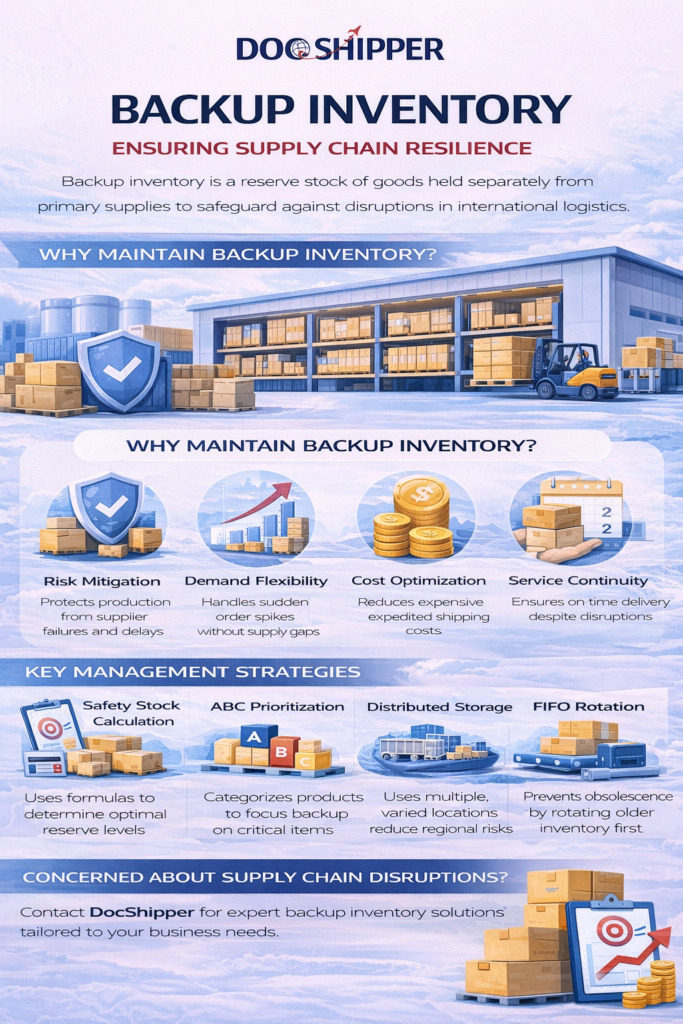
Backup inventory is a strategic reserve of goods maintained separately from primary stock to ensure business continuity during supply chain disruptions, demand spikes, or unexpected delays. It serves as a critical safety buffer in international logistics operations.
Introduction
Many businesses face devastating losses when primary suppliers fail or transportation routes become blocked. The absence of proper contingency stock can halt production lines, damage customer relationships, and erode market share.
Backup inventory addresses this vulnerability by creating a controlled redundancy system. In global trade, where lead times span weeks or months, this reserve stock becomes essential for operational resilience.
- Risk mitigation: Protection against supplier failures, port congestion, and customs delays
- Demand flexibility: Capacity to handle unexpected order surges without production interruption
- Cost optimization: Reduction of expedited shipping expenses during emergencies
- Service continuity: Maintenance of delivery commitments despite supply chain volatility
- Strategic positioning: Competitive advantage through reliable availability
Strategic Management & Best Practices
Effective backup inventory management requires balancing protection against capital immobilization. The calculation methodology depends on industry volatility, product lifecycle, and supply chain complexity.
The safety stock formula provides a mathematical foundation: Safety Stock = (Maximum Daily Usage × Maximum Lead Time) – (Average Daily Usage × Average Lead Time). This calculation must incorporate demand variability and supplier reliability metrics.
ABC classification determines which items warrant backup stock. Category A products (high value, low volume) require minimal reserves. Category C items (low value, high volume) justify larger buffers due to their operational criticality and lower holding costs.
The storage location strategy significantly impacts effectiveness. Geographic diversification across multiple warehouses reduces regional risk exposure. Climate-controlled facilities protect sensitive goods. Proximity to production centers minimizes emergency deployment time.
Rotation protocols prevent obsolescence. First-In-First-Out (FIFO) systems ensure backup stock remains fresh. Regular audits identify slow-moving items for liquidation. Integration with primary inventory systems maintains real-time visibility.
At DocShipper, we implement automated backup inventory triggers within our warehouse management systems, ensuring clients maintain optimal reserve levels without manual intervention. Our WTO Trade Facilitation Agreement compliance protocols guarantee backup stock readiness for cross-border deployment.
Practical Examples & Data Analysis
Real-world application demonstrates how backup inventory transforms supply chain resilience. The following scenarios illustrate calculation methods and financial impacts.
Use Case: Electronics Manufacturer
A European electronics company imports microchips from Taiwan. Average monthly consumption: 50,000 units. Standard lead time: 45 days. Supplier reliability: 85%.
Calculation: Maximum consumption = 50,000 × 1.3 (demand spike factor) = 65,000 units. Maximum lead time = 45 × 1.4 (delay factor) = 63 days. Backup inventory = (65,000 ÷ 30 × 63) – (50,000 ÷ 30 × 45) = 136,500 – 75,000 = 61,500 units.
Result: Maintaining 61,500 units prevented a €2.3M production halt during the 2021 semiconductor shortage. Storage cost: €18,000/month. ROI: 12,700% during crisis period.
Comparative Analysis: Backup Inventory Strategies
| Strategy Type | Holding Cost | Risk Coverage | Best For |
|---|---|---|---|
| Centralized Reserve | Low (15-20% annual) | Medium (60-70%) | Stable demand, predictable logistics |
| Distributed Network | High (25-35% annual) | High (85-95%) | Volatile markets, perishable goods |
| Vendor-Managed | Minimal (5-10% annual) | Variable (40-80%) | Strong supplier partnerships |
| Just-In-Case (JIC) | Very High (30-45% annual) | Maximum (95-99%) | Critical components, single-source items |
DocShipper Platform
Cut logistics costs. Not corners.
See exactly where your logistics costs are bleeding — and how to fix it. Book your expert demo.

Key Performance Metrics
- Inventory turnover ratio: Backup stock should rotate 2-4 times annually to avoid obsolescence
- Service level achievement: Target 95-99% order fulfillment during disruptions
- Carrying cost percentage: Optimal range 18-28% of inventory value annually
- Stockout prevention rate: Measure incidents avoided versus total potential disruptions
- Emergency deployment time: Benchmark 24-72 hours from activation to production line
DocShipper clients utilizing our backup inventory services report average disruption cost reductions of 67% and service level improvements of 23 percentage points compared to reactive procurement strategies.
Conclusion
Backup inventory represents insurance against supply chain uncertainty. Strategic reserves convert potential catastrophic failures into manageable operational adjustments, preserving revenue streams and customer trust.
Need expert guidance on optimizing your backup inventory strategy? Contact DocShipper for customized logistics solutions tailored to your industry requirements.
📚 Quiz
Test Your Knowledge: Backup Inventory
Q1 — What is the primary purpose of backup inventory in international logistics?
Q2 — How does backup inventory differ from safety stock?
Q3 — A company sources critical components from a single overseas supplier with a 45-day lead time and 85% reliability. Which backup inventory strategy is most appropriate?
🎯 Your Result
📞 Free Quote in 24hFAQ | Backup Inventory: Definition, Management & Practical Examples
Typically 10-30% of primary inventory, varying by industry volatility, product lifecycle, and supply chain reliability. High-risk sectors maintain larger reserves.
Safety stock addresses normal demand variability. Backup inventory covers catastrophic events like supplier bankruptcy, natural disasters, or geopolitical disruptions requiring extended alternative sourcing.
Yes. Many businesses use inventory financing, vendor consignment agreements, or dedicated credit facilities to fund backup stock without impacting operational capital.
Warehouse Management Systems (WMS), Enterprise Resource Planning (ERP) platforms, and IoT sensors enable real-time tracking, automated reordering, and predictive analytics for optimal reserve levels.
Quarterly physical counts minimum, with monthly cycle counts for high-value items. Continuous digital monitoring through RFID or barcode systems provides real-time accuracy.
Standard commercial property insurance covers backup stock, but extended coverage for obsolescence, spoilage, and market value decline may require additional riders or specialized policies.
Generally deductible as ordinary business expense. Consult tax professionals regarding depreciation schedules, write-off provisions, and jurisdiction-specific regulations affecting reserve stock valuation.
Bonded warehouses allow duty deferral until goods enter commerce. Free trade zones provide additional flexibility. Proper classification and documentation prevent clearance delays during emergency deployment.
Yes, with temperature-controlled storage and strict rotation protocols. Pharmaceutical, food, and chemical sectors commonly maintain climate-managed backup reserves with shortened shelf-life considerations.
Predefined thresholds: primary stock depletion below safety levels, supplier failure notifications, transportation disruptions exceeding 72 hours, or demand surges beyond forecasted capacity.
Initial capital outlay reduces liquidity but prevents catastrophic revenue loss. Proper management yields positive net present value through disruption cost avoidance exceeding holding expenses.
Depends on risk profile. Domestic storage offers faster deployment and regulatory simplicity. International positioning near manufacturing hubs reduces total landed costs but increases complexity.
Need Help with
Logistics or Sourcing ?
First, we secure the right products from the right suppliers at the right price by managing the sourcing process from start to finish. Then, we simplify your shipping experience - from pickup to final delivery - ensuring any product, anywhere, is delivered at highly competitive prices.


Fill the Form
Prefer email? Send us your inquiry, and we’ll get back to you as soon as possible.
Contact us