
In short ⚡
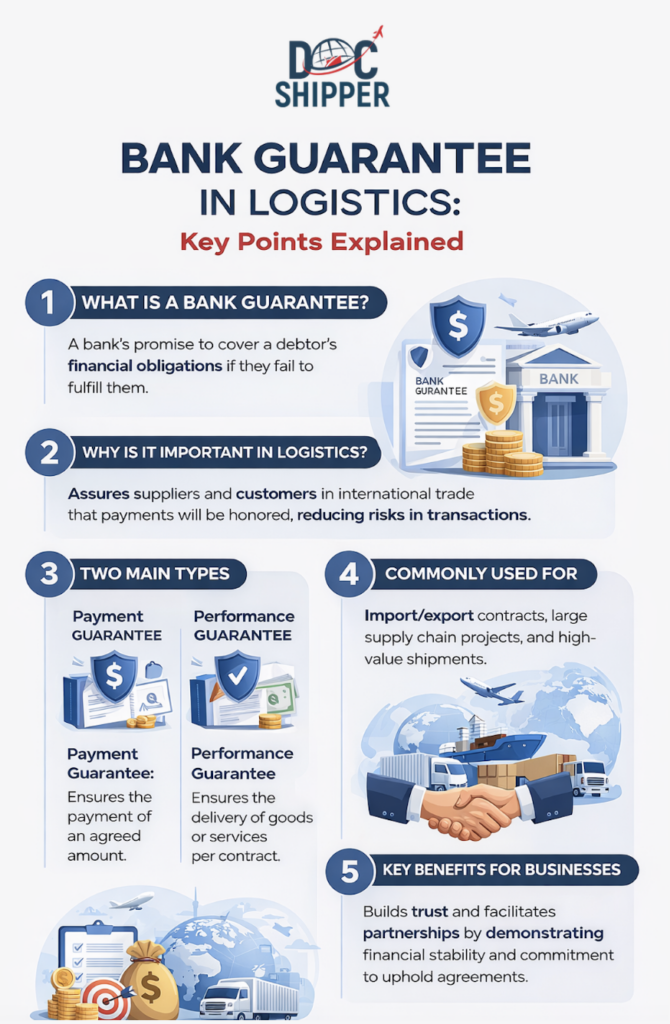
A Bank Guarantee is a financial commitment issued by a bank on behalf of its client, ensuring payment or performance to a beneficiary if the client defaults on contractual obligations. Widely used in international trade, it mitigates risk for exporters and importers by providing security against non-payment or non-performance, facilitating smoother cross-border transactions.
Introduction
In international logistics, payment security remains a critical concern. Buyers fear paying for goods never delivered, while sellers risk shipping products without receiving payment. This uncertainty can paralyze trade relationships and delay shipments.
The Bank Guarantee addresses this challenge by acting as a safety net. It ensures contractual obligations are met, protecting both parties in import-export operations. Understanding its mechanics is essential for anyone involved in global supply chains.
Key characteristics include:
- Third-party assurance: A bank commits to pay if the applicant defaults
- Risk mitigation: Reduces financial exposure for beneficiaries
- Contractual security: Ensures performance or payment obligations are honored
- Global acceptance: Recognized instrument in international trade law
- Versatile applications: Used in tenders, shipments, and project financing
Mechanisms & Types of Bank Guarantees
A Bank Guarantee functions through a tripartite relationship: the applicant (buyer/contractor), the beneficiary (seller/project owner), and the guarantor bank. When the applicant requests a guarantee, the bank evaluates creditworthiness before issuing the document. If the applicant fails to fulfill obligations, the beneficiary can claim payment directly from the bank.
Legal frameworks governing Bank Guarantees include the ICC Uniform Rules for Demand Guarantees (URDG 758), which standardize practices globally. These rules define claim procedures, validity periods, and documentation requirements.
Common types include:
Performance Guarantee: Ensures the applicant completes contractual obligations. If a contractor abandons a construction project, the beneficiary claims compensation to hire a replacement. Typically 10-20% of contract value.
Payment Guarantee: Secures payment obligations. Importers provide this to exporters, guaranteeing payment upon shipment delivery. At DocShipper, we verify these guarantees to ensure our clients’ transactions proceed without payment disputes.
Advance Payment Guarantee: Protects buyers who pay upfront. If the seller fails to deliver, the buyer recovers the advance. Common in manufacturing contracts where deposits are required.
Bid Bond Guarantee: Required in tender processes. Ensures bidders honor their proposals. If the winning bidder withdraws, the project owner receives compensation (usually 1-5% of bid value).
Shipping Guarantee: Allows cargo release without original Bills of Lading. Carriers accept bank guarantees when documents are delayed, preventing demurrage charges. DocShipper coordinates these guarantees to expedite customs clearance for time-sensitive shipments.
Practical Examples & Data
Understanding Bank Guarantees through real-world scenarios clarifies their application. The following examples demonstrate how these instruments function across different trade situations.
Comparative Analysis: Bank Guarantee vs. Letter of Credit
| Criteria | Bank Guarantee | Letter of Credit |
|---|---|---|
| Primary Function | Secondary payment method (backup) | Primary payment method |
| Activation | Only if applicant defaults | Automatic upon document compliance |
| Cost | 0.5-2% of guaranteed amount | 1-3% of transaction value |
| Documentation | Minimal (claim letter) | Extensive (shipping docs, invoices) |
| Best Use Case | Performance security, tenders | Direct payment for goods |
Use Case: Electronics Import from China
Scenario: A French retailer orders €500,000 worth of smartphones from a Shenzhen manufacturer. The supplier requires 30% advance payment (€150,000) before production.
Solution: The retailer’s bank issues an Advance Payment Guarantee covering €150,000. The supplier receives assurance that if production fails or goods aren’t shipped, they can claim the advance from the bank. Production commences immediately.
Outcome: Goods are manufactured and shipped within 45 days. The guarantee expires upon delivery confirmation. Total guarantee cost: €1,500 (1% of guaranteed amount). This represents 0.3% of total order value—a minimal expense for significant risk mitigation.
DocShipper Platform
Optimize Your Global Logistics with Cutting-Edge Solutions
Enhance efficiency, cut costs, and gain 24/7 visibility  over your entire supply chain.
- Cut your shipping costs and maximize your margins
- Manage sourcing, freight, & customs on one platform
- Get real-time tracking and analytics
Key Considerations for Effective Use
Validity Period: Align guarantee expiry with contract milestones. Standard periods range from 3 to 24 months. Extensions require applicant consent and additional fees.
Claim Procedures: Beneficiaries must submit claims before expiry. Under URDG 758, banks have 5 business days to process claims. Documentation requirements vary by guarantee type.
Cost Structure: Fees depend on applicant creditworthiness, guarantee amount, and duration. Banks may require collateral (typically 100-110% of guarantee value) for clients with limited credit history.
Jurisdictional Issues: Cross-border guarantees require careful legal review. Specify governing law and dispute resolution mechanisms in the guarantee text.
Unconditional vs. Conditional: Unconditional guarantees (demand guarantees) pay upon simple claim. Conditional guarantees require proof of default. International trade favors unconditional formats for faster resolution.
Conclusion
Bank Guarantees remain indispensable tools in international logistics, balancing risk between trading partners while enabling transactions that might otherwise stall. Their versatility across payment security, performance assurance, and tender processes makes them fundamental to global commerce.
Need expert guidance on securing Bank Guarantees for your import-export operations? Contact DocShipper for tailored solutions that protect your transactions and streamline your supply chain.
📚 Quiz
Test Your Knowledge: Bank Guarantee
1. What is the primary role of a Bank Guarantee in international trade?
2. A French importer pays €150,000 upfront to a Chinese manufacturer. The manufacturer fails to deliver the goods. Which type of Bank Guarantee would allow the importer to recover their advance payment?
3. A cargo shipment arrives at port but the original Bill of Lading is delayed in transit. Which Bank Guarantee instrument allows the importer to release the goods immediately and avoid demurrage charges?
🎯 Your Result
📞 Free Quote in 24hFAQ | Bank Guarantee: Definition, Types & Practical Examples
Both serve as payment security, but Bank Guarantees are governed by URDG 758, while Standby Letters of Credit follow UCP 600 rules. Bank Guarantees are more common in Europe and Asia, whereas Standby LCs dominate North American trade. Functionally, they operate similarly as backup payment mechanisms.
Processing time ranges from 3 to 10 business days, depending on the applicant's banking relationship and creditworthiness. Established clients with pre-approved credit facilities can receive guarantees within 24-48 hours. First-time applicants may require additional documentation and collateral assessment.
Most Bank Guarantees are non-transferable unless explicitly stated. Transferable guarantees require specific clauses allowing assignment to third parties. This feature is rare and typically increases issuance costs by 0.5-1% due to additional risk for the guarantor bank.
Beneficiaries remain protected through deposit insurance schemes (up to €100,000 in the EU) and interbank guarantee networks. For amounts exceeding insurance limits, beneficiaries may claim against the applicant directly. Choosing banks with strong credit ratings (AA- or higher) minimizes this risk.
Issuance fees are non-refundable, but banks may return collateral once the guarantee expires unused. Some banks offer partial fee refunds for early cancellation (typically 25-50% of remaining period fees), subject to beneficiary consent to release the guarantee.
Collateral requirements vary by creditworthiness. Established clients may secure guarantees with 10-30% cash margin. New clients typically provide 100-110% collateral through cash deposits, fixed deposits, or pledged securities. Alternative collateral includes property liens or inventory pledges.
Yes, multi-currency guarantees are standard in international trade. Banks issue guarantees in USD, EUR, GBP, CNY, and other major currencies. Currency selection should match the underlying contract to avoid exchange rate risks. Some banks charge 0.1-0.3% additional fees for non-domestic currency guarantees.
For unconditional guarantees, beneficiaries submit a written claim stating the applicant's default, along with the original guarantee document. Conditional guarantees require additional proof: independent surveyor reports, court judgments, or arbitration awards demonstrating breach of contract. Claims must be submitted before the guarantee expiry date.
Enforcement depends on local laws and international conventions. Countries adhering to URDG 758 or the UN Convention on Independent Guarantees provide strong legal frameworks. Always specify governing law and arbitration clauses in the guarantee text. Legal review is essential for transactions involving countries with underdeveloped commercial law systems.
Extensions are possible with applicant consent and additional fees (typically 0.25-0.5% per extended quarter). The beneficiary must agree to the extension terms. Automatic extension clauses can be included at issuance, triggering renewal unless either party objects 30 days before expiry.
No regulatory maximum exists, but practical limits depend on the issuing bank's capital and risk appetite. Guarantees exceeding €10 million often involve syndication, where multiple banks share the risk. Small businesses typically access guarantees up to €500,000 through standard banking relationships.
A Shipping Guarantee specifically allows cargo release without original Bills of Lading. It indemnifies carriers against claims from lawful B/L holders. Validity is typically 30-90 days, covering the period until original documents arrive. This instrument is crucial for avoiding demurrage charges when documents are delayed in transit.
Need Help with
Logistics or Sourcing ?
First, we secure the right products from the right suppliers at the right price by managing the sourcing process from start to finish. Then, we simplify your shipping experience - from pickup to final delivery - ensuring any product, anywhere, is delivered at highly competitive prices.


Fill the Form
Prefer email? Send us your inquiry, and we’ll get back to you as soon as possible.
Contact us