In short ⚡
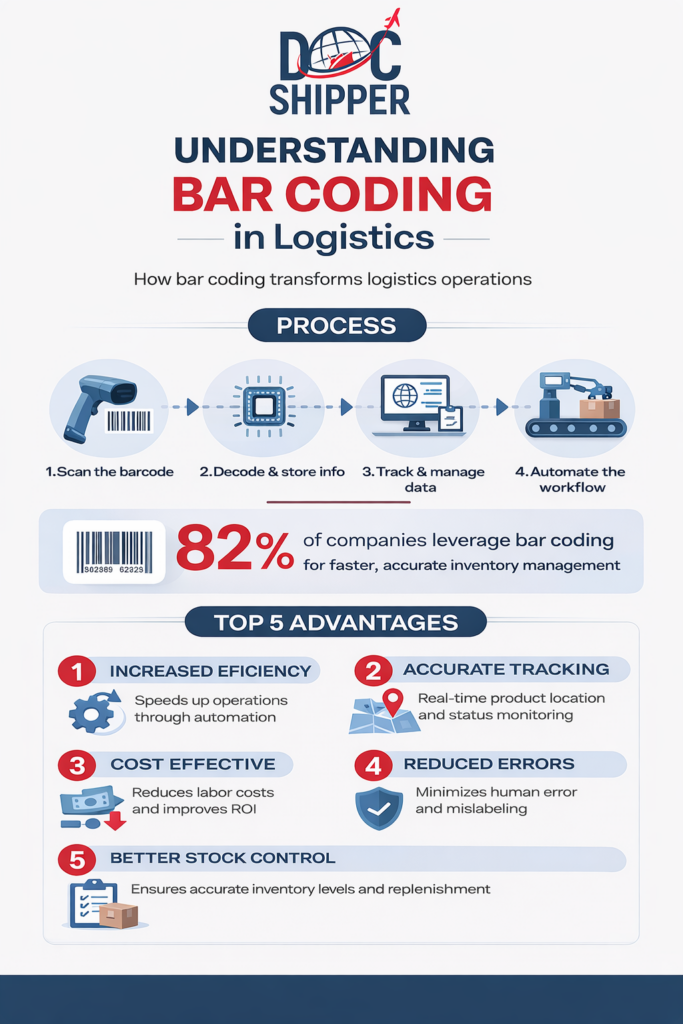
Bar coding is an automated identification system using parallel lines of varying widths to encode product data, enabling rapid scanning and tracking throughout the supply chain. This technology revolutionizes inventory management, shipment verification, and customs clearance in international logistics.Introduction
How can a simple pattern of lines transform global trade efficiency? Many importers underestimate the critical role of proper bar coding in preventing shipment delays, customs rejections, and inventory errors. In modern logistics, bar codes serve as the universal language connecting manufacturers, freight forwarders, customs authorities, and retailers.
Bar coding has become indispensable in international freight operations, where accuracy directly impacts delivery timelines and cost control. From warehouse receiving to final mile delivery, these encoded identifiers ensure traceability and compliance across borders.
- Universal standardization: GS1 standards enable global interoperability across 150+ countries
- Error reduction: Scanning accuracy reaches 99.9%, compared to 2-5% human data entry error rates
- Speed optimization: Barcode scanning processes information 5-7 times faster than manual entry
- Regulatory compliance: Required by customs authorities in most developed markets for commercial shipments
- Cost efficiency: Reduces labor costs by up to 40% in warehouse operations
Technical Standards & Expertise
The foundation of effective bar coding lies in understanding the various symbologies and their specific applications. Linear barcodes (1D) encode data horizontally, while 2D barcodes (like QR codes and Data Matrix) store information both horizontally and vertically, enabling significantly higher data capacity. For international shipping, the most common standards include UPC (Universal Product Code), EAN (European Article Number), and Code 128 for shipment tracking.
Customs authorities worldwide increasingly mandate GS1-compliant barcodes for commercial imports. The GS1 system provides unique identification through GTINs (Global Trade Item Numbers), ensuring each product has a distinct identifier recognized globally. According to GS1 standards, proper implementation requires registration with national GS1 organizations and adherence to specific formatting rules.
Print quality specifications directly affect scanning reliability. The ISO/IEC 15416 standard defines barcode quality grades from A (excellent) to F (failure). For logistics applications, a minimum grade of C is recommended, though grade B or higher ensures optimal performance across various scanning environments. Factors affecting quality include print resolution, contrast ratio, and substrate material.
In multi-modal transportation, SSCC barcodes (Serial Shipping Container Code) track pallets and containers throughout the supply chain. This 18-digit identifier links physical goods to electronic documentation, facilitating seamless handoffs between carriers, warehouses, and distribution centers. At DocShipper, we verify SSCC compliance during cargo preparation to prevent delays at transshipment points and customs checkpoints.
Mobile scanning technology has transformed field operations, enabling real-time data capture via smartphones and tablets. Modern warehouse management systems (WMS) integrate barcode scanning with cloud-based inventory platforms, providing instant visibility across global networks. This integration supports advanced features like batch tracking, expiration date management, and serial number verification—critical for pharmaceutical and food imports subject to strict traceability requirements.
Practical Applications & Data
Real-world implementation reveals the tangible impact of bar coding on logistics efficiency. Consider a typical container shipment from Shanghai to Rotterdam: proper bar coding reduces customs clearance time from 48 hours to under 6 hours by enabling automated document verification and risk assessment.
| Barcode Type | Data Capacity | Primary Use Case | Scanning Speed |
|---|---|---|---|
| UPC-A | 12 numeric digits | Retail product identification (North America) | 0.3 seconds |
| EAN-13 | 13 numeric digits | Global product identification | 0.3 seconds |
| Code 128 | Variable (alphanumeric) | Shipping labels, carton tracking | 0.4 seconds |
| QR Code | Up to 4,296 characters | Complex data, mobile scanning | 0.5 seconds |
| Data Matrix | Up to 2,335 characters | Small items, pharmaceuticals | 0.6 seconds |
Use Case: Electronics Import Optimization
A European electronics retailer importing 50,000 units monthly from Taiwan implemented GS1-128 barcodes on master cartons. Results after six months: receiving time decreased 62%, inventory accuracy improved from 94% to 99.7%, and customs processing costs dropped by €12,000 monthly. The investment in barcode printers and scanner infrastructure paid back within 4.2 months.
Industry data reveals compelling efficiency gains. According to logistics benchmarking studies, warehouses using integrated barcode systems achieve picking accuracy rates of 99.8% versus 92-95% for manual processes. For high-volume operations processing 10,000+ items daily, this translates to 200-800 fewer errors requiring costly corrections.
Customs compliance advantages are equally significant. EU customs regulations (Union Customs Code) increasingly require electronic pre-arrival data linked to physical cargo via barcodes. Non-compliant shipments face inspection rates 3-4 times higher than properly coded cargo. DocShipper ensures all client shipments meet destination country barcode requirements, reducing clearance delays by an average of 18 hours per container.
Temperature-sensitive cargo benefits particularly from advanced barcode integration. Pharmaceutical shipments using Data Matrix codes linked to IoT sensors enable real-time temperature monitoring throughout cold chain logistics. Regulatory bodies like the FDA and EMA recognize these systems as meeting serialization requirements under the Drug Supply Chain Security Act and Falsified Medicines Directive.
DocShipper Platform
Optimize Your Global Logistics with Cutting-Edge Solutions
Enhance efficiency, cut costs, and gain 24/7 visibility 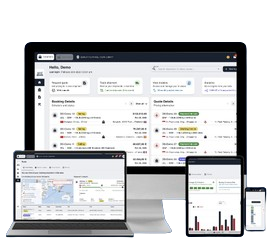 over your entire supply chain.
- Cut your shipping costs and maximize your margins
- Manage sourcing, freight, & customs on one platform
- Get real-time tracking and analytics
Conclusion
Bar coding represents far more than simple product labeling—it forms the digital backbone of modern supply chain visibility and control. Proper implementation delivers measurable improvements in accuracy, speed, and regulatory compliance across international logistics operations.
Need expert guidance on implementing barcode systems for your import/export operations? Contact DocShipper for tailored solutions that ensure compliance and optimize your supply chain efficiency.
📚 Quiz
Test Your Knowledge: Bar Coding
Q1 — What does bar coding primarily do in international logistics?
Q2 — A common misconception is that 2D barcodes (like QR codes) simply store the same data as 1D barcodes in a different shape. What is the correct interpretation?
Q3 — A pharmaceutical company is shipping temperature-sensitive medication internationally and needs to encode batch numbers, expiration dates, and product identifiers on small packaging. Which barcode format is the most appropriate choice?
🎯 Your Result
📞 Free Quote in 24hFAQ | Bar Coding: Definition, Application & Practical Examples
1D barcodes store data linearly (like UPC codes), holding limited information. 2D barcodes (QR codes, Data Matrix) encode data vertically and horizontally, storing up to 100 times more information including tracking numbers, batch codes, and expiration dates in a smaller space.
GS1 standards ensure global compatibility, but registration requirements vary. North American products typically use UPC codes, while international markets prefer EAN-13. Your GS1 company prefix determines which formats you can generate, making registration with your national GS1 organization essential.
Poor quality barcodes cause scanning failures, triggering manual processing and inspection delays. Customs authorities require minimum ISO grade C quality. Damaged or unreadable codes can result in shipment holds lasting 24-72 hours while documentation is manually verified.
Standard office printers work for low-volume needs but lack durability. Thermal transfer printers produce warehouse-grade labels resistant to moisture, abrasion, and temperature extremes. For international shipping, thermal printing ensures labels remain scannable throughout multi-week transit.
Amazon requires GS1-compliant UPC or EAN barcodes for product identification, plus Amazon-specific FNSKU labels for inventory tracking. FBA shipments also need box content labels with scannable codes linking cartons to shipment plans within Seller Central.
Modern TMS platforms link barcode scans to shipment milestones, updating status in real-time. Each scan (pickup, warehouse receipt, customs clearance, delivery) creates a digital timestamp, enabling precise ETAs and proactive exception management throughout the supply chain.
RFID complements rather than replaces barcodes. While RFID enables bulk scanning without line-of-sight, barcodes remain more cost-effective for most applications. Hybrid systems use barcodes for item-level tracking and RFID for pallet/container monitoring in high-value shipments.
Serial Shipping Container Code (SSCC) is an 18-digit barcode identifying pallets and containers. It's mandatory for EDI transactions with major retailers (Walmart, Carrefour, Tesco) and recommended for all LTL/FCL shipments to enable automated receiving and cross-docking.
Use GS1 verification tools or professional barcode verifiers measuring parameters like quiet zones, contrast, and modulation. Many freight forwarders offer pre-shipment audits. DocShipper includes barcode verification in our quality control services to prevent costly clearance delays.
Partial damage may still allow scanning if core data areas remain intact. However, customs authorities typically reject shipments with unreadable codes, requiring new labels before clearance. Protective lamination or clear tape over printed codes significantly reduces damage risk during handling.
Entry-level setups (thermal printer, scanner, software) start around $800-1,500. Enterprise WMS integration ranges from $5,000-50,000 depending on complexity. Most businesses achieve ROI within 6-12 months through reduced errors and labor savings in receiving and inventory management.
GS1-128 barcodes are preferred for perishables, encoding production dates, batch numbers, and expiration dates alongside product identifiers. This enables automated FEFO (First Expired, First Out) inventory rotation and meets traceability requirements for food safety regulations like FSMA and EU Regulation 178/2002.
Need Help with
Logistics or Sourcing ?
First, we secure the right products from the right suppliers at the right price by managing the sourcing process from start to finish. Then, we simplify your shipping experience - from pickup to final delivery - ensuring any product, anywhere, is delivered at highly competitive prices.


Fill the Form
Prefer email? Send us your inquiry, and we’ll get back to you as soon as possible.
Contact us