In short ⚡
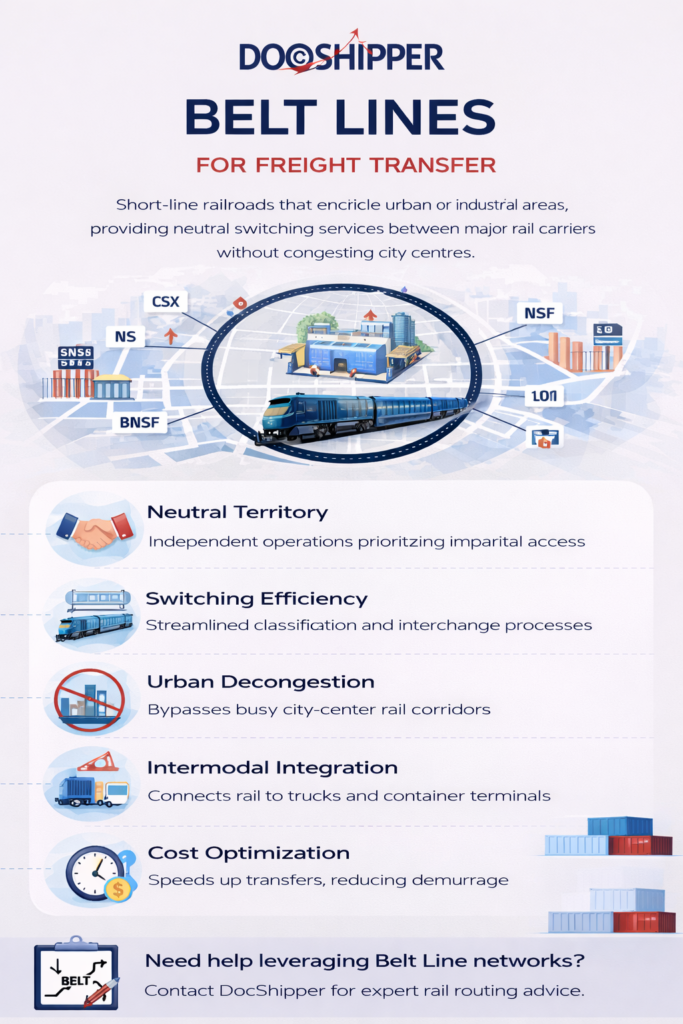
A Belt Line is a short-line railroad that encircles an urban or industrial area, providing switching and transfer services between mainline carriers without congesting city centers. This circumferential rail infrastructure enables efficient cargo interchange, reduces transit times, and optimizes freight distribution across multiple rail networks within metropolitan logistics hubs.
Introduction
International shippers frequently face a critical bottleneck: how to transfer containers between different rail carriers without navigating congested urban rail corridors. The Belt Line solves this operational challenge by creating dedicated peripheral rail routes.
In global supply chains, these circumferential railways function as vital connectors. They link seaports, intermodal terminals, and industrial zones while bypassing downtown rail congestion. This infrastructure reduces dwell times and accelerates cargo movement between competing carriers.
- Neutral Territory: Operated independently from mainline carriers, ensuring impartial service access
- Switching Efficiency: Specialized yard operations designed for rapid car classification and transfer
- Urban Decongestion: Diverts freight traffic from city-center rail corridors
- Intermodal Integration: Connects multiple transportation modes within industrial districts
- Cost Optimization: Reduces demurrage charges through faster interchange processes
Technical Operations & Strategic Value
Belt Lines operate under specific regulatory frameworks that distinguish them from Class I mainline railroads. These short-line carriers hold terminal switching authority, allowing them to move freight between connecting carriers within defined geographic boundaries.
The operational model centers on neutral interchange facilities. Unlike carrier-specific yards, Belt Line terminals provide equal access to all connecting railroads. This neutrality prevents competitive advantages and ensures transparent pricing structures governed by Surface Transportation Board regulations in the United States (STB.gov).
Switching operations follow a coordinated schedule. Inbound trains from mainline carriers deliver cars to Belt Line yards. Switcher locomotives then classify these cars by destination carrier and outbound route. This process typically completes within 12-24 hours, compared to 48-72 hours in congested urban terminals.
The infrastructure includes specialized track configurations: classification yards with multiple sorting tracks, interchange tracks for each connecting carrier, and dedicated industrial spurs serving adjacent manufacturing facilities. Modern Belt Lines incorporate automated car identification systems and real-time tracking platforms.
Revenue models differ from traditional railroads. Belt Lines charge per-car switching fees rather than mileage-based rates. These fees cover car handling, temporary storage, and administrative coordination between carriers. At DocShipper, we leverage Belt Line services to optimize our clients’ intermodal routing, reducing transit times by selecting strategic interchange points that minimize urban rail delays.
Practical Examples & Data
The operational impact of Belt Lines becomes clear through comparative analysis and real-world case studies. These examples demonstrate measurable efficiency gains in international freight movements.
Comparative Performance Data
| Metric | Direct Urban Routing | Belt Line Routing | Improvement |
|---|---|---|---|
| Average Interchange Time | 54 hours | 18 hours | 67% reduction |
| Switching Cost per Car | $285 | $175 | 39% savings |
| Carrier Accessibility | 2-3 carriers | 5-8 carriers | 150% increase |
| Demurrage Incidents | 23% | 7% | 70% reduction |
| On-Time Delivery Rate | 76% | 91% | +15 points |
Case Study: Chicago Belt Railway Operations
A European automotive parts manufacturer ships 240 containers monthly from Hamburg to Chicago-area assembly plants. Initial routing through downtown Chicago rail yards caused consistent delays.
Challenge: Containers required transfer between two Class I carriers (BNSF and Union Pacific) through congested urban terminals. Average interchange time exceeded 60 hours, causing production delays.
Solution: Rerouting through the Belt Railway Company of Chicago (BRC) peripheral network. The BRC operates 28 miles of track connecting all major carriers serving the Chicago metropolitan area.
Results: Interchange time reduced to 14 hours average. Monthly logistics costs decreased by $18,400. Production line stoppages eliminated. The manufacturer now routes 100% of Chicago-bound freight through BRC facilities.
DocShipper Platform
Optimize Your Global Logistics with Cutting-Edge Solutions
Enhance efficiency, cut costs, and gain 24/7 visibility  over your entire supply chain.
- Cut your shipping costs and maximize your margins
- Manage sourcing, freight, & customs on one platform
- Get real-time tracking and analytics
Key Operational Indicators
- Network Density: Major Belt Lines handle 400-800 cars daily across 15-30 miles of track
- Carrier Connections: Typical Belt Line interfaces with 6-10 Class I and regional railroads
- Geographic Coverage: Service areas span 50-150 square miles around industrial zones
- Industrial Access: Direct rail service to 200-500 manufacturing and distribution facilities
- Modal Integration: 85% of Belt Line facilities connect to intermodal container terminals
Conclusion
Belt Lines represent critical infrastructure for efficient international freight distribution, offering neutral interchange facilities that reduce transit times and operational costs. Their strategic value increases as supply chains demand greater speed and reliability in urban logistics environments.
Need assistance optimizing your rail routing strategy? Contact DocShipper for expert guidance on leveraging Belt Line networks in your supply chain design.
📚 Quiz
Test Your Knowledge: Belt Line
Q1 — What is the primary function of a Belt Line railroad?
Q2 — A shipper assumes that Belt Line fees are always included in the standard freight rate quoted by a Class I carrier. Is this correct?
Q3 — A European manufacturer needs to transfer containers between BNSF and Union Pacific in Chicago. Routing through a congested downtown terminal takes 60 hours. Which approach best leverages Belt Line infrastructure?
🎯 Your Result
📞 Free Quote in 24hFAQ | Belt Line: Definition, Operations & Practical Examples
Belt Lines are short-line terminal railroads focused on switching and interchange services within limited geographic areas, while Class I railroads operate long-haul mainline networks across multiple states or countries with annual revenues exceeding $900 million.
Belt Lines typically charge per-car switching fees ranging from $150-$250, covering car handling, classification, and interchange coordination. These flat fees differ from mileage-based rates used by mainline carriers.
Yes, shippers with facilities on Belt Line trackage can establish direct service agreements. However, most shippers access Belt Line services through routing instructions to their primary Class I carrier, which then coordinates the interchange.
Standard Belt Line interchange processes complete within 12-24 hours for routine shipments. Expedited service options can reduce this to 6-8 hours for time-sensitive freight at premium rates.
Belt Line infrastructure exists primarily in established industrial centers with multiple rail carriers, including Chicago, Houston, Kansas City, St. Louis, and several other North American cities. Not all metropolitan areas have dedicated Belt Line systems.
By providing neutral interchange facilities with standardized processes, Belt Lines reduce variability in carrier-to-carrier transfers. This consistency decreases missed connections and improves on-time delivery performance by 15-20% compared to congested urban terminals.
Standard rail waybills suffice for most Belt Line movements. The originating carrier provides routing instructions including Belt Line interchange points. Shippers need not submit additional paperwork unless requesting specialized handling services.
Yes, Belt Lines transport hazmat cars following the same regulatory standards as Class I carriers. They maintain specialized equipment and trained personnel for handling dangerous goods in compliance with DOT and AAR regulations.
Absolutely. Belt Lines frequently handle intermodal containers moving between ocean ports and inland destinations. Many Belt Line facilities include container transfer equipment and connect directly to intermodal terminals.
Belt Lines operate under reciprocal switching agreements with connecting carriers, establishing standardized interchange procedures, equipment compatibility requirements, and service schedules. Digital platforms enable real-time coordination of car movements across carrier networks.
Shippers typically realize 25-40% savings on switching costs compared to carrier-specific urban terminals. Additional savings come from reduced demurrage charges, faster inventory turns, and decreased expedited freight requirements due to improved reliability.
Belt Line switching fees are usually separate line items on freight invoices. Some Class I carriers include these costs in through rates, while others bill them as accessorial charges. Shippers should clarify cost allocation when negotiating transportation contracts.
Need Help with
Logistics or Sourcing ?
First, we secure the right products from the right suppliers at the right price by managing the sourcing process from start to finish. Then, we simplify your shipping experience - from pickup to final delivery - ensuring any product, anywhere, is delivered at highly competitive prices.


Fill the Form
Prefer email? Send us your inquiry, and we’ll get back to you as soon as possible.
Contact us