In short ⚡
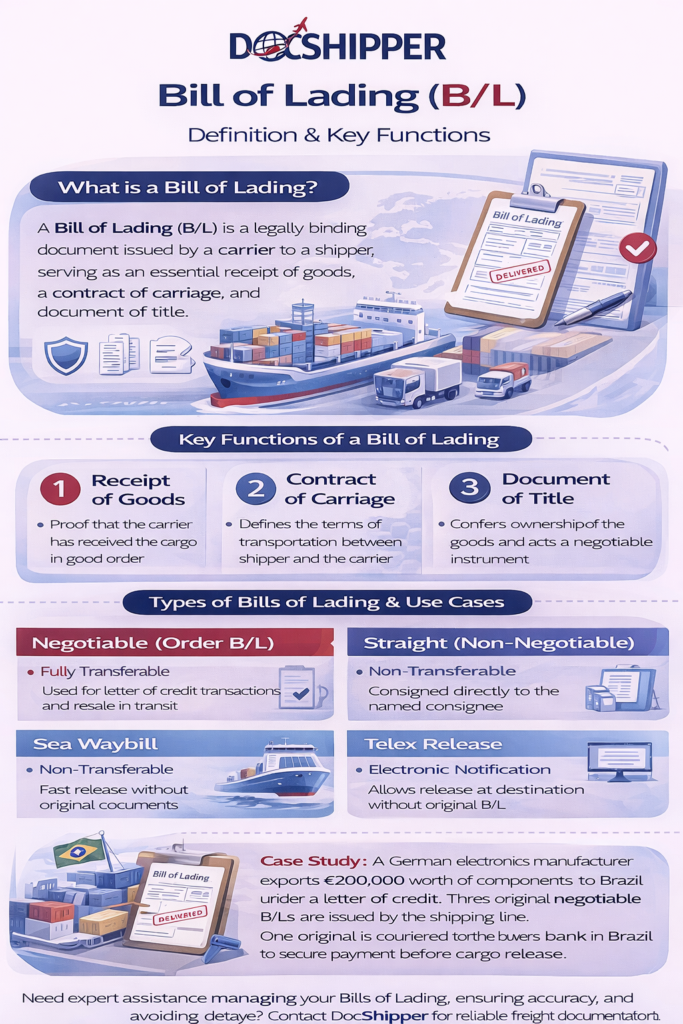
The Bill of Lading (B/L) is a legally binding document issued by a carrier to a shipper, acknowledging receipt of cargo for transport. It serves three critical functions: receipt of goods, contract of carriage, and document of title, making it indispensable in international trade and freight operations.
Introduction
Confusion between a Bill of Lading and other shipping documents like invoices or packing lists can lead to customs delays, financial disputes, and cargo release issues. Understanding the B/L’s precise role is essential for smooth international logistics.
In global trade, the Bill of Lading governs the legal relationship between shipper, carrier, and consignee. It determines cargo ownership, liability, and delivery rights across borders.
- Legal proof of ownership: Transferable document granting title to goods
- Contract evidence: Establishes terms between shipper and carrier
- Receipt confirmation: Verifies cargo condition and quantity at loading
- Customs requirement: Mandatory for clearance in most jurisdictions
- Financial instrument: Used in letters of credit and trade finance
Understanding the Bill of Lading: Functions & Legal Framework
The Bill of Lading operates under international conventions, primarily the Hague-Visby Rules and the Rotterdam Rules, which define carrier liability and shipper obligations. These frameworks standardize how disputes are resolved globally.
As a receipt of goods, the B/L confirms the carrier received cargo in apparent good condition. Any damage or discrepancy must be noted as “claused” or “dirty,” affecting insurance claims and payment terms.
Functioning as a contract of carriage, it outlines freight rates, routing, delivery terms, and liability limits. The reverse side typically contains detailed terms and conditions binding all parties.
Most critically, the B/L acts as a document of title. Possession of an original negotiable B/L grants legal ownership rights. This feature enables cargo to be sold in transit by transferring the document through endorsement.
The surrender process is vital: cargo can only be released upon presentation of original B/Ls (typically issued in three originals). Electronic Bills of Lading (eBL) are increasingly adopted via platforms like BOLERO and essDOCS, eliminating physical document delays. At DocShipper, we systematically verify B/L accuracy before cargo departure to prevent customs holds and ensure smooth consignee delivery.
Types, Practical Examples & Industry Data
Different B/L types serve specific trade scenarios. Understanding these variations prevents costly errors in documentation and cargo release procedures.
| B/L Type | Transferability | Use Case | Risk Level |
|---|---|---|---|
| Negotiable (Order B/L) | Fully transferable by endorsement | Letter of credit transactions, resale in transit | Low (secure ownership transfer) |
| Straight (Non-negotiable) | Consigned to named party only | Direct shipments between trusted partners | Medium (no resale flexibility) |
| Sea Waybill | Non-negotiable receipt | Fast release without original documents | High (no title transfer capability) |
| Telex Release | Electronic surrender notification | Expedited clearance when originals delayed | Medium (requires carrier verification) |
| House B/L | Issued by freight forwarder | Consolidated shipments (LCL) | Low (flexible for small shippers) |
Practical Case Study: A German electronics manufacturer exports €200,000 worth of components to a Brazilian buyer under a letter of credit. The bank requires a “clean on board” negotiable B/L showing goods loaded in Hamburg. The exporter receives three original B/Ls from the shipping line. One original is couriered to the buyer, one sent to the bank for payment release, and one retained for records. The buyer cannot claim cargo in Santos without presenting the original B/L to the carrier’s agent, ensuring payment security.
According to the International Chamber of Commerce, over 80% of international trade disputes involve discrepancies in Bills of Lading. Common errors include incorrect consignee details, missing cargo descriptions, or “claused” B/Ls noting damage that wasn’t disclosed to buyers.
Industry Data Insight: Digital B/L adoption remains below 2% globally despite proven efficiency gains. The average physical B/L takes 5-7 days to reach destination ports, while electronic versions transmit instantly, reducing demurrage costs by an estimated $6.5 billion annually according to maritime industry studies.
Conclusion
The Bill of Lading remains the cornerstone document in maritime logistics, balancing legal protection, ownership transfer, and operational efficiency. Mastering its variations and legal implications prevents costly delays and disputes.
Need expert guidance on B/L management or international shipping documentation? Contact DocShipper for comprehensive freight forwarding support.
DocShipper Platform
Cut logistics costs. Not corners.
See exactly where your logistics costs are bleeding — and how to fix it. Book your expert demo.
📚 Quiz
Test Your Knowledge: Bill of Lading (B/L)
Q1 — Which of the following best describes the three core functions of a Bill of Lading?
Q2 — A buyer needs to resell cargo while it is still at sea. Which type of Bill of Lading makes this legally possible?
Q3 — A German exporter ships goods to Brazil under a letter of credit. The bank receives a B/L noting visible damage to the packaging. What is the most likely outcome?
🎯 Your Result
📞 Free Quote in 24hFAQ | Bill of Lading (B/L): Definition, Types & Practical Examples
The shipper must request a Letter of Indemnity from the carrier and often provide a bank guarantee covering the cargo value. Alternatively, a court order declaring the original B/L void may be required, causing significant delays.
Only through a Telex Release (electronic surrender) or Sea Waybill, both requiring shipper authorization. Unauthorized release exposes carriers to legal liability for misdelivery.
A Master B/L is issued by the ocean carrier to the freight forwarder. The forwarder then issues House B/Ls to individual shippers in consolidated (LCL) shipments, simplifying documentation for smaller exporters.
Banks typically reject claused B/Ls under letters of credit, as they indicate damaged or discrepant cargo. Buyers may refuse payment until the issue is resolved or negotiate discounts.
Most major trading nations recognize eBLs under the UNCITRAL Model Law on Electronic Transferable Records, but adoption varies. China, Singapore, and the UK have robust eBL frameworks, while some jurisdictions still require paper originals.
This confirms cargo is physically loaded onto the vessel, not just received at the terminal. It's critical for letter of credit compliance, as banks require proof of actual shipment.
Yes, through a Letter of Correction or Amendment issued by the carrier, but all original B/Ls must be surrendered. Amendments require shipper and consignee agreement and may incur fees.
Freight prepaid means the shipper paid shipping costs before departure. Freight collect indicates the consignee pays upon cargo arrival. This affects cash flow and delivery terms (Incoterms).
There's no universal expiration, but carriers typically allow 7-14 days after vessel arrival for original B/L presentation. Beyond this, demurrage and storage charges accrue at the destination port.
A Switch B/L replaces the original, changing consignee or shipper details while cargo is in transit. It's common in commodity trading when goods are resold before arrival, though some countries restrict this practice.
No, air cargo uses an Air Waybill (AWB), which is non-negotiable and not a document of title. The consignee named on the AWB receives goods directly without presenting originals.
Under Hague-Visby Rules, carriers are liable for cargo loss or damage up to approximately $500 per package or customary freight unit, unless higher value is declared and additional freight paid.
Need Help with
Logistics or Sourcing ?
First, we secure the right products from the right suppliers at the right price by managing the sourcing process from start to finish. Then, we simplify your shipping experience - from pickup to final delivery - ensuring any product, anywhere, is delivered at highly competitive prices.


Fill the Form
Prefer email? Send us your inquiry, and we’ll get back to you as soon as possible.
Contact us