


In short ⚡
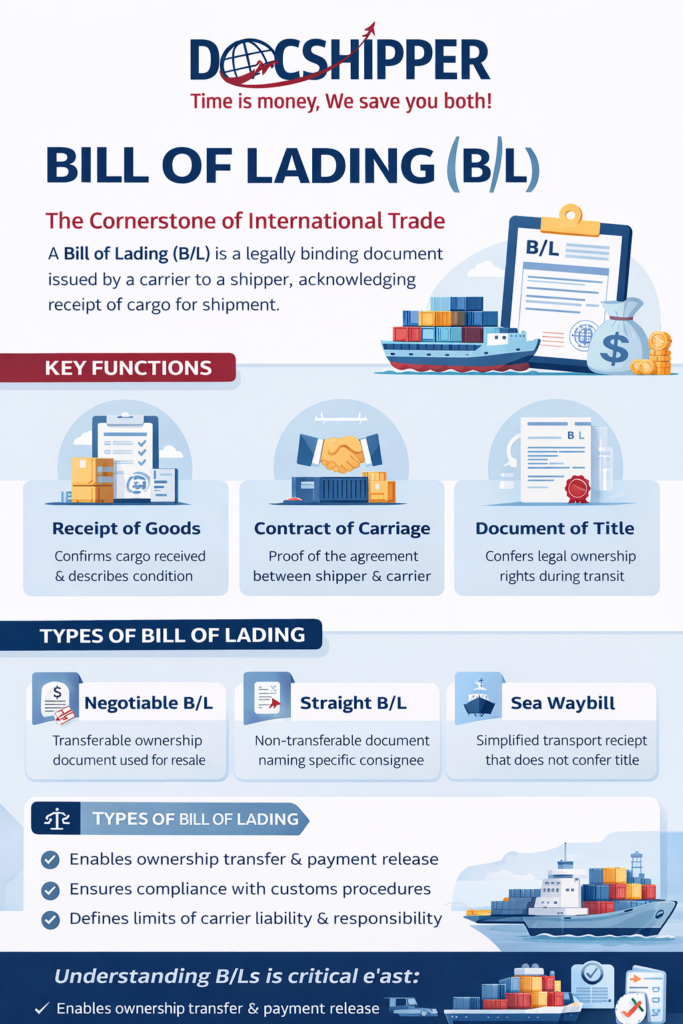
The Bill of Lading (B/L) is a legally binding document issued by a carrier to a shipper, acknowledging receipt of cargo for shipment. It serves three critical functions: receipt of goods, contract of carriage, and document of title. In international trade, the B/L enables ownership transfer and is essential for customs clearance and payment release.
Introduction
Confusion between different shipping documents causes costly delays in international logistics. Many importers mistakenly treat the B/L as a simple receipt, overlooking its legal power as a negotiable instrument.
The Bill of Lading remains the cornerstone of maritime commerce. Without this document, cargo cannot be released at destination, payments cannot be processed through letters of credit, and ownership cannot be transferred during transit.
Understanding the B/L is critical because:
- Legal protection: It provides evidence of the contract between shipper and carrier
- Financial instrument: Banks require it for documentary credit transactions
- Customs requirement: Mandatory for import/export clearance procedures
- Title transfer: Enables goods to be bought and sold while in transit
- Liability definition: Establishes carrier responsibility limits and coverage
Types of B/L & Legal Implications
The maritime industry recognizes several B/L types, each with distinct legal consequences. Choosing the wrong type can jeopardize cargo security or payment terms.
The negotiable B/L (or “order B/L”) allows title transfer through endorsement. It’s issued “to order” or “to order of shipper,” making the document itself a tradable instrument. This type is essential for letter of credit transactions where banks require control over goods.
The straight B/L (or “non-negotiable B/L”) names a specific consignee who alone can claim the cargo. It cannot be endorsed or transferred. This type suits transactions between trusted parties or within corporate groups, reducing documentation complexity.
A sea waybill is a non-negotiable transport document that doesn’t confer title. The consignee can claim cargo by proving identity, without presenting the original document. This speeds up delivery but eliminates payment security for sellers.
The charter party B/L applies when an entire vessel is chartered. It references the charter party contract rather than containing full terms. These B/Ls are rarely acceptable to banks due to their complexity and non-standard terms.
Under the Hague-Visby Rules (adopted by most maritime nations), carriers have specific liability limits unless gross negligence is proven. The B/L must be issued within 24 hours of loading and accurately describe the cargo’s apparent condition. According to UK Maritime Law, discrepancies between B/L descriptions and actual cargo can void carrier liability protections.
At DocShipper, we systematically verify B/L types match payment terms and incoterms before shipment. This prevents documentary credit rejections and ensures smooth cargo release at destination.
Practical Examples & Comparative Data
Real-world scenarios demonstrate how B/L selection impacts transaction security and delivery speed. The choice depends on payment method, relationship trust, and urgency.
| B/L Type | Negotiability | Best Use Case | Delivery Speed | Payment Security |
|---|---|---|---|---|
| Negotiable B/L | Yes (endorsable) | LC transactions, new suppliers | Slower (document courier needed) | Maximum (bank controls release) |
| Straight B/L | No (named consignee) | Established relationships | Moderate (original required) | Medium (trust-based) |
| Sea Waybill | No (no title transfer) | Urgent shipments, intra-company | Fastest (no original needed) | Low (no payment control) |
| Charter Party B/L | Limited (complex terms) | Bulk cargo, full vessel charters | Variable (contract-dependent) | Low (banks rarely accept) |
Use Case: Electronics Import from China
A European retailer orders $250,000 of smartphones from a new Chinese supplier. Payment terms: Letter of Credit at sight. The bank requires a full set of clean, on-board negotiable B/Ls made out “to order of [Bank Name].”
The supplier ships via Shanghai-Rotterdam route (transit time: 28 days). The B/L is issued by the carrier with notation “Clean on Board” confirming goods loaded in apparent good condition. The supplier presents documents to their bank, which forwards them to the buyer’s bank.
Upon document verification, the buyer’s bank releases payment to the supplier. The buyer receives the original B/L set (typically 3 originals), endorses them, and presents one original to the carrier’s agent in Rotterdam to claim the cargo. Customs clearance proceeds using the B/L as proof of ownership.
Key Data Points:
- Document courier time: 3-5 days (Shanghai to Europe via DHL/FedEx)
- Bank processing: 2-3 business days for compliant documents
- Carrier release time: Same day upon original B/L presentation
- Total documentary cycle: 5-8 days from shipment to payment release
- Demurrage risk: High if B/L arrival delays exceed free time (typically 7-14 days)
If the same transaction used a sea waybill instead, the consignee could claim cargo immediately upon arrival without presenting originals. However, the bank would refuse financing since sea waybills don’t provide payment security—the supplier receives no guarantee of payment before cargo release.
Conclusion
The Bill of Lading remains irreplaceable in international maritime trade, balancing legal protection, financial security, and operational efficiency. Selecting the appropriate B/L type directly impacts transaction risk and delivery timelines.
Need expert guidance on shipping documentation or customs procedures? Contact DocShipper for comprehensive logistics support tailored to your supply chain needs.
DocShipper Platform
Optimize Your Global Logistics with Cutting-Edge Solutions
Enhance efficiency, cut costs, and gain 24/7 visibility 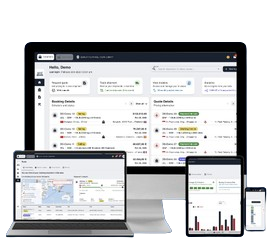 over your entire supply chain.
- Cut your shipping costs and maximize your margins
- Manage sourcing, freight, & customs on one platform
- Get real-time tracking and analytics
📚 Quiz
Bill of Lading (B/L)
Q1 — Which of the following best describes the Bill of Lading (B/L)?
Q2 — A European importer needs to finance a $250,000 shipment through a Letter of Credit. The bank requires control over the goods during transit. Which B/L type must be used?
Q3 — A company ships goods urgently between two of its own subsidiaries and needs the fastest possible cargo release at destination. Which document is most appropriate?
🎯 Your Result
📞 Free Quote in 24hFAQ | B/L (Bill of Lading): Definition, Types & Practical Examples
The shipper must request a letter of indemnity from the carrier and often provide a bank guarantee equal to the cargo value. The process can delay cargo release by 1-2 weeks and incurs additional costs.
Yes, electronic B/Ls (eBLs) are legally recognized under platforms like Bolero and essDOCS. They reduce courier time and costs but require all parties to use compatible systems and accept digital documents.
A clean B/L contains no notations indicating damaged or deficient cargo condition. Banks typically refuse B/Ls with clauses like "rusted containers" or "torn packaging" as they indicate potential cargo issues.
The carrier (shipping line) or their authorized agent issues the B/L after cargo is loaded. Freight forwarders may issue House B/Ls for consolidated shipments, while the carrier issues Master B/Ls.
Typically three originals are issued, each with equal legal standing. Once cargo is released against one original, the others become void. This prevents duplicate claims on the same shipment.
Unlike the negotiable B/L, an Air Waybill is always non-negotiable and doesn't confer title. It serves only as receipt and contract of carriage, not as a document of title for air cargo.
Amendments require agreement from all parties (shipper, carrier, consignee). The carrier issues a letter of correction or amendment, but banks may reject amended B/Ls under letter of credit terms.
A switch B/L replaces the original at an intermediate port, allowing the shipper to conceal supplier identity from the final buyer. This is common in trading operations but must comply with carrier policies.
Freight prepaid indicates shipping costs were paid at origin; freight collect means charges are payable at destination. This notation determines who bears financial responsibility for transportation costs.
Technically yes, but it's poor practice. A "shipped on board" B/L should be issued within 24 hours of loading. Late issuance can cause letter of credit discrepancies and payment delays.
A telex release allows cargo release without presenting original B/Ls. The shipper surrenders originals at origin, and the carrier notifies the destination agent electronically. It's faster but offers less payment security.
There's no expiration date, but letters of credit typically require presentation within 21 days of shipment. Demurrage charges accrue if cargo isn't collected within the carrier's free time period (usually 7-14 days).
Need Help with
Logistics or Sourcing ?
First, we secure the right products from the right suppliers at the right price by managing the sourcing process from start to finish. Then, we simplify your shipping experience - from pickup to final delivery - ensuring any product, anywhere, is delivered at highly competitive prices.


Fill the Form
Prefer email? Send us your inquiry, and we’ll get back to you as soon as possible.
Contact us



:%20Definition%20&%20Guide%20for%202026)