In short ⚡
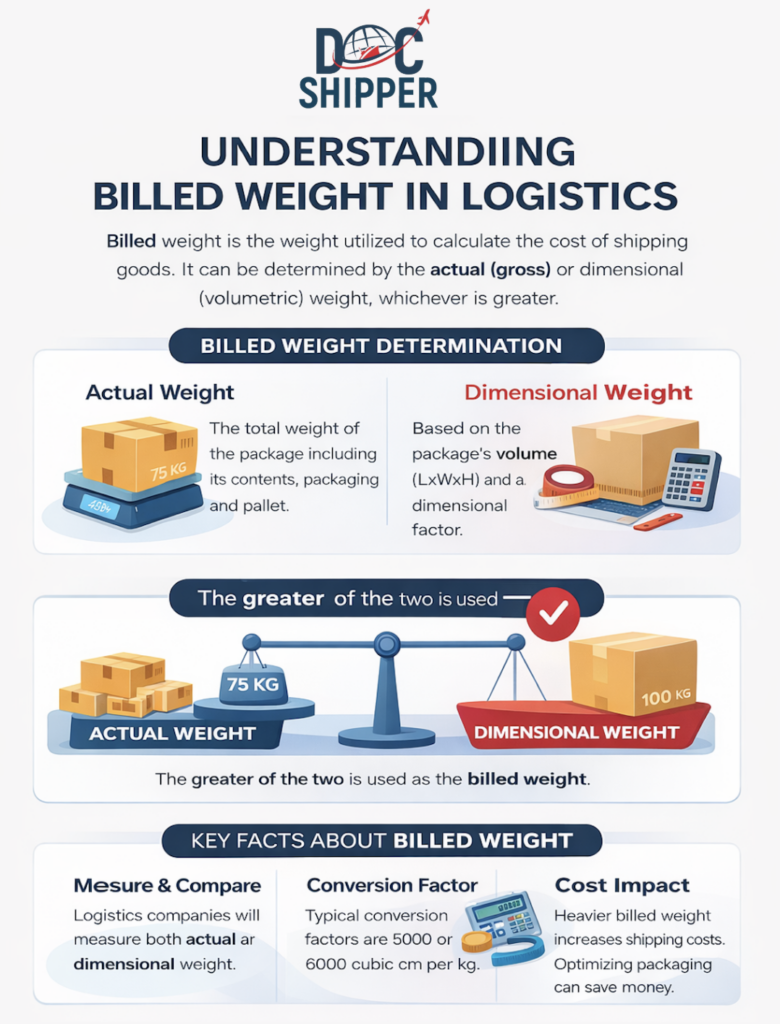
Billed weight is the weight used by carriers to calculate shipping costs, determined by comparing actual weight and volumetric weight, then selecting the higher value. This metric directly impacts freight charges in air, sea, and road transport.
Introduction
Many importers discover unexpected shipping costs only after their cargo is loaded. The confusion stems from misunderstanding how carriers actually bill shipments. Unlike simple weight-based pricing, international logistics uses a dual-calculation system that penalizes low-density cargo.
Billed weight determines the final freight charge in virtually every international shipment. Whether shipping electronics from China or furniture from Vietnam, this metric affects your bottom line more than any other logistical variable.
Key characteristics of billed weight:
- Dual calculation: Compares actual weight against volumetric weight
- Higher value wins: Carriers always charge based on the greater number
- Mode-specific formulas: Air freight uses different divisors than ocean freight
- Direct cost impact: Determines base freight charges before surcharges
- Optimization potential: Proper packaging can reduce billed weight significantly
Understanding Billed Weight: Technical Framework
The billed weight mechanism exists because carriers optimize space utilization. A shipment occupying significant cargo hold volume but weighing little generates less revenue per cubic meter than dense cargo. To compensate, the industry developed volumetric weight (also called dimensional weight).
The calculation process follows three steps. First, measure the package’s actual gross weight using calibrated scales. Second, calculate volumetric weight using the formula: (Length × Width × Height) ÷ Volumetric Divisor. Third, compare both values—the higher becomes the billed weight.
Volumetric divisors vary by transport mode. Air freight typically uses 6000 cm³/kg (or 166 in³/lb), while express couriers often apply 5000 cm³/kg. Ocean freight LCL shipments commonly use 1 CBM = 1000 kg as the conversion standard. Road freight in Europe frequently applies 3000 cm³/kg.
Regulatory oversight comes from industry bodies. The International Air Transport Association (IATA) standardizes air cargo calculations globally, though individual carriers may apply stricter divisors. For maritime transport, the International Maritime Organization provides guidelines, but freight forwarders negotiate specific terms with shipping lines.
Legal implications arise when shippers misdeclare dimensions or weight. Carriers reserve the right to re-weigh and re-measure cargo at destination. Discrepancies trigger weight correction invoices, often including penalty fees. At DocShipper, we verify all measurements before shipment departure to prevent these costly adjustments and ensure accurate quotations from the start.
Practical Examples & Cost Calculations
Consider a textile importer shipping 50 cartons of cotton garments from Bangladesh to France via air freight. Each carton measures 60×40×30 cm and weighs 8 kg. The freight rate is €4.50 per kg.
| Calculation Type | Formula | Result |
|---|---|---|
| Actual Weight | 50 cartons × 8 kg | 400 kg |
| Volumetric Weight | (60×40×30×50) ÷ 6000 | 600 kg |
| Billed Weight | Higher of both values | 600 kg |
| Freight Cost | 600 kg × €4.50 | €2,700 |
Had the shipper used actual weight only, the cost would be €1,800. The volumetric calculation adds €900—a 50% increase. This demonstrates why packaging optimization matters critically for low-density goods.
Contrast this with industrial machinery. A single machine weighing 1,200 kg with dimensions 100×80×90 cm yields a volumetric weight of only 120 kg (720,000 ÷ 6000). Here, actual weight exceeds volumetric weight, so the billed weight remains 1,200 kg. Dense cargo benefits from weight-based billing.
Key optimization strategies include:
- Compress packaging: Reduce void space inside cartons by 20-30%
- Custom carton sizing: Match box dimensions to product dimensions precisely
- Pallet optimization: Stack efficiently to minimize total shipment volume
- Mode selection: Switch to ocean LCL when volumetric penalties exceed 40%
- Consolidation: Combine multiple small shipments into one optimized load
Industry data shows that proper packaging reduces billed weight by an average of 18% for textiles, 12% for consumer electronics, and 25% for plastic products. These savings translate directly to reduced freight expenditure without compromising product protection.
Conclusion
Billed weight represents the fundamental cost driver in international shipping, directly linking physical cargo characteristics to financial outcomes. Mastering its calculation prevents budget overruns and enables strategic packaging decisions that improve profit margins.
Need expert guidance on optimizing your shipment costs? Contact DocShipper for a detailed freight analysis tailored to your specific cargo profile.
📚 Quiz
Test Your Knowledge: Billed Weight
Q1 — What is the correct definition of "billed weight" in international freight?
Q2 — A shipper sends a lightweight but bulky carton by air. Its actual weight is 5 kg, but its volumetric weight is 12 kg. What is the billed weight?
Q3 — A company ships a dense industrial machine weighing 1,200 kg with a volumetric weight of only 120 kg. Which billing scenario applies?
🎯 Your Result
📞 Free Quote in 24hFAQ | Billed Weight: Definition, Calculation & Real-World Examples
Gross weight is the actual physical weight of the shipment including packaging. Billed weight is the higher value between gross weight and volumetric weight, used for calculating freight charges.
Carriers use calibrated scales and automated dimensioning systems at cargo terminals. Discrepancies trigger re-weighing protocols and potential invoice adjustments with photographic evidence provided to shippers.
Direct shippers rarely negotiate divisors. High-volume accounts or freight forwarders with consolidated buying power may secure preferential divisors, typically 6500-7000 cm³/kg for air freight instead of the standard 6000.
No. FCL shipments are charged per container unit regardless of weight or volume, as long as cargo stays within container weight limits (typically 22-28 tons depending on container type and route).
Overweight containers face rejection at ports or additional heavy lift fees. Road transport may require special permits. Carriers charge penalty fees ranging from $500-$2000 per container depending on excess weight.
Customs duties calculate based on declared gross weight, not billed weight. However, significant discrepancies between shipping documents and customs declarations trigger inspections and potential penalties.
Certain cargo types like heavy machinery, metals, or liquids typically bill on actual weight only. Express couriers may waive volumetric calculations for documents under 0.5 kg.
Measure the longest, widest, and highest points of the package to create a theoretical rectangular box. Use these maximum dimensions for calculation, even if the actual shape differs.
Ocean LCL typically uses "revenue ton" calculation: 1 cubic meter (CBM) = 1 metric ton. Carriers charge based on whichever is greater: actual weight in tons or volume in CBM.
Yes. Switching from rigid boxes to flexible packaging, using vacuum compression for textiles, or eliminating excess dunnage can reduce volumetric weight by 15-35% depending on product type.
No. While IATA recommends 6000 cm³/kg, individual airlines apply divisors between 5000-6000. Cargo airlines serving dense trade routes may use stricter divisors to maximize revenue per flight.
Insurance premiums calculate based on declared cargo value, not billed weight. However, underinsuring high-value lightweight cargo creates coverage gaps if volumetric charges inflate total shipment costs beyond insured amounts.
Need Help with Logistics or Sourcing ?
First, we secure the right products from the right suppliers at the right price by managing the sourcing process from start to finish. Then, we simplify your shipping experience - from pickup to final delivery - ensuring any product, anywhere, is delivered at highly competitive prices.
Fill the Form
Prefer email? Send us your inquiry, and we’ll get back to you as soon as possible.
Contact us