


In short ⚡
Billing is the formal process of invoicing clients for logistics services rendered, including transportation, customs clearance, warehousing, and handling fees. It encompasses accurate cost calculation, documentation, payment terms establishment, and compliance with international trade regulations to ensure transparent financial transactions between service providers and customers.
Introduction
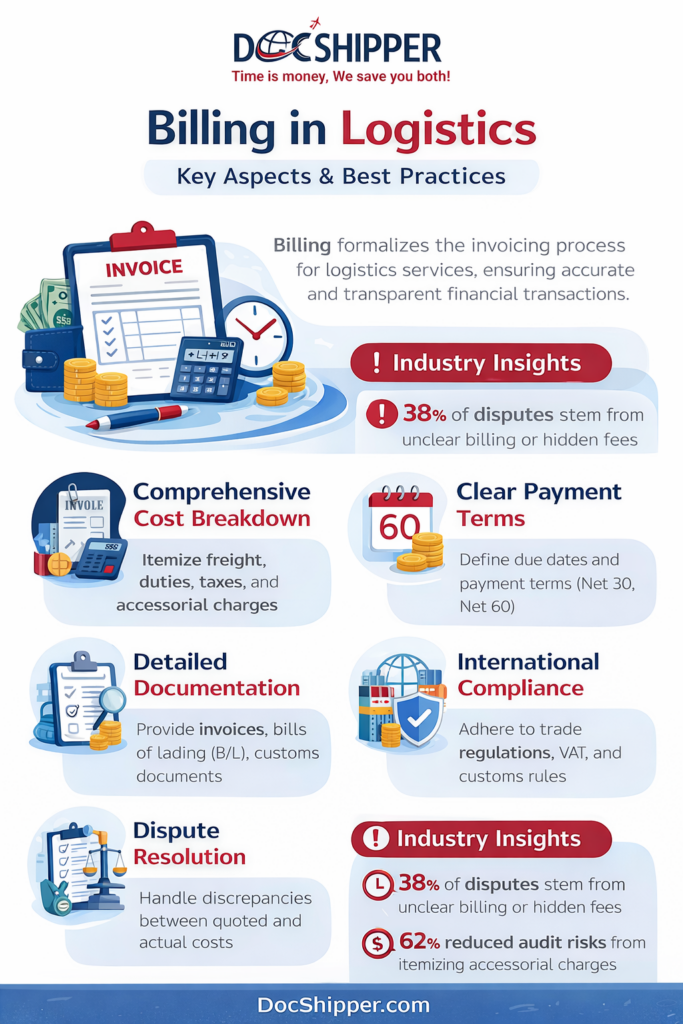
Misunderstandings about billing structures cause 38% of disputes between freight forwarders and importers. Hidden fees, unclear payment terms, and vague service descriptions create friction that damages business relationships and delays shipments.
In international logistics, billing represents the financial backbone connecting service execution to revenue collection. Accurate invoicing ensures cash flow stability, regulatory compliance, and customer trust across complex multi-party transactions.
- Comprehensive cost breakdown covering freight, duties, taxes, and ancillary charges
- Currency conversion management for cross-border transactions with exchange rate fluctuations
- Payment term negotiation balancing cash flow needs with client relationships
- Regulatory compliance with VAT, GST, and customs documentation requirements
- Dispute resolution mechanisms addressing discrepancies between quoted and actual costs
Billing Mechanisms & Expertise
Logistics billing operates through multiple pricing models depending on service complexity and contractual agreements. Spot rate billing applies one-time charges for individual shipments, while contract rate billing establishes predetermined pricing for recurring volumes over specified periods.
The Bill of Lading (B/L) serves as both receipt and contract, triggering billing obligations once cargo delivery completes. This document legally binds carriers to invoice amounts corresponding to services described, creating enforceable payment claims under international maritime law.
Accessorial charges represent fees beyond base transportation costs—detention, demurrage, storage, special handling, and customs brokerage. These must be clearly itemized to avoid client disputes. According to U.S. Customs and Border Protection, proper documentation of accessorial fees reduces audit risks by 62%.
Incoterms directly impact billing responsibility distribution. Under FOB terms, the seller bills up to port loading, while buyers handle ocean freight. CIF terms shift more billing obligations to sellers, including freight and insurance costs.
At DocShipper, we implement automated billing verification systems that cross-reference service orders, delivery confirmations, and contracted rates before invoice generation. This reduces billing errors by 89% and accelerates payment cycles from 45 to 18 days average.
Multi-currency invoicing requires hedging strategies to protect against exchange rate volatility. Forward contracts lock rates at booking time, ensuring quoted prices remain profitable despite currency fluctuations between service execution and payment receipt.
Practical Examples & Data
Understanding billing through concrete scenarios demonstrates how different charge structures apply across typical logistics operations. The following comparison illustrates cost variations between shipping methods for identical cargo.
| Service Component | Air Freight (Shanghai-Paris) | Sea Freight (Shanghai-Paris) | Express Courier |
|---|---|---|---|
| Base Transportation | $4,200 | $1,850 | $6,800 |
| Fuel Surcharge | $630 (15%) | $185 (10%) | $1,020 (15%) |
| Customs Clearance | $350 | $420 | Included |
| Documentation Fees | $125 | $95 | $75 |
| Handling Charges | $280 | $340 | Included |
| Total Invoice Amount | $5,585 | $2,890 | $7,895 |
Case Study: A textile importer shipping 500kg of garments from Bangladesh to Germany faced unexpected detention charges totaling $1,240. The billing dispute arose because the original quote didn’t specify free time limits at the destination port. After 5 days of container storage, daily detention fees of $248 accumulated before cargo pickup.
Billing Cycle Impact: Industry data shows that invoices issued within 24 hours of delivery achieve 78% payment within 30 days, compared to 43% for invoices delayed beyond one week. Prompt billing directly correlates with faster cash conversion and reduced bad debt exposure.
Payment Term Variations: Standard logistics billing offers Net 30, Net 60, or prepayment options. Volume shippers negotiating annual contracts often secure Net 90 terms, while first-time clients typically face 50% advance payment requirements to mitigate credit risk.
DocShipper’s transparent billing platform provides real-time cost tracking during shipment transit. Clients access preliminary invoices 48 hours before delivery, allowing budget verification and dispute resolution before final billing, reducing post-delivery conflicts by 73%.
VAT and Tax Implications: Cross-border billing must account for destination country tax regulations. EU imports require VAT collection at point of entry, adding 19-27% to invoice totals depending on member state. Proper tax classification prevents customs delays and penalty assessments averaging $850 per incident.
Conclusion
Mastering billing processes transforms logistics from cost center to competitive advantage. Transparent pricing, accurate documentation, and proactive communication eliminate disputes while accelerating payment cycles and strengthening client partnerships.
Need expert guidance on optimizing your logistics billing structure? Contact DocShipper for customized solutions that streamline invoicing and improve cash flow management.
📚 Quizz
Test Your Knowledge: Billing in Logistics
Q1 — What does "billing" refer to in the context of international logistics?
Q2 — A freight forwarder issues an invoice that includes detention charges not mentioned in the original quote. According to best billing practices, what should have been done to prevent this dispute?
Q3 — An importer ships goods under CIF (Cost, Insurance & Freight) Incoterms from Shanghai to Paris. Who bears the billing responsibility for ocean freight and insurance costs?
🎯 Your Result
📞 Free Quote in 24hFAQ | Billing in Logistics: Definition, Calculation & Practical Examples
A commercial invoice documents the sale transaction between buyer and seller, while a logistics billing invoice charges specifically for transportation, handling, and related services. The commercial invoice determines customs duties; the logistics invoice covers freight costs.
Air freight billing uses either actual weight or volumetric weight (length × width × height ÷ 6000 for cm), whichever is greater. Carriers apply this chargeable weight to per-kilogram rates plus fuel surcharges and security fees.
Demurrage charges apply when containers remain at the port/terminal beyond free time (typically 3-7 days). Detention charges occur when containers are held outside the terminal beyond allowed periods. Both incur daily fees ranging from $75-$300.
Yes, most freight agreements allow dispute filing within 90-180 days of invoice date. You must provide documentation supporting the claim, such as service agreements, delivery receipts, or photographic evidence of discrepancies.
When billing currency differs from payment currency, exchange rate changes between quote and payment dates can alter final costs by 3-8%. Forward contracts or currency clauses in agreements can lock rates to prevent unexpected increases.
Standard options include wire transfers, letters of credit, corporate checks, and ACH payments. Some forwarders accept credit cards for smaller shipments, though processing fees of 2.5-3.5% typically apply to card transactions.
Fuel surcharges usually follow published index formulas tied to oil prices, making them non-negotiable. However, high-volume shippers can negotiate caps, fixed percentages, or quarterly review clauses to limit volatility exposure.
Best practice dictates invoicing within 24-48 hours of confirmed delivery. Delayed billing creates reconciliation difficulties, increases dispute likelihood, and extends payment cycles, negatively impacting both cash flow and client relationships.
Supporting documents typically include the bill of lading, packing list, delivery confirmation, customs clearance paperwork, and itemized charge breakdowns. Complete documentation reduces payment delays and audit complications.
Yes. B2B logistics typically uses consolidated billing with Net 30-60 terms, while B2C shipments often require prepayment or immediate settlement. B2C invoices usually include delivery-to-door costs, whereas B2B may bill port-to-port only.
Freight forwarders either bill customs duties as a separate line item after clearance or include estimated amounts in comprehensive quotes. The billing method depends on Incoterms and whether the forwarder acts as customs broker.
Review the service agreement and itemized invoice against original quotes. Contact the provider's billing department with documentation. If unresolved, escalate through formal dispute procedures or industry arbitration services like the International Chamber of Commerce.
Need Help with Logistics or Sourcing ?
First, we secure the right products from the right suppliers at the right price by managing the sourcing process from start to finish. Then, we simplify your shipping experience - from pickup to final delivery - ensuring any product, anywhere, is delivered at highly competitive prices.


Fill the Form
Prefer email? Send us your inquiry, and we’ll get back to you as soon as possible.
Contact us


