In short ⚡
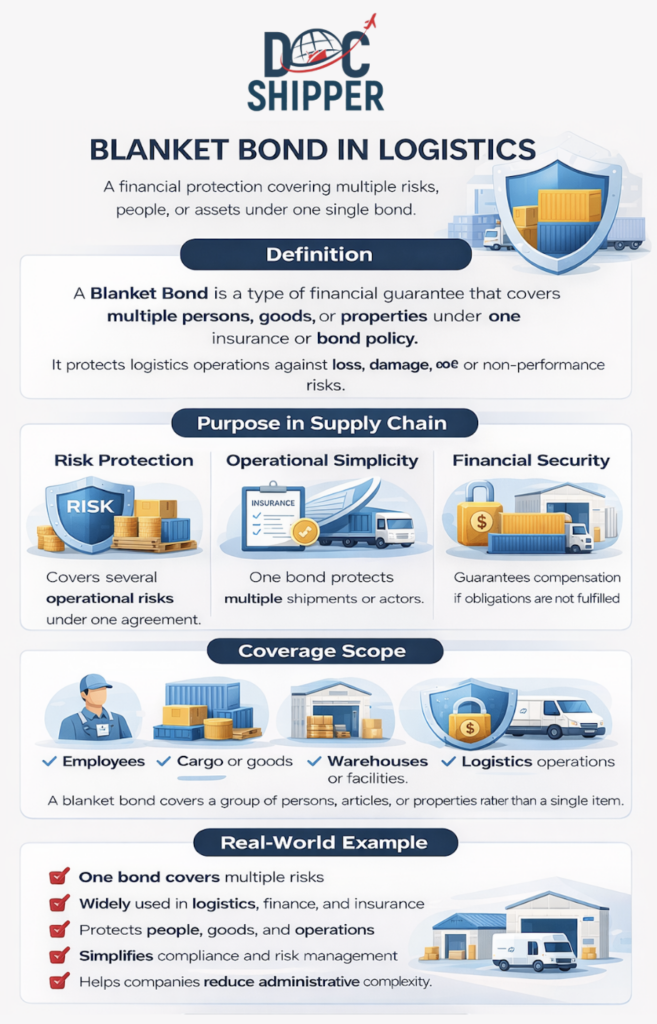
A Blanket Bond is a comprehensive fidelity insurance policy that protects businesses against financial losses caused by employee dishonesty, fraud, or theft across all positions within the organization. Unlike individual bonds covering specific employees, this single policy provides uniform coverage for the entire workforce, streamlining risk management in logistics and international trade operations.
Introduction
International freight forwarding involves handling high-value shipments, sensitive customs documentation, and substantial financial transactions daily. A single act of employee fraud can devastate operations, delay shipments, and trigger costly legal disputes.
The Blanket Bond addresses this vulnerability by providing comprehensive protection against internal threats. This insurance mechanism is particularly critical for logistics providers managing multi-jurisdictional operations where oversight becomes challenging.
Key characteristics include:
- Universal employee coverage – protects against dishonest acts by any staff member
- Simplified administration – eliminates the need for individual position bonds
- Scalable protection – coverage adjusts automatically as workforce changes
- Multi-peril coverage – includes theft, forgery, embezzlement, and fraudulent documentation
- Third-party protection – safeguards client assets under company custody
Understanding Blanket Bond Mechanics & Legal Framework
The Blanket Bond operates through a per-loss limit structure rather than per-employee limits. This means the policy specifies a maximum payout amount for each covered incident, regardless of how many employees are involved.
Coverage typically extends to five primary risk categories. Employee dishonesty encompasses theft of goods, funds, or proprietary information. Forgery and alteration protects against falsified bills of lading, customs declarations, or payment instruments. Computer fraud addresses unauthorized electronic fund transfers or data manipulation. Funds transfer fraud covers losses from deceptive payment instructions. Money order and counterfeit currency protection shields against acceptance of fraudulent instruments.
Under international regulations, freight forwarders often face mandatory bonding requirements. The U.S. Federal Maritime Commission requires ocean transportation intermediaries to maintain a $75,000 bond (FMC regulations). European customs brokers must comply with EU Regulation 952/2013 regarding financial guarantees.
The policy activation process requires discovery and notification protocols. Most insurers mandate reporting within 30-90 days of discovering a loss. Documentation must include incident details, estimated loss amount, affected transactions, and preliminary investigation findings.
At DocShipper, we maintain comprehensive Blanket Bond coverage across all operational hubs to ensure client cargo and financial transactions remain protected throughout the supply chain journey.
Premium calculations depend on five core factors: total coverage amount, employee headcount, claims history, industry risk classification, and internal control strength. Annual premiums typically range from 0.5% to 2% of the coverage limit for logistics operations.
Coverage Analysis & Real-World Applications
Understanding how Blanket Bonds function in actual logistics scenarios clarifies their protective value. The following comparative analysis demonstrates coverage differences:
| Coverage Type | Blanket Bond | Individual Position Bond |
|---|---|---|
| Employee Scope | All employees automatically covered | Only specifically named positions |
| Coverage Limit | Single aggregate per incident | Per-person limits |
| Administrative Burden | Minimal – one policy | High – multiple renewals |
| New Hire Process | Automatic inclusion | Requires separate bonding |
| Premium Structure | Based on total coverage | Cumulative individual costs |
Use Case: Customs Documentation Fraud
A mid-sized freight forwarder with $500,000 Blanket Bond coverage discovered a customs broker had been submitting falsified valuation declarations to reduce duty payments. The scheme involved 47 shipments over eight months, resulting in $280,000 in unpaid duties and penalties.
The Blanket Bond covered the full loss amount minus the $25,000 deductible. Without this coverage, the company would have faced bankruptcy. The claim process took 45 days from submission to payment.
Use Case: Warehouse Inventory Theft
A logistics provider’s warehouse manager systematically diverted high-value electronics shipments over 14 months. Total loss exceeded $420,000 in client goods plus $85,000 in replacement shipping costs.
The $1 million Blanket Bond policy paid the full claim. The insurer’s investigation revealed weak inventory controls, leading to a premium increase but maintaining coverage continuity.
Critical implementation factors for logistics operations include:
- Coverage adequacy assessment – calculate based on maximum shipment values and cash handling exposure
- Deductible optimization – balance premium costs against risk tolerance (typically $10,000-$50,000)
- Extended coverage endorsements – consider adding client property, third-party liability, and cyber fraud extensions
- Claims documentation protocols – establish internal procedures for rapid incident reporting
- Underwriter relationship management – maintain transparent communication to facilitate renewals and claims
DocShipper Platform
Cut logistics costs. Not corners.
See exactly where your logistics costs are bleeding — and how to fix it. Book your expert demo.

Conclusion
The Blanket Bond represents essential financial protection for logistics operations exposed to employee-related fraud risks. Its comprehensive coverage model, administrative efficiency, and scalability make it the preferred bonding solution for international freight forwarders.
Need guidance on implementing appropriate bonding coverage for your logistics operations? Contact DocShipper for expert consultation on risk management strategies.
📚 Quiz
Test Your Knowledge: Blanket Bond
Q1 — What does a Blanket Bond primarily protect a logistics company against?
Q2 — A warehouse manager and two colleagues collude to steal high-value cargo over several months. How does a Blanket Bond handle this multi-employee fraud?
Q3 — A freight forwarder hires a new customs agent. Under a Blanket Bond, what happens to this new employee's coverage?
🎯 Your Result
📞 Free Quote in 24hFAQ | Blanket Bond: Definition, Coverage & Practical Examples
While both protect against employee dishonesty, Blanket Bonds specifically cover fidelity risks (employee theft and fraud), whereas commercial crime insurance provides broader coverage including third-party crimes like burglary and robbery. Many logistics companies maintain both for comprehensive protection.
Standard policies typically exclude independent contractors. Coverage extends only to direct employees on payroll. However, endorsements can add temporary workers if they receive W-2 forms and work under direct company supervision.
Most policies require notification within 30 to 90 days of discovery. Delayed reporting can result in claim denial. Establish internal protocols to identify and report irregularities immediately upon detection.
Yes, but insurers typically provide only short-rate refunds (less than pro-rata) for mid-term cancellations. Additionally, discovery periods for prior acts may require extended reporting endorsements to protect against claims arising after cancellation.
Essential documentation includes detailed incident reports, financial records showing the loss, employee statements, internal investigation findings, law enforcement reports (if filed), and proof of discovery date. Comprehensive documentation accelerates claim processing.
No. Coverage applies only to dishonest or fraudulent acts committed with intent to cause loss. Simple mistakes, incompetence, or negligent errors fall outside policy scope. Consider errors and omissions insurance for negligence-related exposures.
The policy automatically covers new hires without additional underwriting. However, significant workforce expansion may trigger premium adjustments at renewal. Notify your insurer of major organizational changes to ensure adequate limits.
Deductibles generally range from $10,000 to $50,000 depending on coverage limits and company size. Higher deductibles reduce premiums but increase out-of-pocket exposure. Select deductibles aligned with your financial capacity to absorb losses.
Yes, if the dishonest act occurred during the policy period and employment. Most policies include a discovery period (typically 12-24 months post-termination) for uncovering prior-period fraud. Extended discovery endorsements can lengthen this window.
Absolutely. Insurers often mandate segregation of duties, dual authorization for financial transactions, regular audits, and background checks for sensitive positions. Failure to maintain required controls can void coverage or result in claim denials.
They serve different purposes. Customs broker bonds guarantee duty payment and regulatory compliance to government agencies. Blanket Bonds protect the company against employee dishonesty. Both are typically required for comprehensive risk management in freight forwarding.
The policy treats collusion as a single occurrence, subject to the per-loss limit rather than individual per-employee limits. This makes Blanket Bonds more efficient than multiple individual bonds when addressing organized internal fraud.
Need Help with
Logistics or Sourcing ?
First, we secure the right products from the right suppliers at the right price by managing the sourcing process from start to finish. Then, we simplify your shipping experience - from pickup to final delivery - ensuring any product, anywhere, is delivered at highly competitive prices.


Fill the Form
Prefer email? Send us your inquiry, and we’ll get back to you as soon as possible.
Contact us