Blanket Waybill: Definition & Guide for 2026

  • admin 7 Min
  • Published on March 16, 2026
img

In short ⚡

A Blanket Waybill is a consolidated transport document covering multiple shipments under a single air waybill number, streamlining documentation for regular shippers with consistent routing. This master document simplifies customs clearance, reduces administrative costs, and accelerates cargo processing for high-frequency shipments between the same origin and destination points.

Introduction

Shipping documentation can overwhelm businesses managing frequent international air cargo movements. Processing individual air waybills for every consignment creates bottlenecks, increases costs, and slows customs clearance.

The Blanket Waybill addresses this challenge by consolidating multiple shipments under one master document. This approach is particularly valuable for manufacturers, e-commerce platforms, and distributors maintaining regular supply chains between fixed locations.

  • Consolidation efficiency: One document covers multiple shipments over a defined period
  • Cost reduction: Lower documentation fees and administrative overhead
  • Customs optimization: Pre-approved routing accelerates clearance procedures
  • Carrier agreements: Requires established relationships with air freight forwarders
  • Compliance framework: Must align with IATA regulations and customs authorities

Operational Framework & Regulatory Context

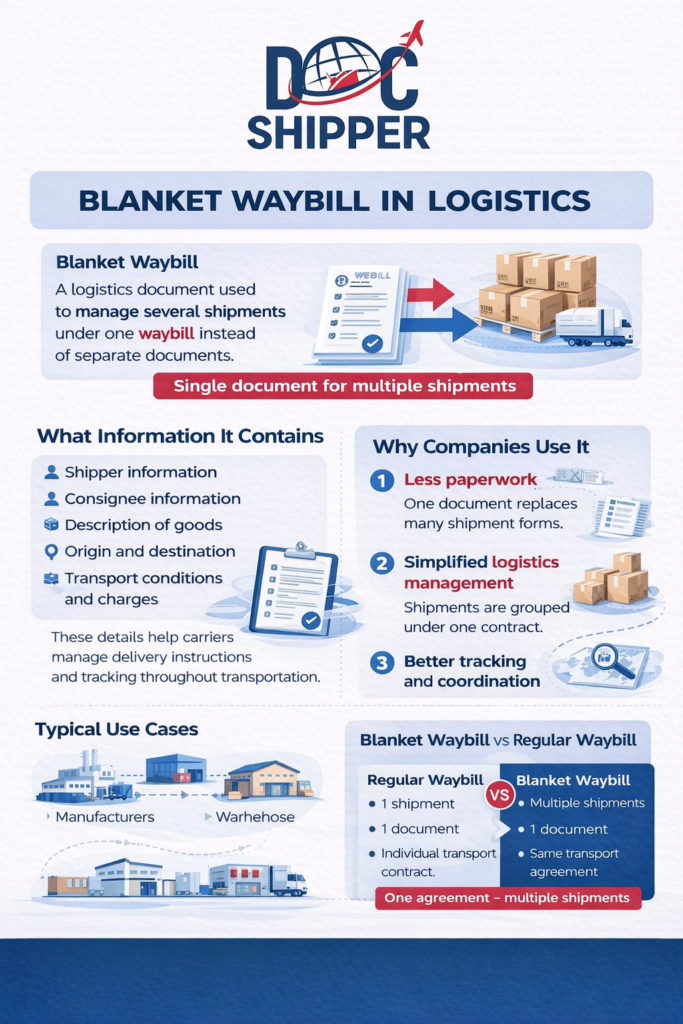
A Blanket Waybill functions as an umbrella contract between shipper and carrier, pre-authorizing cargo movements within specified parameters. Unlike standard air waybills issued per shipment, this master document remains valid for a predetermined period—typically 30 to 90 days.

The legal foundation rests on IATA Resolution 600b, which permits consolidated documentation for repetitive shipments. Carriers must verify that goods maintain consistent commodity codes, weight ranges, and routing. Any deviation requires separate documentation.

Implementation demands precise shipper-carrier coordination. The blanket agreement specifies allowable product categories, maximum shipment values, and destination customs facilities. At DocShipper, we establish these frameworks during contract negotiation to ensure seamless execution across your supply chain.

From a customs perspective, authorities like U.S. Customs and Border Protection accept blanket waybills when shippers maintain Trusted Trader status or equivalent certification. The European Union’s Authorized Economic Operator (AEO) program facilitates similar arrangements under EU customs regulations.

The operational advantage emerges in high-volume scenarios. Rather than generating 50 individual waybills monthly, shippers reference one master number with sub-identifiers. This reduces data entry errors, accelerates warehouse processing, and simplifies invoice reconciliation across international borders.

BLANKET WAYBILL IN LOGISTICS

Practical Applications & Data Insights

Consider an electronics manufacturer shipping smartphone components from Shenzhen to Frankfurt three times weekly. Under standard procedures, each flight requires separate air waybill processing, averaging €45 per document. With 12 monthly shipments, documentation alone costs €540.

Implementing a Blanket Waybill structure reduces this to a single master document fee of approximately €120 monthly, generating 78% cost savings. Processing time drops from 25 minutes per shipment to 8 minutes for sub-manifest updates.

Documentation MethodMonthly ShipmentsDocument FeesProcessing TimeError Rate
Individual Air Waybills12€540300 minutes4.2%
Blanket Waybill12€12096 minutes0.8%

A pharmaceutical distributor case study demonstrates compliance benefits. Shipping temperature-controlled vaccines from Belgium to multiple African destinations, the company consolidated 8 weekly flights under one blanket arrangement. Customs pre-clearance reduced airport dwell time from 18 hours to 4 hours, critical for maintaining cold chain integrity.

Key implementation factors include:

  • Volume threshold: Minimum 10 shipments monthly to justify setup costs
  • Route consistency: Same origin-destination pairs with identical customs procedures
  • Commodity homogeneity: Products within the same HS code chapter
  • Carrier capability: Freight forwarder must support blanket waybill systems
  • Digital integration: EDI or API connections for real-time manifest updates

At DocShipper, we analyze your shipment patterns to determine blanket waybill viability, negotiating carrier agreements that align with your operational cadence and compliance requirements.

Conclusion

The Blanket Waybill transforms repetitive air freight operations into streamlined processes, cutting costs while improving compliance accuracy. For businesses with predictable shipping patterns, this documentation approach delivers measurable efficiency gains.

Need assistance implementing blanket waybill systems for your supply chain? Contact DocShipper for expert guidance on optimizing your international logistics documentation.

📚 Quizz
Test Your Knowledge: Blanket Waybill

FAQ | Blanket Waybill: Definition, Application & Practical Examples

Typically 8-10 shipments monthly on the same route make blanket waybills cost-effective, though specific thresholds depend on carrier fee structures and administrative overhead.

Ask us anything!

Need Help with Logistics or Sourcing ?

First, we secure the right products from the right suppliers at the right price by managing the sourcing process from start to finish. Then, we simplify your shipping experience - from pickup to final delivery - ensuring any product, anywhere, is delivered at highly competitive prices.

Live Chat

Get instant assistance from our team—just click and start chatting!

Live Chat Now
image

Fill the Form

Prefer email? Send us your inquiry, and we’ll get back to you as soon as possible.

Contact us
image

Call us

Reach out to us on WhatsApp for quick, convenient, and personal support.

Call us
image