In short ⚡
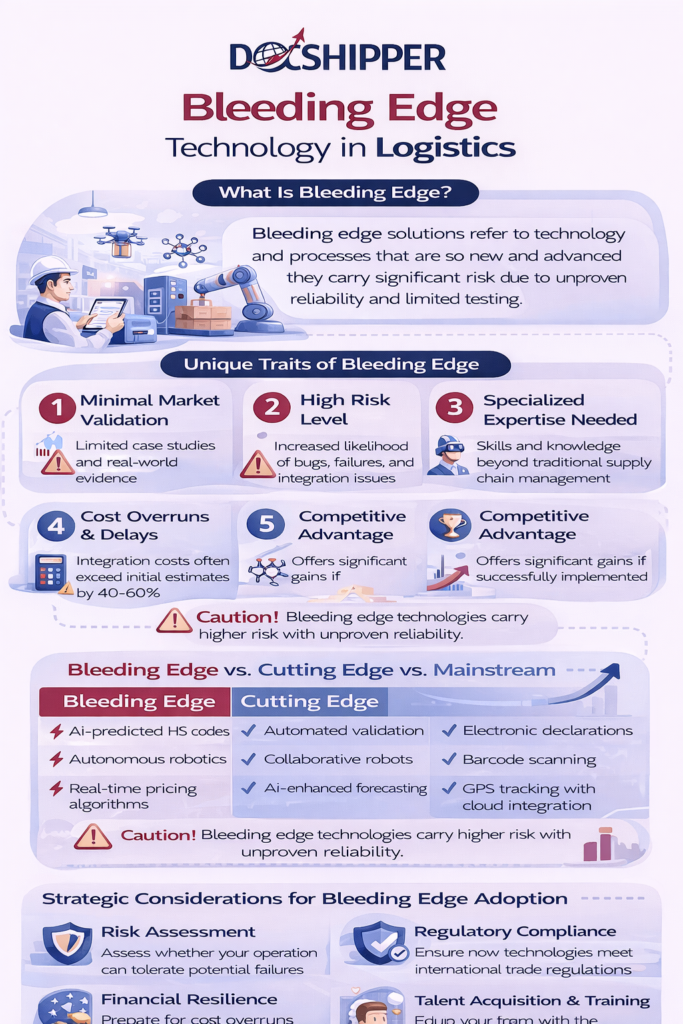
Bleeding edge refers to technology, processes, or methodologies so advanced and recently developed that they carry significant risk due to limited testing, unproven reliability, and potential operational failures. Unlike "cutting edge," which represents proven innovation, bleeding edge solutions prioritize innovation over stability, making them suitable only for organizations willing to accept higher uncertainty in exchange for competitive advantage.
Introduction: Why Bleeding Edge Matters in Global Logistics
Many companies confuse bleeding edge with cutting edge, leading to costly implementation failures. In international logistics, adopting untested technology can mean shipment delays, compliance issues, or complete system breakdowns.
The term becomes critical when evaluating supply chain digitalization, automation investments, or new customs clearance platforms. Understanding the risk-reward balance determines whether innovation accelerates operations or creates operational chaos.
Key characteristics of bleeding edge solutions:
- Limited market validation with minimal case studies
- High potential for bugs, integration failures, or compatibility issues
- Requires specialized expertise rarely available in-house
- Offers significant competitive differentiation if successfully implemented
- Typically lacks comprehensive vendor support or documentation
In logistics, bleeding edge appears in AI-driven route optimization, blockchain customs platforms, autonomous warehouse systems, and predictive freight pricing algorithms. Each promises transformation but demands careful evaluation.
Strategic Implications & Risk Framework
Bleeding edge technology operates at the intersection of innovation and instability. Organizations must assess whether their operational resilience can absorb potential failures without compromising customer commitments or regulatory compliance.
The primary distinction lies in maturity levels. Cutting edge technology has undergone market validation, established best practices, and demonstrated ROI. Bleeding edge lacks this foundation, making it experimental by nature.
In international trade, regulatory compatibility becomes crucial. Customs authorities worldwide follow established digital protocols. Implementing bleeding edge customs declaration systems risks non-compliance if the technology hasn’t been certified by relevant agencies like World Customs Organization standards.
Financial exposure represents another critical factor. Implementation costs for bleeding edge solutions typically exceed projections by 40-60% due to unforeseen integration challenges, extended testing periods, and required infrastructure upgrades.
Vendor stability must be evaluated. Startups offering bleeding edge logistics platforms may lack long-term viability. If the vendor fails, companies face stranded investments and forced system migrations during critical operational periods.
At DocShipper, we systematically evaluate technology maturity before recommending solutions to clients, ensuring innovations enhance rather than disrupt established supply chains.
The talent gap poses operational risk. Bleeding edge systems require specialized knowledge that traditional logistics teams don’t possess. Training timelines extend implementation periods, and staff turnover creates knowledge loss vulnerabilities.
Real-World Applications & Data
Understanding bleeding edge requires examining actual implementations across logistics sectors. These examples illustrate both the potential and pitfalls of early technology adoption.
Comparative Analysis: Technology Maturity Levels
| Technology Category | Bleeding Edge | Cutting Edge | Mainstream |
|---|---|---|---|
| Customs Clearance | AI-predicted HS code assignment (12% error rate) | Automated document validation (2% error rate) | Electronic declaration systems |
| Warehouse Management | Fully autonomous mobile robots (requires constant supervision) | Collaborative robots (cobots) with human oversight | Barcode scanning systems |
| Freight Pricing | Real-time dynamic pricing algorithms (±15% accuracy) | AI-enhanced rate forecasting (±5% accuracy) | Contract-based rate tables |
| Track & Trace | IoT sensors with blockchain verification (interoperability issues) | GPS tracking with API integration | Manual status updates |
| Documentation | Smart contracts for automatic compliance (limited adoption) | Cloud-based document management with OCR | PDF-based document exchange |
Case Study: Blockchain Customs Platform Implementation
A European electronics importer adopted a bleeding edge blockchain-based customs declaration system in 2022. The platform promised automated compliance verification and reduced clearance times.
Results after 12 months:
- Implementation cost: €340,000 (initial estimate: €180,000)
- Average clearance time increased from 18 hours to 34 hours during integration
- 23% of declarations required manual intervention due to system errors
- Customs authorities rejected platform outputs, requiring parallel traditional submissions
- Project suspended after 14 months, reverting to established systems
The failure stemmed from regulatory non-recognition and insufficient testing with actual customs data formats. The technology worked theoretically but lacked practical validation.
DocShipper Platform
Optimize Your Global Logistics with Cutting-Edge Solutions
Enhance efficiency, cut costs, and gain 24/7 visibility 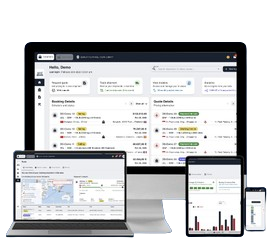 over your entire supply chain.
- Cut your shipping costs and maximize your margins
- Manage sourcing, freight, & customs on one platform
- Get real-time tracking and analytics
Success Scenario: Controlled Bleeding Edge Adoption
A multinational freight forwarder implemented bleeding edge AI route optimization for 10% of their shipment volume as a pilot program. This controlled approach allowed:
- Real-world testing without jeopardizing core operations
- Gradual staff training and system refinement
- Data collection to validate vendor claims (actual fuel savings: 8.3% vs. promised 15%)
- Risk mitigation through parallel traditional routing for critical shipments
- Incremental expansion based on proven performance metrics
After 18 months, the system achieved stability and expanded to 45% of operations, demonstrating successful bleeding edge adoption through phased implementation.
Conclusion
Bleeding edge technology represents high-risk innovation requiring careful evaluation of operational resilience, regulatory compliance, and financial exposure. Success depends on controlled implementation, realistic expectations, and organizational capacity to absorb potential failures.
Need expert guidance on technology adoption for your supply chain? Contact DocShipper for strategic consultation on balancing innovation with operational stability.
📚 Quiz
Test Your Knowledge: Bleeding Edge
Q1 — What best defines "bleeding edge" technology in a logistics context?
Q2 — A company adopts a bleeding edge blockchain customs platform. Customs authorities reject its outputs. What is the most likely reason?
Q3 — A freight forwarder wants to test a bleeding edge AI route optimization tool responsibly. Which approach best reflects industry best practice?
🎯 Your Result
📞 Free Quote in 24hFAQ | Bleeding Edge: Definition, Strategic Value & Real-World Implementation
Bleeding edge technology lacks market validation and carries significant implementation risk, while cutting edge represents proven innovation with established best practices. Bleeding edge prioritizes novelty over reliability.
Only if they possess technical expertise, financial reserves to absorb failures, and operations that can tolerate disruption. Most companies benefit more from cutting edge technology with proven ROI.
Autonomous vessel navigation systems, blockchain-based bills of lading, AI-predicted customs classifications, quantum computing for route optimization, and fully automated customs clearance platforms represent current bleeding edge applications.
Implement pilot programs affecting limited shipment volumes, maintain parallel traditional systems, establish clear failure criteria, secure vendor guarantees, and ensure internal technical expertise before full deployment.
Industry best practice suggests limiting bleeding edge implementations to 5-10% of operations initially, expanding only after demonstrating stability and measurable benefits over 12-18 months.
Most customs agencies require certified systems meeting established protocols. Bleeding edge platforms typically lack official recognition, necessitating parallel traditional submissions until regulatory approval is obtained.
Budget 150-200% of initial estimates, as bleeding edge implementations typically encounter unforeseen integration challenges, extended testing periods, and required infrastructure upgrades that exceed projections.
Typically 2-4 years from initial release until sufficient market validation occurs. Technology transitions to cutting edge status once multiple successful implementations demonstrate reliability and ROI.
Rarely advisable due to limited financial cushion and technical resources. Small companies benefit more from proven technologies that reduce operational risk rather than experimental systems requiring specialized expertise.
Companies face stranded investments, forced system migrations, loss of proprietary data, and operational disruption. This risk makes vendor financial stability assessment critical before adoption.
Specialized technology implementation insurance exists but carries high premiums and extensive exclusions. Most policies require proof of vendor stability and phased implementation approaches to qualify for coverage.
Establish baseline metrics before implementation, track operational disruptions, measure actual versus promised benefits, assess total cost of ownership, and compare performance against traditional methods over minimum 12-month periods.
Need Help with
Logistics or Sourcing ?
First, we secure the right products from the right suppliers at the right price by managing the sourcing process from start to finish. Then, we simplify your shipping experience - from pickup to final delivery - ensuring any product, anywhere, is delivered at highly competitive prices.


Fill the Form
Prefer email? Send us your inquiry, and we’ll get back to you as soon as possible.
Contact us