In short ⚡
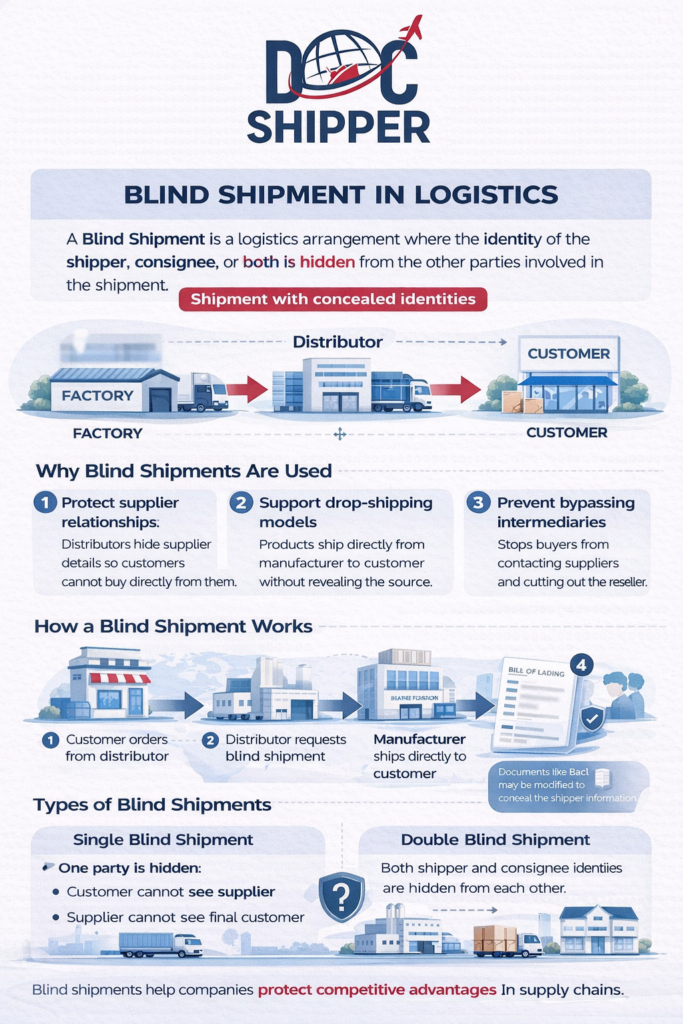
Blind shipment is a logistics practice where the shipper conceals the identity of the supplier or buyer from one or both parties in a transaction. This method protects commercial relationships, prevents direct contact between manufacturers and end customers, and maintains pricing confidentiality throughout the supply chain.
Introduction
Many importers face a critical dilemma: how to protect their supplier network while fulfilling customer orders. Without proper safeguards, manufacturers can bypass distributors and contact end buyers directly, destroying business relationships built over years.
Blind shipment addresses this challenge by creating information barriers in the logistics chain. This practice is essential for trading companies, distributors, and intermediaries who add value through sourcing, quality control, or market expertise rather than manufacturing.
- Confidentiality protection: Supplier and buyer identities remain separate
- Commercial relationship preservation: Prevents disintermediation risks
- Pricing strategy control: Maintains markup confidentiality between parties
- Multi-party coordination: Requires precise documentation management
- Customs compliance: Must satisfy regulatory transparency requirements
Mechanisms & Strategic Expertise
Blind shipment operates through strategic document control and third-party intermediation. The process involves creating two sets of commercial documents: one for the supplier relationship and another for the customer relationship.
Single blind shipment conceals the supplier’s identity from the end customer. The freight forwarder receives goods with the supplier’s details but ships with documentation showing only the intermediary as the sender. The buyer never sees the original manufacturer’s information.
Double blind shipment hides both parties from each other. The supplier ships to the intermediary’s address (or freight forwarder acting as intermediary) without knowing the final destination. The buyer receives goods showing only the intermediary as origin. Neither party knows the other’s identity.
Documentation requirements become complex in blind shipments. Commercial invoices, packing lists, and bills of lading must be reissued or modified. Customs authorities require accurate information about the actual shipper and consignee, creating compliance challenges that must be carefully managed.
Legal considerations vary by jurisdiction. Some countries restrict blind shipments for tax transparency, anti-money laundering, or trade security reasons. The European Union and United States generally permit the practice but require full disclosure to customs authorities. According to World Customs Organization guidelines, beneficial ownership information must be available upon request.
At DocShipper, we manage blind shipment documentation across multiple jurisdictions, ensuring compliance while protecting your commercial relationships. Our team coordinates with suppliers and customers to maintain confidentiality throughout the shipping process.
Concrete Examples & Operational Data
Understanding blind shipment implementation requires examining real-world scenarios and their operational implications. The following cases illustrate common applications and associated costs.
Comparative Scenario Analysis
| Shipment Type | Additional Cost | Processing Time | Risk Level |
|---|---|---|---|
| Standard Shipment | Baseline | 3-5 days | Low |
| Single Blind | +$150-300 | 4-6 days | Medium |
| Double Blind | +$300-500 | 5-8 days | Medium-High |
| Multi-Country Blind | +$500-800 | 7-12 days | High |
Use Case: Electronics Distributor
A US-based electronics distributor sources smartphones from a Shenzhen manufacturer at $180 per unit. The distributor sells to European retailers at $320 per unit. To prevent direct contact, they implement double blind shipment.
Operational flow: The manufacturer ships 5,000 units to a Hong Kong freight forwarder designated by the distributor. The forwarder receives goods with original documentation, then creates new commercial documents showing the distributor as shipper. The European retailer receives goods believing they originated from the distributor’s US warehouse.
Cost breakdown: Documentation handling ($400), temporary warehousing in Hong Kong ($650), additional coordination fees ($350). Total blind shipment premium: $1,400 for a $1.6 million transaction (0.09% of transaction value). The distributor protects a $140 per unit margin ($700,000 total) by preventing direct manufacturer-retailer contact.
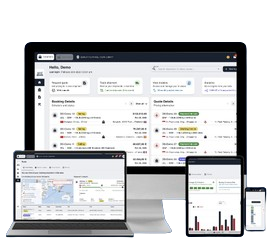
DocShipper Platform
One platform. Your entire supply chain
Sourcing, freight, customs & documents — all centralised, all visible, 24/7.
Key Implementation Factors
- Freight forwarder selection: Partner must have experience with blind shipments and maintain strict confidentiality protocols
- Document timing: New documentation must be prepared before customs clearance to avoid delays
- Payment structure: Separate payment flows to supplier and from customer prevent information leakage
- Insurance coverage: Policies must reflect actual parties while maintaining confidentiality requirements
- Communication protocols: Establish separate channels for supplier and customer interactions to prevent accidental disclosure
Conclusion
Blind shipment represents a strategic tool for protecting commercial relationships and maintaining competitive advantages in international trade. While adding modest costs and complexity, it prevents disintermediation worth significantly more than its implementation expense.
Need assistance implementing blind shipment for your operations? Contact DocShipper for expert guidance on protecting your supply chain relationships.
📚 Quiz
Test Your Knowledge: Blind Shipment
Q1 — What is the primary purpose of a blind shipment in international logistics?
Q2 — A common misconception about blind shipments is that they allow shippers to hide information from customs authorities. What is the correct interpretation?
Q3 — A US distributor sources products from a Chinese manufacturer and sells to European retailers. Neither party should know the other exists. Which type of blind shipment should the distributor use?
🎯 Your Result
📞 Free Quote in 24hFAQ | Blind Shipment: Definition, Process & Concrete Examples
Yes, blind shipment is legal in most jurisdictions when proper customs documentation is provided. Authorities require accurate shipper and consignee information for regulatory purposes, but this doesn't prevent commercial confidentiality between parties.
Single blind conceals the supplier from the buyer only. Double blind hides both the supplier from the buyer and the buyer from the supplier, with the intermediary acting as the sole visible party to each side.
Additional costs range from $150-800 per shipment depending on complexity, typically representing 0.05-0.2% of transaction value. Costs include documentation handling, coordination fees, and potential warehousing charges.
Yes, customs declarations must contain accurate information about all parties. The confidentiality applies to commercial relationships, not regulatory compliance. Authorities have full visibility for security and tax purposes.
Commercial invoices, packing lists, and sometimes bills of lading require modification or reissuance. Original documents go to customs while modified versions go to the end customer for commercial purposes.
Insurance policies must reflect the actual shipper and consignee for claims purposes. Your freight forwarder can arrange coverage that maintains confidentiality while ensuring proper protection.
Typically 1-3 additional days for documentation preparation and potential consolidation. Complex multi-country scenarios may add 3-7 days depending on warehousing requirements.
Yes, blind shipment works for all transport modes including air, ocean, and ground. Air freight requires faster document turnaround but follows the same confidentiality principles.
While not illegal, discovery defeats the purpose of blind shipment. Robust confidentiality agreements and careful document control minimize this risk. Experienced freight forwarders maintain strict protocols to prevent information leakage.
Most countries permit blind shipment, but some require additional disclosure for security or tax reasons. Middle Eastern countries and some Asian markets have stricter requirements. Always verify local regulations before implementing.
Yes, blind shipment complements dropshipping by preventing the end customer from seeing the supplier's information. This protects your sourcing strategy while maintaining the dropshipping business model.
Freight forwarders should only share shipment status and logistics information, never commercial details like pricing, party identities, or business relationships. Clear confidentiality agreements define these boundaries.
Need Help with
Logistics or Sourcing ?
First, we secure the right products from the right suppliers at the right price by managing the sourcing process from start to finish. Then, we simplify your shipping experience - from pickup to final delivery - ensuring any product, anywhere, is delivered at highly competitive prices.


Fill the Form
Prefer email? Send us your inquiry, and we’ll get back to you as soon as possible.
Contact us