


In short ⚡
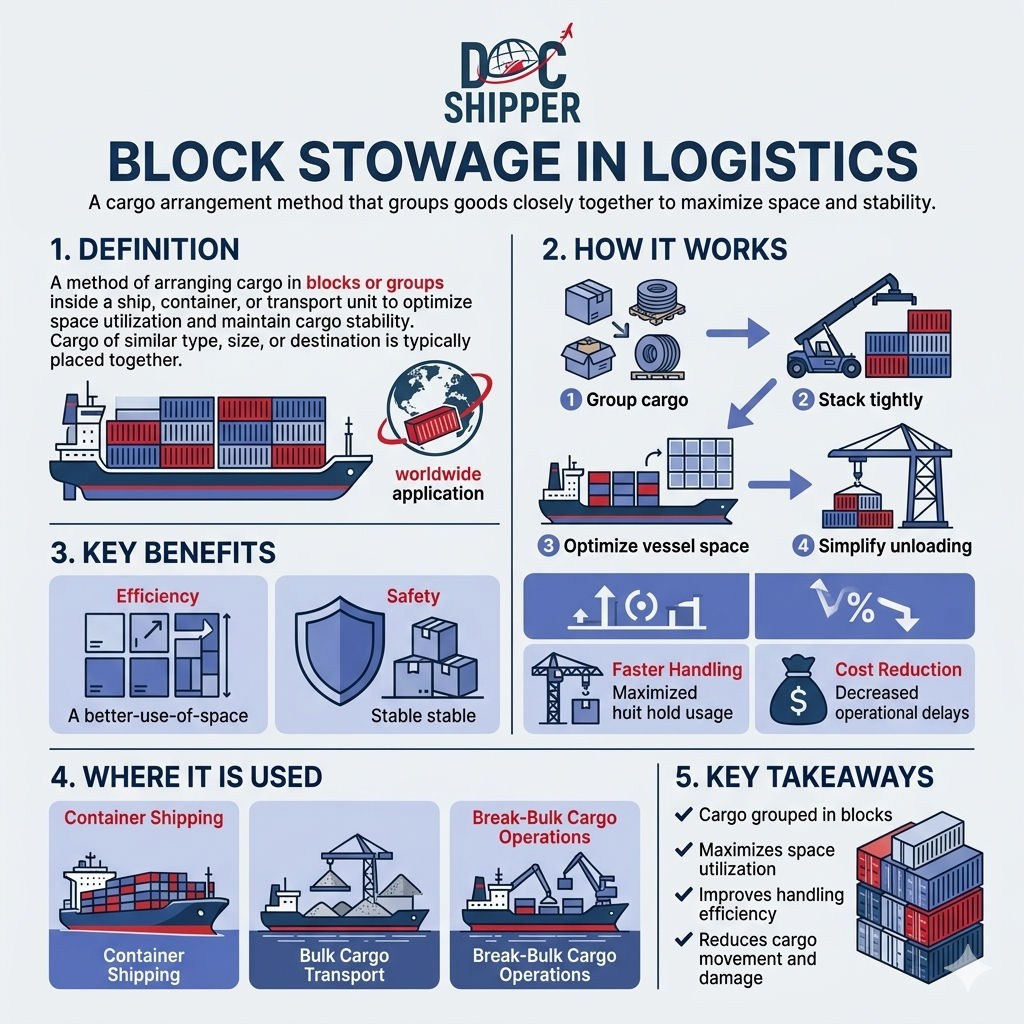
Block stowage is a cargo loading method where containers or goods from the same consignee, destination, or shipment are grouped together in a single block within the vessel or warehouse. This strategic arrangement optimizes discharge operations, reduces handling time, and minimizes cargo movement during transit, making it essential for efficient port operations and cost-effective logistics.
Introduction
One of the most common inefficiencies in container shipping is the need to shift multiple containers to access a single unit buried deep in the cargo hold. This problem costs shipping lines millions annually in wasted labor hours and vessel delays.
Block stowage addresses this challenge by organizing cargo systematically according to discharge ports, consignees, or cargo characteristics. This method is fundamental to modern container vessel operations and warehouse management systems.
Key characteristics of block stowage include:
- Destination-based grouping: Containers destined for the same port are stowed together
- Sequential discharge planning: Cargo is positioned to match the vessel’s port rotation sequence
- Minimized restows: Reduces the need to move containers multiple times
- Optimized space utilization: Maximizes cargo density while maintaining accessibility
- Enhanced operational efficiency: Accelerates loading and unloading operations at each port
Technical Principles & Strategic Implementation
Block stowage operates on the principle of vertical and horizontal segregation. Containers are arranged in three-dimensional blocks, with each block representing a specific discharge port or cargo category. The stowage coordinator must balance weight distribution, vessel stability, and discharge sequence simultaneously.
The bay planning process begins with the vessel’s port rotation schedule. Containers for the last port of call are loaded first and placed at the bottom or rear of the cargo hold, while containers for the first discharge port are positioned for easy access. This systematic approach prevents the costly problem of overstowage, where containers must be temporarily removed to access underlying cargo.
Modern stowage planning software uses algorithms to calculate optimal block configurations. These systems consider factors including container weight, type (standard, reefer, hazardous), size (20ft, 40ft, 45ft), and special handling requirements. The software generates a stowage plan that maximizes vessel capacity while ensuring safe navigation and efficient port operations.
According to International Maritime Organization (IMO) guidelines, proper block stowage must also account for cargo segregation rules, particularly for dangerous goods. Incompatible materials must be separated by minimum distances, which the blocking strategy must incorporate without compromising discharge efficiency.
The restow rate serves as a critical performance indicator for block stowage effectiveness. Industry benchmarks suggest that well-executed block stowage should maintain restow rates below 5% of total container moves. At DocShipper, we work closely with shipping lines to ensure optimal stowage plans that minimize these inefficiencies and reduce your overall logistics costs.
Weight distribution management represents another crucial aspect. Heavier containers are typically placed lower in the stack to maintain vessel stability, but this must be balanced against discharge sequence requirements. The stowage plan must comply with the vessel’s stability booklet while adhering to block stowage principles.
Practical Applications & Performance Data
Real-world implementation of block stowage demonstrates measurable operational improvements across various shipping scenarios. Consider a container vessel with a five-port rotation: Shanghai, Singapore, Colombo, Rotterdam, and Hamburg.
Comparative Performance Analysis
| Stowage Method | Average Restows per Port | Port Time (hours) | Labor Cost per Port | Annual Fuel Savings |
|---|---|---|---|---|
| Random Stowage | 45-60 moves | 18-24 hours | $12,000-15,000 | Baseline |
| Block Stowage | 3-8 moves | 12-16 hours | $6,500-8,000 | $180,000-220,000 |
Case Study: Asia-Europe Trade Lane
A major shipping line implemented advanced block stowage on its 14,000 TEU vessels operating between Asia and Europe. The results over a 12-month period revealed:
- 67% reduction in restow operations across all discharge ports
- Port productivity increased by 42% measured in container moves per hour
- $2.3 million annual savings in port handling charges per vessel
- 15% improvement in schedule reliability due to faster port turnaround times
- Reduced cargo damage claims by 28% from decreased container handling
DocShipper Platform
Cut logistics costs. Not corners.
See exactly where your logistics costs are bleeding — and how to fix it. Book your expert demo.

Warehouse Block Stowage Application
Block stowage principles extend beyond maritime operations into warehouse management. A 50,000 square meter distribution center implemented block stowage for export consolidation, achieving:
- Storage density improvement: 35% increase in usable warehouse capacity
- Picking efficiency: 48% reduction in travel time for order fulfillment
- Loading time reduction: Container stuffing operations completed 40% faster
- Error rate decrease: Shipment accuracy improved from 94% to 99.2%
At DocShipper, our logistics specialists analyze your specific shipping patterns to design customized block stowage strategies. We coordinate directly with carriers and terminal operators to ensure your cargo is positioned optimally, reducing both transit time and handling costs throughout your supply chain.
Key Performance Indicators
Successful block stowage implementation should target these benchmarks:
- Restow ratio: Below 5% of total container moves
- Bay utilization rate: Above 90% of available slot capacity
- Crane productivity: Minimum 30 moves per hour at major ports
- Overstowage incidents: Less than 2% per voyage
- Weight distribution variance: Within 3% of optimal stability parameters
Conclusion
Block stowage represents a fundamental logistics principle that directly impacts operational efficiency, cost control, and service reliability in international shipping. Proper implementation requires expertise in vessel operations, cargo characteristics, and port logistics coordination.
Need assistance optimizing your cargo stowage strategy or coordinating with carriers? Contact DocShipper for expert guidance on improving your shipping operations and reducing logistics costs.
📚 Quiz
Test Your Knowledge: Block Stowage
Q1 — What is the primary purpose of block stowage in container shipping?
Q2 — A shipping coordinator claims that with block stowage, containers for the first discharge port should be loaded first and placed at the bottom of the cargo hold. Is this correct?
Q3 — A 14,000 TEU vessel on the Asia-Europe trade lane switches from random stowage to block stowage. Which outcome best reflects what the data shows?
🎯 Your Result
📞 Free Quote in 24hFAQ | Block Stowage: Definition, Benefits & Practical Examples
Block stowage groups containers by destination or consignee in organized blocks, while random stowage places containers wherever space is available without systematic planning. Block stowage significantly reduces restow operations and port handling time.
Block stowage reduces costs by minimizing restow operations, decreasing port handling charges, reducing vessel time in port, and lowering fuel consumption through optimized weight distribution. Shippers can save 30-45% on handling costs compared to random stowage methods.
Yes, block stowage accommodates mixed cargo including standard containers, refrigerated units, and hazardous materials. The stowage plan must incorporate segregation requirements while maintaining destination-based grouping principles.
Modern stowage planning uses specialized software like MACS3, CASP, and Navis that calculate optimal container placement considering weight, destination, cargo type, and vessel stability. These systems integrate with terminal operating systems for seamless execution.
Proper block stowage enhances vessel stability by systematically distributing weight across bays and tiers. Planning software ensures compliance with stability parameters while maintaining discharge efficiency, preventing dangerous listing or trim conditions.
Industry-leading block stowage operations maintain restow rates below 5% of total container moves, compared to 15-25% with poorly planned stowage. Each percentage point reduction represents significant cost savings and time efficiency.
Block stowage is particularly effective for feeder vessels serving multiple small ports. The method allows efficient multi-port discharge operations where containers are grouped by destination, minimizing handling at each stop along the route.
Terminals receive the vessel's stowage plan via EDI systems before arrival. This advance information allows pre-planning of discharge sequences, equipment allocation, and yard positioning to maintain the block stowage efficiency throughout the cargo handling process.
Container weight is critical for both vessel stability and stack safety. Heavier containers are placed lower in the stack, but this must be balanced with discharge sequence requirements. VGM (Verified Gross Mass) regulations ensure accurate weight data for planning.
Shippers can request preferred stowage positions, especially for time-sensitive or fragile cargo. However, final stowage decisions rest with the carrier's stowage coordinator who must balance all cargo requirements while maintaining vessel safety and operational efficiency.
Block stowage reduces cargo damage incidents by minimizing container movements and handling operations. Insurance providers often recognize this reduced risk, and shippers using carriers with proven block stowage practices may benefit from lower premium rates.
Late cargo changes require stowage plan adjustments. Modern planning software can quickly recalculate optimal configurations, but frequent changes reduce efficiency. Carriers typically impose fees for late bookings that disrupt established stowage plans to discourage such practices.
Need Help with Logistics or Sourcing ?
First, we secure the right products from the right suppliers at the right price by managing the sourcing process from start to finish. Then, we simplify your shipping experience - from pickup to final delivery - ensuring any product, anywhere, is delivered at highly competitive prices.


Fill the Form
Prefer email? Send us your inquiry, and we’ll get back to you as soon as possible.
Contact us


