In short ⚡
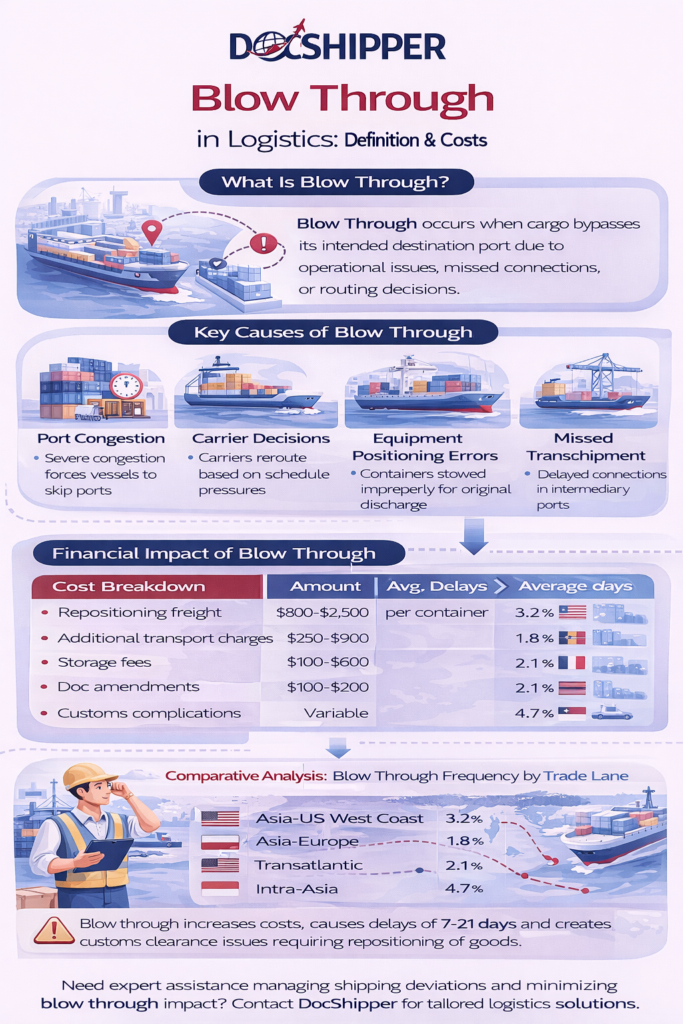
Blow Through refers to a logistics scenario where cargo bypasses its intended destination port and continues to another location due to operational constraints, missed connections, or carrier routing decisions. This unintended deviation creates additional costs, delays, and requires repositioning arrangements to return goods to the original destination.Introduction
Importers frequently encounter unexpected disruptions when containers fail to discharge at the planned port. The cargo “blows through” to the next destination on the vessel’s route, creating cascading complications for supply chains.
This phenomenon represents a critical risk in international shipping. Understanding blow through mechanics helps businesses implement preventive measures and rapid response protocols.
Key characteristics include:
- Unplanned continuation beyond the intended discharge port
- Triggered by vessel schedule pressures or operational errors
- Generates repositioning costs averaging $800-$2,500 per container
- Creates customs clearance complications at unintended locations
- Delays delivery timelines by 7-21 days on average
Mechanisms & Operational Implications
Blow through events stem from multiple operational factors. Port congestion ranks as the primary cause, forcing carriers to skip discharge operations to maintain schedule integrity across their network.
Equipment positioning errors occur when containers are stowed incorrectly aboard vessels. Stevedores may be unable to access specific units without extensive restacking operations, prompting carriers to defer discharge.
The financial liability framework typically places responsibility on the ocean carrier. However, bill of lading terms often include force majeure clauses that limit compensation for operational delays beyond carrier control.
Customs implications create significant complexity. When cargo arrives at an unintended country, importers face potential duty assessments, temporary import declarations, or bond requirements before repositioning can commence.
Recovery procedures involve coordinating with the carrier to arrange backhaul shipping. At DocShipper, we systematically monitor vessel schedules and intervene immediately when blow through risks emerge, minimizing financial exposure for our clients.
According to International Maritime Organization guidelines, carriers must provide prompt notification when cargo cannot be discharged as planned, though enforcement mechanisms remain limited.
Concrete Examples & Cost Data
Real-world blow through scenarios demonstrate the financial and operational impact on importers.
Use Case: Electronics Shipment from Shenzhen to Los Angeles
A consumer electronics importer scheduled a 40-foot container for discharge at Los Angeles. Due to terminal congestion, the carrier bypassed LA, continuing to Oakland.
| Cost Component | Amount (USD) |
|---|---|
| Repositioning freight (Oakland to LA) | $1,200 |
| Additional drayage charges | $450 |
| Storage fees (5 days at Oakland) | $375 |
| Documentation amendments | $150 |
| Opportunity cost (delayed sales) | $3,200 |
| Total Impact | $5,375 |
The 12-day delay forced the importer to expedite air shipment for replacement inventory, doubling the total financial impact.
Comparative Analysis: Blow Through Frequency by Trade Lane
| Trade Route | Incident Rate (%) | Avg. Delay (Days) |
|---|---|---|
| Asia-US West Coast | 3.2% | 9 |
| Asia-Europe | 1.8% | 14 |
| Transatlantic | 2.1% | 11 |
| Intra-Asia | 4.7% | 6 |
Data collected from 2023 shipping operations reveals higher blow through rates on congested short-haul routes where schedule pressure intensifies.
Prevention strategies include booking with carriers maintaining strong operational performance metrics, utilizing direct port pair services, and implementing real-time container tracking systems that alert to routing deviations.
DocShipper Platform
Cut logistics costs. Not corners.
See exactly where your logistics costs are bleeding — and how to fix it. Book your expert demo.
Conclusion
Blow through events represent avoidable supply chain disruptions that require proactive monitoring and rapid response protocols. Understanding carrier liability frameworks and cost implications enables better risk management strategies.
Need assistance managing shipping risks and preventing blow through scenarios? Contact DocShipper for expert logistics support.
📚 Quiz
Test Your Knowledge: Blow Through
Q1 — What does "blow through" mean in ocean freight logistics?
Q2 — How does a blow through differ from a transshipment?
Q3 — An importer's container bound for Los Angeles is bypassed due to terminal congestion and arrives in Oakland instead. Which of the following best describes the correct next step?
🎯 Your Result
📞 Free Quote in 24hFAQ | Blow Through: Definition, Calculation & Concrete Examples
Port congestion, vessel schedule pressures, equipment positioning errors, and operational constraints force carriers to skip intended discharge ports, continuing cargo to subsequent destinations on the routing.
Carriers typically bear responsibility, though bill of lading terms may limit liability. Shippers should review service contracts and pursue claims through carrier customer service channels immediately upon notification.
Average repositioning requires 7-21 days depending on the distance between the unintended port and original destination, plus vessel availability for backhaul arrangements.
Yes. Selecting direct port pair services, avoiding transshipment routes, booking with carriers demonstrating strong schedule reliability, and utilizing premium service tiers reduce blow through risk significantly.
Cargo arriving at unintended countries may trigger temporary import procedures, bonding requirements, or duty assessments before repositioning authorization. Customs brokers must file amended declarations reflecting actual arrival locations.
Carriers are obligated to provide notification, though timing varies. Proactive shippers implement container tracking systems that detect routing deviations independently, enabling faster response than relying on carrier communications.
Bill of lading amendments, arrival notices reflecting actual discharge port, customs entry modifications, and delivery order updates must be processed before cargo release and repositioning can commence.
Refrigerated containers and oversized cargo face higher risk due to specialized handling requirements and limited vessel stowage positions that complicate discharge operations under time pressure.
Experienced forwarders maintain carrier relationships enabling priority repositioning, negotiate cost absorption, expedite documentation amendments, and coordinate alternative delivery solutions minimizing supply chain disruption.
Standard cargo insurance excludes delay-related losses. Specialized contingency insurance policies covering consequential damages from shipping delays may provide coverage, though premiums reflect the elevated risk profile.
Shippers may file formal claims citing breach of carriage contract, pursue arbitration through bill of lading dispute resolution clauses, or engage maritime legal counsel for recovery proceedings.
Transshipment involves planned cargo transfer between vessels at intermediate ports. Blow through represents unplanned continuation past the intended final destination, requiring backhaul rather than forward connection.
Need Help with
Logistics or Sourcing ?
First, we secure the right products from the right suppliers at the right price by managing the sourcing process from start to finish. Then, we simplify your shipping experience - from pickup to final delivery - ensuring any product, anywhere, is delivered at highly competitive prices.


Fill the Form
Prefer email? Send us your inquiry, and we’ll get back to you as soon as possible.
Contact us