Board Feet: Definition & Calculation Guide for 2026

  • admin 8 Min
  • Published on March 17, 2026 Updated on March 17, 2026
img

In short ⚡

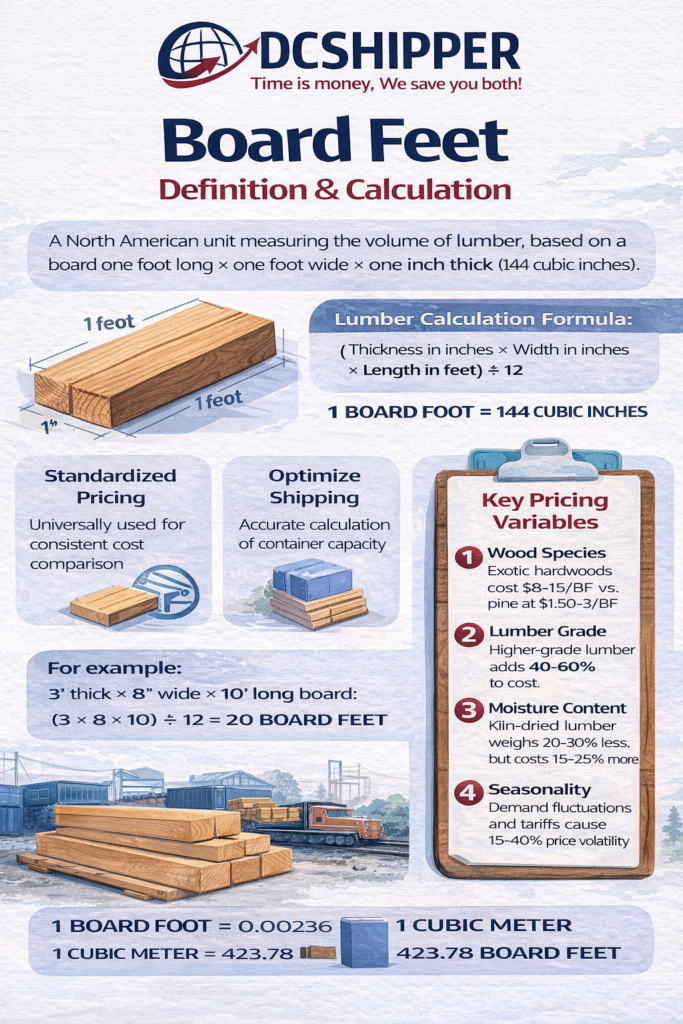
Board Feet is a standardized unit of lumber volume measurement used primarily in North America, representing the volume of a board one foot long, one foot wide, and one inch thick (144 cubic inches). This measurement system enables consistent pricing, ordering, and inventory management across the timber and logistics industries.

Introduction

Many importers face confusion when ordering timber internationally. Suppliers quote prices “per board foot,” but without understanding this measurement, companies risk over-ordering, under-budgeting, or receiving incorrect shipments.

In international lumber trade, Board Feet serves as the universal language between sawmills, freight forwarders, and buyers. This measurement directly impacts freight costs, customs valuation, and container optimization.

Key characteristics of Board Feet measurement:

  • Volume-based system: Accounts for length, width, and thickness simultaneously
  • Standardized pricing: Enables transparent cost comparison across suppliers
  • Logistics optimization: Critical for calculating container capacity and weight distribution
  • Customs documentation: Required for accurate HS code classification and duty calculation
  • Industry standard: Universally recognized in North American and international timber trade

Technical Framework & Industry Applications

The Board Foot formula follows a precise mathematical structure: (Thickness in inches × Width in inches × Length in feet) ÷ 12. This calculation assumes nominal dimensions, which differ from actual finished dimensions due to planing and drying processes.

Understanding nominal versus actual dimensions prevents costly disputes. A “2×4″ board actually measures 1.5″ × 3.5″ after milling, yet pricing calculations use the nominal 2″ × 4” dimensions. This industry convention affects both procurement and customs valuation.

In international shipping, container loading calculations require precise board foot measurements. A 40-foot container typically accommodates 18,000-22,000 board feet of lumber, depending on dimensions and stacking configuration. Miscalculations lead to wasted space or overweight penalties.

The customs classification process relies on accurate board foot declarations. Different wood species and dimensions fall under distinct HS codes, directly impacting duty rates. For example, hardwood versus softwood classifications can vary duty rates by 3-8% (U.S. International Trade Commission).

At DocShipper, we systematically verify board foot calculations during pre-shipment inspections to prevent documentation discrepancies that could trigger customs delays or additional fees.

Moisture content considerations also affect board foot pricing. Green lumber (unseasoned) weighs significantly more than kiln-dried wood, impacting freight costs despite identical board foot measurements. Contracts should specify moisture content percentages to avoid disputes.

Board Feet

Calculation Methods & Real-World Examples

Practical application of board foot calculations requires understanding various lumber configurations and their logistical implications.

Standard Calculation Example

Scenario: An importer orders 500 pieces of oak planks measuring 2″ thick × 6″ wide × 8′ long.

Calculation per piece: (2 × 6 × 8) ÷ 12 = 8 board feet
Total volume: 500 pieces × 8 BF = 4,000 board feet
Pricing impact: At $4.50/BF, total cost = $18,000
Weight estimate: Oak averages 3.8 lbs/BF (kiln-dried), total weight ≈ 15,200 lbs (6,895 kg)

Comparative Analysis: Board Feet vs. Cubic Meters

Measurement System Volume Unit Typical Use Case Conversion Factor
Board Feet 144 cubic inches North American lumber trade 1 BF = 0.00236 m³
Cubic Meters 1,000,000 cm³ European/Asian markets 1 m³ = 423.78 BF
Linear Feet Length only Molding/trim materials Varies by cross-section

Container Optimization Case Study

Challenge: A furniture manufacturer needs to import mixed-dimension hardwood within a single 40′ container.

Shipment breakdown:

  • 200 pcs @ 2″×8″×10′ = 2,667 BF
  • 300 pcs @ 1″×6″×12′ = 1,800 BF
  • 150 pcs @ 3″×12″×8′ = 3,600 BF
  • Total: 8,067 board feet

Logistics considerations: While the volume fits (under 20,000 BF limit), weight becomes critical. Walnut at 4.2 lbs/BF yields 33,881 lbs—exceeding the 40′ container payload of 58,000 lbs when including packaging. DocShipper’s pre-shipment planning identified this issue, recommending a split shipment to avoid overweight penalties.

Key Pricing Variables

  • Species premium: Exotic hardwoods command $8-15/BF versus softwood pine at $1.50-3/BF
  • Grade classification: FAS (Firsts and Seconds) grade adds 40-60% cost versus Common grade
  • Moisture content: Kiln-dried lumber costs 15-25% more but reduces shipping weight by 20-30%
  • Dimensional premiums: Wider boards (10″+) and longer lengths (14’+) carry 10-20% surcharges
  • Market fluctuations: Seasonal demand and tariff changes cause 15-40% price volatility annually

Conclusion

Mastering board foot calculations ensures accurate procurement, optimized shipping, and compliant customs documentation in international lumber trade. This measurement standard directly impacts cost control and operational efficiency across the supply chain.

Need expert guidance on timber import logistics or board foot verification? Contact DocShipper for comprehensive freight forwarding and customs clearance support.

📚 Quiz
Test Your Knowledge: Board Feet

FAQ | Board Feet: Definition, Calculation & Practical Examples

Multiply board feet by 0.00236 to convert to cubic meters. For example, 5,000 board feet equals approximately 11.8 cubic meters. This conversion is essential when coordinating with European or Asian suppliers using metric systems.

Ask us anything!

Need Help with Logistics or Sourcing ?

First, we secure the right products from the right suppliers at the right price by managing the sourcing process from start to finish. Then, we simplify your shipping experience - from pickup to final delivery - ensuring any product, anywhere, is delivered at highly competitive prices.

Live Chat

Get instant assistance from our team—just click and start chatting!

Live Chat Now
image

Fill the Form

Prefer email? Send us your inquiry, and we’ll get back to you as soon as possible.

Contact us
image

Call us

Reach out to us on WhatsApp for quick, convenient, and personal support.

Call us
image