In short ⚡
Bobtail refers to a semi-truck tractor operating without a trailer attached. This configuration is commonly used for repositioning equipment, returning from deliveries, or moving between terminals. Understanding bobtail operations is essential for fleet management, insurance coverage, and regulatory compliance in international freight transportation.Introduction
Many logistics professionals encounter confusion regarding bobtail operations—particularly concerning liability, fuel efficiency, and regulatory requirements. The term “bobtail” specifically describes a tractor without its trailer, creating unique operational and insurance considerations that differ significantly from standard loaded configurations.
In import/export logistics, bobtail movements represent critical non-revenue miles that impact fleet efficiency and cost structures. These movements occur daily across supply chains, from port terminals to distribution centers.
Key characteristics of bobtail operations include:
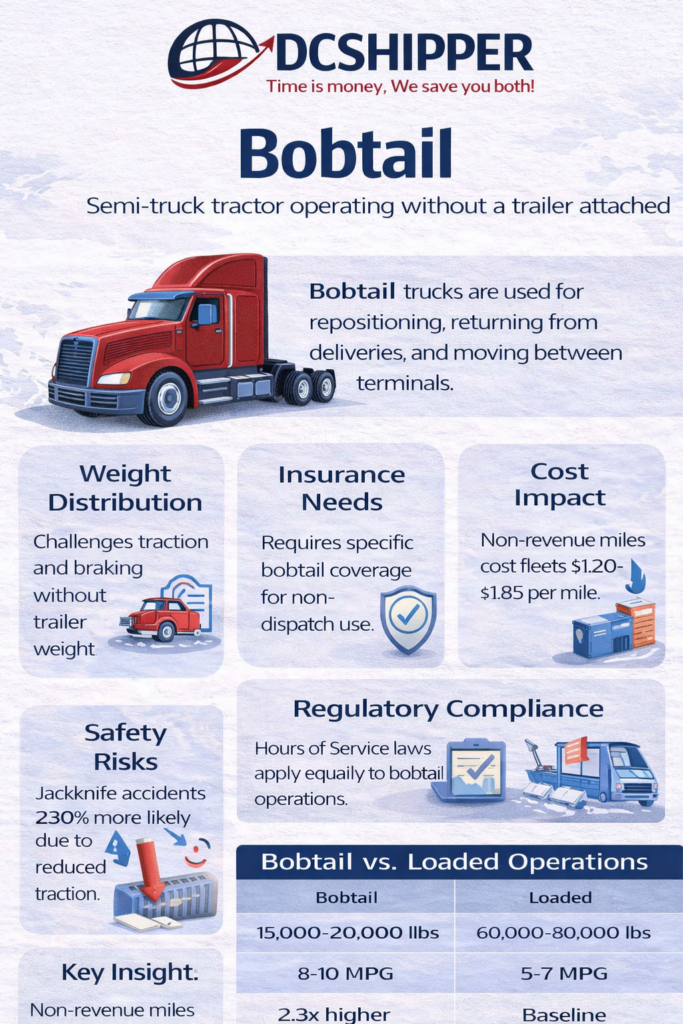
- Weight distribution challenges: Tractors designed for trailer loads handle differently when operating solo
- Insurance requirements: Specialized bobtail liability coverage protects drivers during non-dispatch movements
- Fuel consumption patterns: Unloaded tractors consume less fuel but travel more frequently for repositioning
- Regulatory compliance: Hours of service rules apply equally to bobtail and loaded operations
- Safety considerations: Reduced traction and braking efficiency require adjusted driving techniques
Bobtail Operations & Industry Expertise
Bobtail operations represent a significant portion of non-revenue miles in commercial trucking. When a driver completes a delivery and drops the trailer at a destination facility, the tractor must return to the terminal or proceed to the next pickup location without cargo. This configuration fundamentally alters vehicle dynamics and operational considerations.
The weight distribution becomes critical in bobtail mode. Semi-tractors are engineered with the expectation that trailer weight will press down on the fifth wheel, providing traction to the drive axles. Without this weight, the rear wheels have significantly reduced grip, particularly in adverse weather conditions. This explains why bobtail accidents often involve jackknifing or loss of control during emergency braking.
From an insurance perspective, standard commercial trucking policies may not cover bobtail operations. Carriers must secure specific bobtail liability insurance—also called non-trucking liability—that protects drivers when operating the tractor for personal use or while not under dispatch. According to the Federal Motor Carrier Safety Administration, this coverage gap has led to numerous uninsured incidents when drivers assumed their primary policy covered all tractor movements.
Fuel efficiency improves in bobtail configuration due to reduced weight, but the frequency of these movements can offset savings. Fleet managers must balance the cost of repositioning equipment against the revenue potential of available loads. Advanced logistics software now calculates optimal bobtail routes to minimize deadhead miles.
The regulatory framework treats bobtail operations identically to loaded movements regarding hours of service. Drivers must log bobtail time, and these hours count toward daily and weekly limits. The Electronic Logging Device (ELD) mandate applies equally, ensuring accurate tracking of all commercial vehicle operation.
Safety protocols for bobtail driving differ substantially from trailer operations. Professional drivers receive specialized training on braking distances, cornering speeds, and emergency maneuvers in bobtail configuration. The National Safety Council reports that bobtail-related accidents often result from drivers failing to adjust their technique for the altered vehicle dynamics.
At DocShipper, we coordinate with carriers to optimize bobtail movements during container repositioning, ensuring our clients’ equipment returns efficiently to terminals while maintaining full insurance coverage throughout the supply chain.
Practical Examples & Operational Data
Understanding bobtail operations requires examining real-world scenarios and quantifiable data. Fleet operators track bobtail miles as a key performance indicator, as these represent costs without corresponding revenue generation.
Comparative Analysis: Bobtail vs. Loaded Operations
| Metric | Bobtail Configuration | Loaded Configuration |
|---|---|---|
| Average Weight | 15,000-20,000 lbs | 60,000-80,000 lbs |
| Fuel Consumption | 8-10 MPG | 5-7 MPG |
| Braking Distance (60 mph) | 335-370 feet | 525-600 feet |
| Insurance Rate | $400-$800/year (bobtail policy) | $8,000-$12,000/year (commercial) |
| Accident Risk Factor | 2.3x higher (jackknife incidents) | Baseline |
Use Case: Port-to-Terminal Bobtail Operation
A logistics provider operates a fleet serving the Port of Los Angeles. After delivering an imported container to a distribution center 45 miles inland, the driver drops the chassis and returns bobtail to the port terminal.
Operational breakdown:
- Distance: 45 miles bobtail return
- Fuel cost: 4.5 gallons at $4.20/gallon = $18.90
- Time investment: 1.2 hours (including terminal check-in)
- Driver compensation: $36 (hourly rate during non-revenue time)
- Total cost per bobtail movement: $54.90
By implementing intelligent dispatch software, the company reduced bobtail miles by 23% over six months by coordinating backhaul loads and optimizing driver routes. This translated to annual savings exceeding $127,000 across a 30-truck fleet.
DocShipper Platform
Cut logistics costs. Not corners.
See exactly where your logistics costs are bleeding — and how to fix it. Book your expert demo.

Key Operational Insights
- Deadhead percentage: Industry average bobtail miles represent 12-18% of total fleet mileage
- Cost impact: Each bobtail mile costs carriers $1.20-$1.85 with zero revenue generation
- Safety statistics: Bobtail jackknife accidents increase 230% during wet conditions compared to loaded operations
- Efficiency opportunity: Advanced route optimization can reduce bobtail miles by 15-25%
- Insurance claims: Bobtail-specific incidents account for 8% of commercial trucking liability claims annually
Conclusion
Bobtail operations represent an unavoidable component of commercial trucking logistics, requiring specialized knowledge of vehicle dynamics, insurance requirements, and cost management. Effective fleet management minimizes these non-revenue miles while ensuring full compliance and safety.
Need assistance optimizing your international freight operations and managing equipment repositioning? Contact DocShipper for expert logistics consultation tailored to your supply chain requirements.
📚 Quiz
Test Your Knowledge: Bobtail
Q1 — What does the term "bobtail" specifically refer to in logistics?
Q2 — Why are bobtail tractors considered more dangerous to operate than loaded configurations?
Q3 — A driver drops a container at a distribution center and drives the tractor back to the port terminal alone. Which statement about this movement is correct?
🎯 Your Result
📞 Free Quote in 24hFAQ | Bobtail: Definition, Usage & Practical Examples in Logistics
Bobtail refers specifically to a tractor without a trailer, while deadhead describes any movement of a commercial vehicle without cargo—including tractors pulling empty trailers. Both represent non-revenue miles but have different operational characteristics.
Yes. Standard commercial trucking policies typically exclude coverage when the tractor operates without being under dispatch. Bobtail liability insurance specifically covers these situations, including personal use of the tractor by the driver.
Without trailer weight on the fifth wheel, drive axles have reduced traction. This decreases braking effectiveness and increases the risk of jackknifing, particularly during emergency stops or on slippery surfaces.
Industry averages range from $1.20 to $1.85 per bobtail mile when accounting for fuel, driver compensation, insurance, and equipment depreciation. This represents pure cost with no offsetting revenue.
Yes. All commercial vehicle operation, including bobtail movements, counts toward federal hours of service limits. Drivers must log this time using electronic logging devices and comply with daily and weekly driving limits.
Yes, but only with proper bobtail insurance coverage. Using the tractor for personal purposes without this specific policy creates significant liability exposure if an accident occurs during non-commercial use.
Industry benchmarks indicate 12-18% of total fleet mileage occurs in bobtail configuration. Well-optimized operations can reduce this to 8-10% through strategic load matching and route planning.
Bobtail tractors typically achieve 8-10 MPG compared to 5-7 MPG when loaded. However, the frequency of repositioning movements often negates fuel savings, making route optimization crucial for cost control.
Primary risks include jackknifing during braking, reduced stability in crosswinds, longer stopping distances on wet surfaces, and overconfidence due to lighter weight. Professional training addresses these specific hazards.
Advanced transportation management systems can reduce bobtail miles by 15-25% through intelligent load matching, predictive positioning, and real-time route optimization that coordinates backhaul opportunities.
Yes. After delivering imported containers from ports to inland destinations, tractors often return bobtail to terminals. Efficient coordination of these movements significantly impacts total logistics costs in international trade.
While not federally mandated, most leasing companies and fleet operators require bobtail coverage as a condition of equipment use. Many states also have minimum liability requirements that necessitate this coverage for comprehensive protection.
Need Help with
Logistics or Sourcing ?
First, we secure the right products from the right suppliers at the right price by managing the sourcing process from start to finish. Then, we simplify your shipping experience - from pickup to final delivery - ensuring any product, anywhere, is delivered at highly competitive prices.


Fill the Form
Prefer email? Send us your inquiry, and we’ll get back to you as soon as possible.
Contact us