


In short ⚡
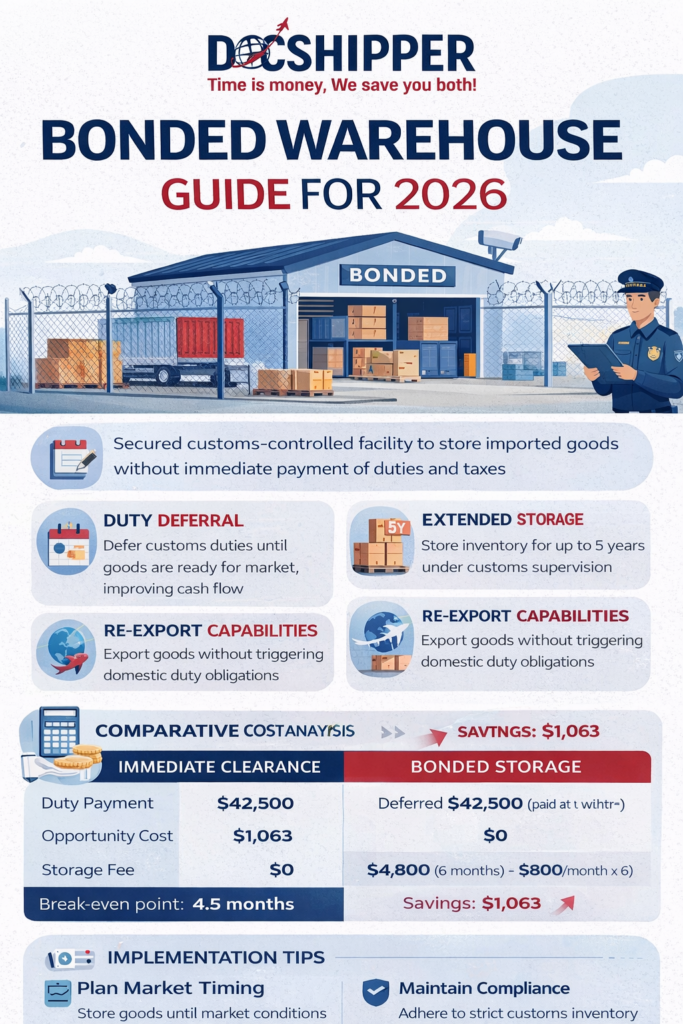
A bonded warehouse is a secured customs-controlled facility where imported goods can be stored without immediate payment of duties and taxes. These specialized storage locations allow businesses to defer customs clearance until goods are ready for market distribution or re-export, providing significant cash flow advantages in international trade operations.
Introduction
Many importers face a critical dilemma: goods arrive at port, but market conditions aren’t ideal for immediate sale. Paying duties upfront on inventory that might sit for months creates unnecessary financial strain.
Bonded warehouses solve this challenge by creating a customs suspension zone. These facilities represent a cornerstone of modern supply chain management, particularly for businesses managing volatile demand or seasonal products.
Key characteristics include:
- Duty deferral until goods leave the warehouse for domestic consumption
- Customs supervision with strict inventory tracking and reporting requirements
- Re-export capability without ever triggering domestic duty obligations
- Value-added operations such as labeling, repackaging, or light assembly under customs oversight
- Extended storage periods typically ranging from 3 to 5 years depending on jurisdiction
Regulatory Framework & Operational Requirements
Bonded warehouses operate under strict customs authorization granted by national authorities. In the United States, they’re classified under 19 CFR Part 19, while the European Union regulates them through Article 237 of the Union Customs Code.
The facility operator must provide financial guarantees covering potential duty liabilities. This bond protects customs authorities if duties become payable but remain uncollected. Bond amounts typically equal the maximum duty exposure expected within the warehouse at any given time.
Inventory reconciliation requirements demand meticulous record-keeping. Operators must track every item’s entry date, quantity, condition, and eventual disposition. Periodic audits by customs officials verify physical stock matches documented records.
Only certain goods qualify for bonded storage. Prohibited items include those restricted for public health, safety, or security reasons. Perishable goods face practical limitations due to storage duration constraints, though temperature-controlled bonded facilities exist for specific product categories.
Permitted activities within bonded warehouses extend beyond simple storage. Goods may undergo examination, sampling, sorting, grading, and even manufacturing processes that don’t alter tariff classification. At DocShipper, we help clients navigate these regulations to maximize operational flexibility while maintaining full compliance with customs requirements.
For detailed regulatory guidance, consult the U.S. Customs and Border Protection bonded warehouse regulations.
Practical Applications & Cost Analysis
Understanding the financial impact of bonded warehousing requires examining real-world scenarios. The duty deferral advantage becomes particularly significant with high-value goods or extended storage periods.
Comparative Cost Analysis
| Scenario | Immediate Clearance | Bonded Storage | Savings |
|---|---|---|---|
| Goods Value | $500,000 | $500,000 | — |
| Duty Rate | 8.5% | 8.5% (deferred) | — |
| Duty Amount | $42,500 (paid upfront) | $42,500 (paid at withdrawal) | — |
| Storage Period | 6 months | 6 months | — |
| Opportunity Cost (5% annual) | $1,063 | $0 | $1,063 |
| Bonded Storage Fee | $0 | $800/month × 6 | ($4,800) |
| Net Benefit | — | — | Break-even at 4.5 months |
Use Case: Electronics Importer
A consumer electronics distributor imports $2 million worth of smartphones quarterly from Asia. Market demand fluctuates significantly based on promotional cycles and competitor launches.
Challenge: Paying $170,000 in duties immediately ties up capital that could fund marketing campaigns or inventory diversification.
Solution: Store goods in a bonded warehouse near major distribution centers. Withdraw inventory in weekly batches aligned with confirmed orders, paying duties only on released quantities.
Results: Cash flow improved by $127,500 on average (75% of duty liability deferred). The company reinvested savings into demand-generation activities, increasing quarterly sales by 18%.
DocShipper Platform
Optimize Your Global Logistics with Cutting-Edge Solutions
Enhance efficiency, cut costs, and gain 24/7 visibility  over your entire supply chain.
- Cut your shipping costs and maximize your margins
- Manage sourcing, freight, & customs on one platform
- Get real-time tracking and analytics
Strategic Advantages
- Market timing flexibility: Release goods when prices peak or demand surges
- Re-export efficiency: Goods destined for third countries never incur domestic duties
- Quality control buffer: Inspect and test products before committing to duty payment
- Supply chain resilience: Maintain strategic inventory reserves without tax burden
- Trade show logistics: Temporarily import exhibition goods duty-free, then re-export
DocShipper manages bonded warehouse operations for clients across multiple jurisdictions, ensuring seamless coordination between customs compliance and inventory optimization strategies.
Conclusion
Bonded warehouses transform duty obligations from immediate cash outlays into manageable, strategic decisions aligned with business operations. This flexibility proves invaluable for importers navigating uncertain demand, seasonal markets, or complex distribution networks.
Need expert guidance on implementing bonded warehouse solutions for your supply chain? Contact DocShipper to discuss how we can optimize your international logistics strategy.
📚 Quiz
Bonded Warehouse
Q1 — What is the primary purpose of a bonded warehouse?
Q2 — A company imports goods and re-exports them to a third country directly from a bonded warehouse. Which statement is correct?
Q3 — An e-commerce business stores 10,000 units in a bonded warehouse and receives orders for 500 units. How are duties calculated at withdrawal?
🎯 Your Result
📞 Free Quote in 24hFAQ | Bonded Warehouse: Definition, Regulations & Practical Examples
Explosives, hazardous materials requiring special permits, perishable foods without temperature control facilities, and goods subject to import prohibitions (such as counterfeit items or endangered species products) are typically excluded from bonded storage eligibility.
Storage periods vary by country. The U.S. allows five years, the EU permits three years with possible extensions, and China typically grants one year. Extensions may be available upon application to customs authorities.
Damaged goods must be reported to customs immediately. If destruction is necessary, it occurs under customs supervision with duty liability eliminated. If goods are withdrawn despite damage, duties apply to the original declared value unless evidence proves the damage occurred in-bond.
Yes, ownership can transfer while goods remain bonded. The new owner assumes duty liability and must be registered with customs. This enables efficient trading without physical movement or duty payment until final domestic consumption.
Bonded warehouses defer duties on imported goods, while free trade zones (FTZs) offer broader benefits including exemption from certain regulations, ability to manufacture products, and potential duty elimination on re-exports. FTZs typically provide more comprehensive trade facilitation.
The goods owner or their designated agent pays storage fees to the warehouse operator. These fees are separate from customs duties and vary based on facility location, storage duration, handling requirements, and value-added services requested.
No, businesses of all sizes use bonded warehouses. Small importers benefit proportionally more from cash flow improvements, though minimum storage fees may make bonding economical only for shipments exceeding certain value thresholds (typically $10,000-$25,000).
Withdrawal requires a customs entry declaration, commercial invoice, packing list, and payment of applicable duties and taxes. Additional permits may be needed for regulated products. The warehouse operator coordinates with customs to ensure proper clearance procedures.
Yes, partial withdrawals are permitted and common. Duties are calculated only on the quantity released. This flexibility allows businesses to match inventory releases precisely with sales demand, optimizing both cash flow and inventory management.
Bonded facilities must meet stringent security standards including 24/7 surveillance, controlled access systems, inventory tracking technology, and regular customs inspections. Insurance coverage protects against theft, damage, or loss, with liability terms specified in warehouse agreements.
Country of origin marking must be completed before goods enter domestic commerce, but can occur while goods are in bonded status. This allows importers to delay final labeling until market destination is confirmed, particularly useful for goods destined for multiple countries.
Absolutely. E-commerce companies use bonded warehouses to stock inventory near major markets without immediate duty payment, then fulfill orders and pay duties only on sold items. This model significantly reduces upfront capital requirements for international market entry.
Need Help with Logistics or Sourcing ?
First, we secure the right products from the right suppliers at the right price by managing the sourcing process from start to finish. Then, we simplify your shipping experience - from pickup to final delivery - ensuring any product, anywhere, is delivered at highly competitive prices.


Fill the Form
Prefer email? Send us your inquiry, and we’ll get back to you as soon as possible.
Contact us


