In short ⚡
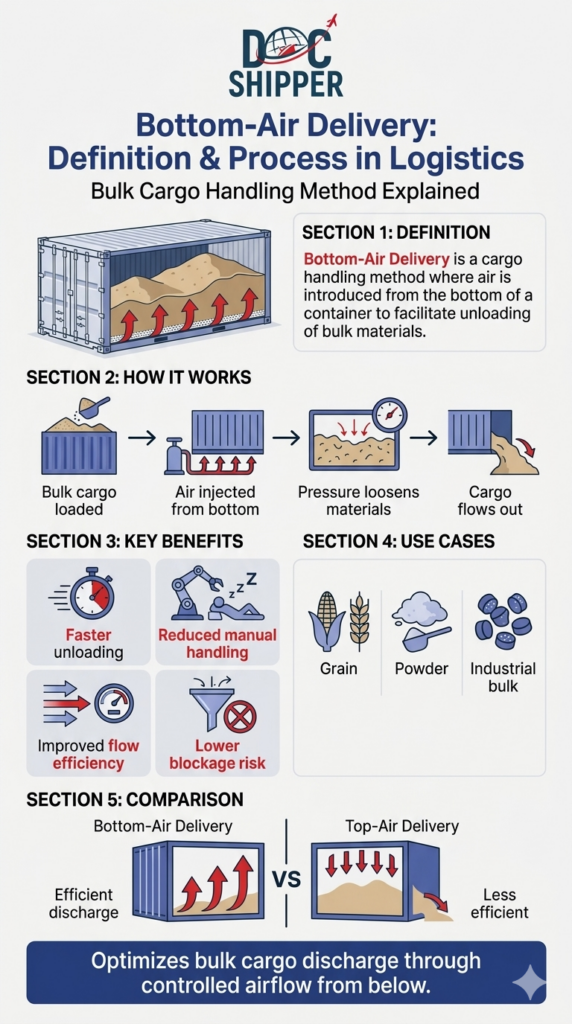
Bottom-Air Delivery is an aircraft loading method where cargo is loaded into the lower deck holds through belly compartments, maximizing space utilization for freight transport. This technique is essential for commercial passenger flights carrying cargo alongside passengers, enabling airlines to optimize revenue per flight while maintaining strict weight distribution requirements.Introduction
Many shippers misunderstand how air cargo actually reaches its destination, assuming all freight travels on dedicated cargo planes. In reality, a significant portion moves via bottom-air delivery on commercial passenger flights, utilizing the aircraft’s lower deck compartments.
This method represents a critical component of global logistics networks, especially for time-sensitive shipments that don’t require full charter services. Understanding bottom-air delivery helps businesses optimize shipping costs while maintaining delivery speed.
- Dual-purpose aircraft utilization – Commercial flights carry passengers above and cargo below simultaneously
- Standardized ULD containers – Unit Load Devices ensure efficient loading and secure transport
- Weight distribution protocols – Strict balance requirements prevent flight safety issues
- Limited cargo dimensions – Lower deck height restrictions typically range from 60-64 inches
- Priority access to routes – Leverages existing passenger flight schedules for faster connections
Technical Process & Operational Expertise
Bottom-air delivery operates through a sophisticated loading system designed around aircraft belly compartments. These lower deck holds are accessed through cargo doors located on the fuselage underside, typically on the right side of the aircraft for Boeing models and left side for Airbus configurations.
The loading process involves mechanized conveyor systems and specialized ground handling equipment. Cargo is consolidated into ULDs (Unit Load Devices) before flight, with containers shaped to fit the curved fuselage interior. Standard ULD types include LD3 containers (60.4″ x 61.5″ x 64″) for narrow-body aircraft and LD6 or LD11 for wide-bodies.
Weight and balance calculations are critical for flight safety. Ground crews must distribute cargo according to the aircraft’s center of gravity requirements, documented on load planning sheets. Improper distribution can affect aircraft performance during takeoff, flight, and landing phases.
Regulatory compliance follows IATA Dangerous Goods Regulations for hazardous materials, with specific restrictions for bottom-air compartments. Certain lithium battery configurations, for example, face stricter limitations in passenger aircraft holds compared to dedicated freighters.
At DocShipper, we coordinate directly with airline cargo departments to ensure proper ULD selection and compliance documentation, preventing costly delays caused by incompatible packaging or missing certifications. Our teams verify dimensional constraints before booking to guarantee seamless bottom-air delivery.
Temperature-controlled compartments exist on many modern aircraft, enabling pharmaceutical and perishable transport via bottom-air delivery. These climate zones maintain specific temperature ranges, though capacity is more limited than dedicated cargo aircraft.
Practical Examples & Industry Data
Bottom-air delivery capacity varies significantly by aircraft type, directly impacting shipping strategies for international freight forwarders. Understanding these differences enables better route planning and cost optimization.
| Aircraft Model | Lower Deck Volume | Typical ULD Capacity | Max Cargo Weight |
|---|---|---|---|
| Boeing 737-800 | 44.5 m³ | 5 LD3 containers | 2,200 kg |
| Airbus A320 | 37.4 m³ | 4-5 LD3 containers | 2,100 kg |
| Boeing 777-300ER | 202 m³ | 32 LD3 containers | 20,000 kg |
| Airbus A350-900 | 139 m³ | 28 LD3 containers | 17,400 kg |
Use Case: Electronics Shipment from Shenzhen to Frankfurt
A European retailer needs 1,500 kg of consumer electronics shipped urgently. Using bottom-air delivery on a daily Cathay Pacific passenger flight (A350-900), the shipment occupies 8 LD3 containers. Transit time: 14 hours door-to-door including customs clearance. Cost: approximately 35% lower than dedicated freighter charter, with delivery within 24 hours versus 3-5 days for ocean freight.
Industry data reveals that bottom-air delivery accounts for approximately 45% of global air cargo volume, according to IATA statistics. This method proves particularly cost-effective for shipments under 5,000 kg requiring rapid delivery but not justifying full charter costs.
Peak season dynamics significantly affect bottom-air availability. During Q4 holiday periods, passenger luggage volume increases, reducing available belly space by 20-30%. Forward-thinking shippers book space weeks in advance or shift to dedicated freighters during these periods.
Cost comparison shows bottom-air delivery typically ranges from $3.50-$6.50 per kg on major trade lanes, versus $5.50-$9.00 per kg for dedicated freighters. However, space availability and priority boarding affect actual rates significantly.
DocShipper Platform
Cut logistics costs. Not corners.
See exactly where your logistics costs are bleeding — and how to fix it. Book your expert demo.
Conclusion
Bottom-air delivery represents an essential logistics solution, combining cost efficiency with speed for small to medium-sized international shipments. Mastering its technical requirements and capacity limitations enables businesses to optimize their supply chain strategies effectively.
Need expert guidance on bottom-air delivery for your shipments? Contact DocShipper for tailored logistics solutions that match your specific requirements and timelines.
📚 Quiz
Test Your Knowledge: Bottom-Air Delivery
Q1 – What does "Bottom-Air Delivery" refer to in air freight logistics?
Q2 – During peak holiday seasons (Q4), what typically happens to belly cargo space on passenger aircraft?
Q3 – A European retailer needs to ship 1,500 kg of consumer electronics from Shenzhen to Frankfurt urgently, without the budget for a full charter. Which option best describes the ideal use of bottom-air delivery in this scenario?
🎯 Your Result
📞 Free Quote in 24hFAQ | Bottom-Air Delivery: Definition, Process & Practical Examples
Maximum dimensions depend on aircraft type, but typical LD3 containers measure 60.4" x 61.5" x 64". Oversized items exceeding these dimensions require main deck loading on freighter aircraft instead.
Yes, many modern aircraft feature climate-controlled lower deck compartments maintaining 2-8°C for pharmaceuticals or perishables. However, capacity is limited compared to dedicated cargo planes with full temperature zones.
Bottom-air delivery typically costs 30-40% less than dedicated freighter services for shipments under 2,000 kg. Rates vary by route density, season, and fuel surcharges, averaging $4-$6 per kg on major lanes.
Prohibited items include certain lithium batteries exceeding watt-hour limits, flammable liquids, compressed gases, and explosives. IATA Dangerous Goods Regulations provide complete restrictions lists for passenger aircraft lower decks.
For standard shipments, booking 3-5 days ahead ensures space availability. During peak seasons (November-January, Chinese New Year), reserve space 2-3 weeks early to avoid capacity shortages.
Yes, airlines provide tracking through AWB (Air Waybill) numbers. Updates occur at departure, arrival, and customs clearance points, though real-time GPS tracking is less common than ocean freight containers.
Airlines prioritize passenger baggage over cargo. If belly space is insufficient, cargo gets offloaded to the next available flight, potentially causing 6-24 hour delays. This risk increases during holidays.
Limited hazardous materials are permitted under strict IATA regulations, including proper labeling, documentation, and packaging. Restrictions are tighter than freighter aircraft, with many Class 1-3 materials prohibited entirely.
Aircraft require precise center-of-gravity balance. Ground crews distribute cargo across forward, center, and aft compartments according to load planning calculations. Improper distribution can delay flights pending reconfiguration.
Essential documents include Air Waybill (AWB), commercial invoice, packing list, and customs declarations. Specialized cargo requires additional certifications like Shipper's Declaration for Dangerous Goods or phytosanitary certificates.
Insurance coverage is identical regardless of aircraft type, based on declared cargo value. However, some insurers apply slightly higher premiums for bottom-air delivery due to mixed-use aircraft handling procedures.
Transit times range from 12-48 hours for major routes, including ground handling and customs. Door-to-door delivery depends on destination airport proximity and customs efficiency, typically adding 6-24 hours beyond flight time.
Need Help with
Logistics or Sourcing ?
First, we secure the right products from the right suppliers at the right price by managing the sourcing process from start to finish. Then, we simplify your shipping experience - from pickup to final delivery - ensuring any product, anywhere, is delivered at highly competitive prices.


Fill the Form
Prefer email? Send us your inquiry, and we’ll get back to you as soon as possible.
Contact us