In short ⚡
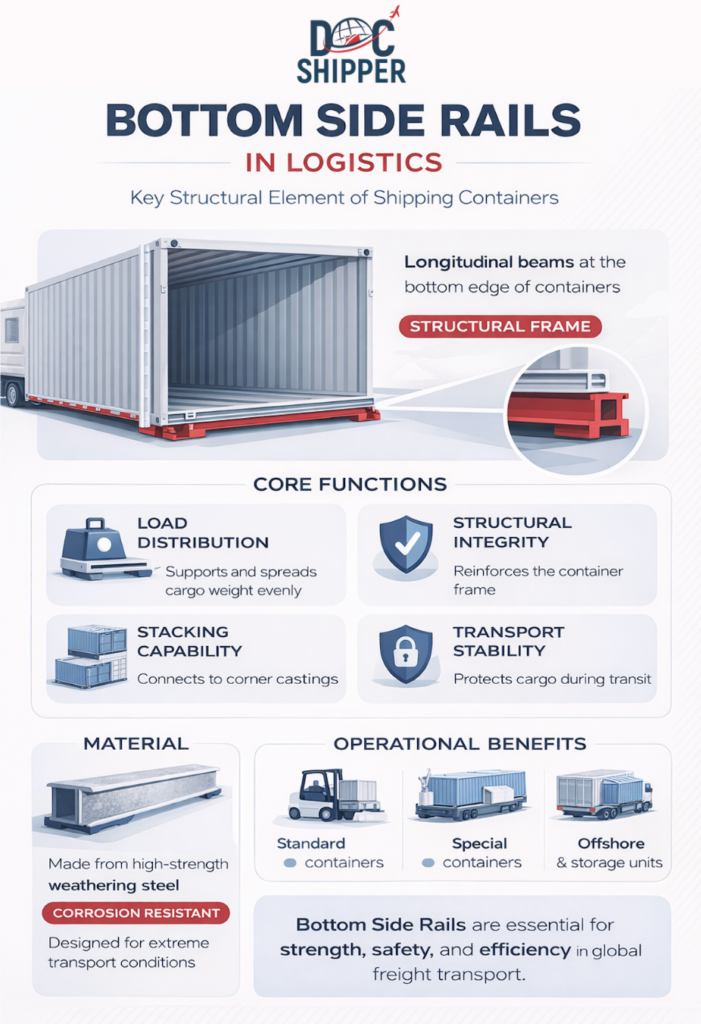
Bottom Side Rails are horizontal structural beams located on the underside of shipping containers, running lengthwise along both edges. These reinforced steel components support the container's base structure, distribute weight evenly across the foundation, and provide essential lifting points for handling equipment during loading, unloading, and stacking operations.Introduction
Many logistics professionals overlook the critical role of bottom side rails when planning container shipments. These seemingly simple components determine whether your cargo arrives intact or suffers costly damage during transit.
In international freight operations, bottom side rails serve as the backbone of container integrity. They connect directly to corner castings, enable secure stacking, and ensure compatibility with standardized handling equipment worldwide.
- Load distribution: Prevent floor deformation by spreading weight across the entire base structure
- Handling compatibility: Designed to work with forklifts, reach stackers, and gantry cranes
- Structural reinforcement: Made from high-tensile steel to withstand repeated stacking cycles
- Standardization compliance: Meet ISO 668 and ISO 1496 specifications for intermodal transport
- Damage prevention: Protect container floors from ground contact and moisture penetration
Structural Function & Technical Specifications
Bottom side rails integrate with the container’s corner posts and cross members to create a rigid framework. This triangulated structure resists torsional forces during crane lifts and prevents catastrophic failures when containers stack nine-high on vessel decks.
The rails typically measure 150-200mm in height and extend the full 20ft or 40ft container length. Constructed from Corten steel (weathering steel), they resist corrosion in marine environments while maintaining structural integrity across temperature extremes from -40°C to +60°C.
Each rail features precisely positioned fork pockets at standard intervals. These openings allow forklift tines to engage safely, supporting loads up to 30,480kg (maximum gross weight for standard containers). The pocket dimensions follow strict tolerances to ensure global equipment compatibility.
Modern container designs incorporate gooseneck tunnels within the bottom side rail structure. These recessed channels accommodate chassis twist locks, enabling secure road transport without additional securing mechanisms. At DocShipper, we verify these structural elements during pre-shipment inspections to prevent transit delays caused by equipment incompatibility.
According to ISO 1496-1 specifications, bottom side rails must withstand stacking test loads of 942 kN applied through corner fittings. This requirement ensures containers maintain structural integrity when positioned at the bottom of nine-tier stacks during ocean transit.
The rail design also incorporates drainage considerations. Slight elevation above ground level prevents water accumulation beneath containers during storage, reducing rust formation and extending service life beyond the typical 10-15 year operational period.
Practical Applications & Industry Data
Understanding bottom side rail specifications directly impacts cargo planning efficiency. Weight distribution across these rails determines maximum payload capacity and influences customs documentation accuracy.
| Container Type | Rail Height (mm) | Fork Pocket Spacing | Maximum Floor Load (kg/m²) |
|---|---|---|---|
| 20ft Standard Dry | 150 | 1,830mm intervals | 5,460 |
| 40ft High Cube | 175 | 2,440mm intervals | 4,890 |
| 20ft Flat Rack | 200 | Full-length access | 6,780 |
| 40ft Refrigerated | 165 | 1,830mm intervals | 4,200 |
Case Study: A machinery exporter shipping CNC equipment from Germany to Vietnam experienced floor buckling during ocean transit. Investigation revealed improper weight concentration exceeding the 5,460 kg/m² floor rating. The cargo’s 8,200kg total weight was positioned over just 1.2m² of floor space, creating localized stress that deformed the bottom side rails.
Proper cargo distribution across the container’s length would have spread this load to approximately 2.8m², maintaining stress levels within acceptable parameters. This incident resulted in €12,400 in repair costs and a three-week delivery delay.
Industry data from the Container Owners Association shows that 23% of container damage claims involve bottom structure failures. Of these, 67% trace back to improper forklift engagement with side rail pockets, causing structural cracks that propagate during stacking operations.
Terminal operators report that containers with damaged bottom side rails require 15-minute average handling delays for safety inspections. Across major European ports processing 14 million TEU annually, this translates to approximately 87,500 hours of lost operational time per year.
At DocShipper, we conduct structural assessments before container loading, verifying rail integrity and fork pocket condition. This preventive approach has reduced our clients’ damage claims by 34% compared to industry averages over the past 24 months.
DocShipper Platform
One platform. Your entire supply chain
Sourcing, freight, customs & documents — all centralised, all visible, 24/7.
Conclusion
Bottom side rails represent the foundation of container structural integrity, directly impacting cargo safety and handling efficiency. Proper understanding of their specifications prevents costly damage and ensures smooth international transit.
Need expert guidance on container specifications or cargo optimization? Contact DocShipper for professional logistics support tailored to your shipping requirements.
📚 Quiz
Test Your Knowledge: Bottom Side Rails
Q1 — What is the primary function of bottom side rails on a shipping container?
Q2 — A logistics manager assumes that bottom side rails and top side rails serve the same structural purpose. Is this correct?
Q3 — A machinery exporter loads an 8,200 kg CNC machine concentrated over just 1.2 m² of a 20ft standard dry container floor (rated at 5,460 kg/m²). What is the most likely outcome?
🎯 Your Result
📞 Free Quote in 24hFAQ | Bottom Side Rails: Definition, Function & Practical Examples
Bottom side rails distribute container weight evenly across the base structure, provide forklift access points, and connect corner castings to maintain structural integrity during stacking and transport operations.
Bottom rails support weight distribution and forklift handling, while top side rails primarily provide structural reinforcement and roof attachment points. Bottom rails feature fork pockets; top rails typically do not.
Minor dents and surface corrosion can be repaired through welding and reinforcement. Severe structural cracks or deformation usually require complete rail replacement to maintain ISO certification and safety standards.
Common causes include improper forklift engagement, excessive point loads exceeding floor ratings, corrosion from prolonged moisture exposure, and metal fatigue from repeated stacking cycles beyond design specifications.
Industry standards recommend visual inspections before each loading operation and comprehensive structural assessments every 30 months or after any impact event that may compromise rail integrity.
While ISO standards ensure basic compatibility, rail height, fork pocket spacing, and reinforcement vary by container type. Specialized units like tank containers and flat racks feature modified designs for specific cargo requirements.
Under normal operating conditions with proper maintenance, bottom side rails last 12-18 years. Marine environments and heavy industrial use may reduce this to 8-10 years before replacement becomes necessary.
Gooseneck tunnels are recessed channels integrated into the bottom side rail structure, allowing chassis twist locks to secure containers during road transport without interfering with the rail's structural function.
Bottom side rails provide limited ground contact points, making containers unstable on uneven surfaces. Proper foundation preparation or additional support structures are required for safe ground storage operations.
Most manufacturers use Corten steel (ASTM A588 or equivalent), a weathering steel alloy that forms a protective oxide layer, providing superior corrosion resistance without requiring paint in marine environments.
Rail structural strength determines maximum stacking weight and floor load distribution. Stronger rail designs allow higher payload capacities, but total weight remains limited by ISO maximum gross weight standards.
ISO 668 and ISO 1496 establish dimensional and strength requirements, ensuring global compatibility. However, manufacturers may incorporate proprietary reinforcements or design variations within these standardized parameters.
Need Help with
Logistics or Sourcing ?
First, we secure the right products from the right suppliers at the right price by managing the sourcing process from start to finish. Then, we simplify your shipping experience - from pickup to final delivery - ensuring any product, anywhere, is delivered at highly competitive prices.


Fill the Form
Prefer email? Send us your inquiry, and we’ll get back to you as soon as possible.
Contact us