


In short ⚡
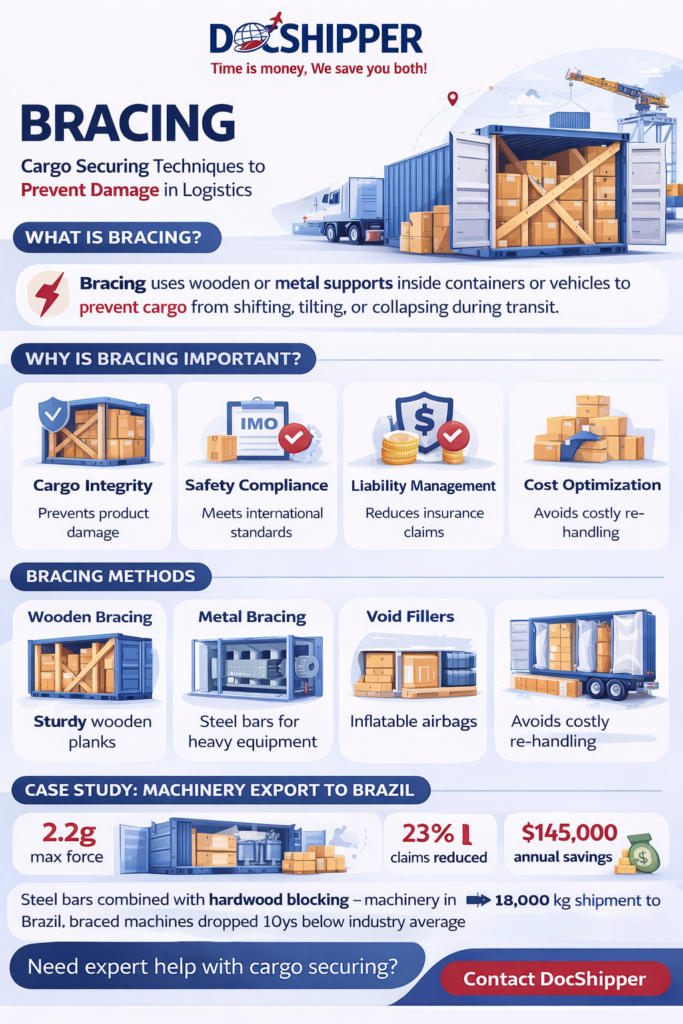
Bracing is a cargo securing technique using wooden or metal supports to prevent load movement during transport. This method creates physical barriers inside containers or vehicles, protecting goods from shifting, tilting, or collapsing during handling and transit operations.Introduction
Cargo damage during international shipping costs the industry billions annually. A significant portion stems from inadequate load securing—particularly the absence of proper bracing.
In maritime, road, and rail transport, bracing serves as the primary defense against dynamic forces. Acceleration, braking, cornering, and sea motion generate forces that can destabilize even heavy loads.
Understanding bracing is essential for:
- Cargo integrity: Prevents product damage and financial losses
- Safety compliance: Meets IMO, IMDG, and CTU Code requirements
- Liability management: Reduces insurance claims and legal disputes
- Operational efficiency: Minimizes delays from cargo incidents
- Cost optimization: Avoids expensive re-handling and repairs
Technical Implementation & Regulatory Framework
Effective bracing requires understanding physical forces and material specifications. The CTU Code (Code of Practice for Packing of Cargo Transport Units) establishes international standards for cargo securing, including bracing methodologies.
Load distribution principles dictate that bracing must counteract longitudinal, lateral, and vertical forces. Longitudinal forces during braking can reach 0.8g, while lateral forces during cornering approach 0.6g. Vertical forces from road irregularities add complexity.
Material selection depends on cargo weight and fragility. Softwood lumber (pine, spruce) suits general applications, while hardwood (oak, beech) handles heavier loads. Metal bracing bars provide maximum strength for industrial machinery.
Attachment methods include nailing directly to container floors (when permitted), friction-based wedging, or integration with lashing systems. The International Maritime Organization (IMO) provides detailed guidance on acceptable securing arrangements.
Regulatory compliance varies by transport mode. Maritime shipping follows the IMDG Code for dangerous goods and general CTU guidelines. Road transport adheres to EN 12195 standards in Europe, while the FMCSA regulates cargo securement in the United States.
At DocShipper, our packing specialists calculate required bracing dimensions based on cargo characteristics and transport conditions, ensuring full regulatory compliance across all shipping modes.
Practical Examples & Industry Data
Real-world applications demonstrate bracing’s critical role in cargo protection. Industry data reveals that properly braced cargo reduces damage claims by 67% compared to inadequately secured shipments.
Comparative Bracing Scenarios
| Cargo Type | Bracing Method | Material Used | Force Resistance |
|---|---|---|---|
| Machinery (8 tons) | Steel I-beam bracing | Metal supports + welding | Up to 1.2g lateral |
| Palletized goods | Wooden void fillers | 4×4″ lumber + plywood | 0.6g longitudinal |
| Fragile electronics | Foam-backed bracing | Softwood + PE foam | 0.4g with cushioning |
| Coiled steel | Radial blocking | Hardwood wedges | 0.8g multi-directional |
Case Study: Automotive Parts Shipment
A European manufacturer shipping engine components to Asia experienced a 23% damage rate. Analysis revealed inadequate bracing allowed pallet shifting during sea transit.
Solution implemented:
- Custom wooden frames around pallet stacks
- Cross-bracing between container walls and cargo
- Anti-slip mats combined with lumber blocking
- Lashing straps integrated with bracing structure
Results: Damage rate dropped to 2.1% within three months, saving approximately €180,000 annually in claims and replacements.
Key Implementation Points
- Gap elimination: Bracing must fill all voids—even 10cm gaps allow dangerous movement
- Load distribution: Pressure points require padding to prevent cargo crushing
- Material quality: Moisture content below 20% prevents wood warping
- Inspection protocols: Pre-shipment checks reduce rejection rates by 34%
- Documentation: Photographic evidence protects against liability disputes
Conclusion
Proper bracing transforms cargo security from risk liability into competitive advantage. Mastering this fundamental technique protects both product integrity and business reputation across global supply chains.
Need expert guidance on cargo securing for your next shipment? Contact DocShipper for customized bracing solutions tailored to your specific logistics requirements.
📚 Quiz
Test Your Knowledge: Bracing
Q1 — What is the primary purpose of bracing in cargo logistics?
Q2 — A common misconception is that bracing and blocking are the same thing. What is the key difference?
Q3 — A shipper is transporting 8-ton industrial machinery by sea. Which bracing approach is most appropriate?
🎯 Your Result
📞 Free Quote in 24hFAQ | Bracing: Definition, Application & Concrete Examples in Logistics
Blocking prevents forward/backward movement using barriers, while bracing prevents lateral or vertical shifting. Both techniques often work together for comprehensive cargo securing.
Yes, if materials show no structural damage, cracks, or excessive wear. Metal bracing offers better reusability than wooden components, which may splinter or weaken after initial use.
Costs range from $50-$300 per container depending on cargo complexity, materials required, and labor intensity. This investment typically prevents damage costs 10-20 times higher.
Not universally mandatory, but strongly recommended for loads exceeding 500kg, fragile items, or shipments facing rough handling conditions. Regulatory requirements vary by jurisdiction and transport mode.
Insufficient contact surface area, using wet or damaged lumber, inadequate fastening to container structures, leaving air gaps, and failing to account for multi-directional forces during transit.
Bracing materials typically add 50-200kg depending on cargo requirements. This represents less than 1% of standard container capacity but must be factored into weight calculations.
No securing method guarantees 100% protection against extreme events (severe accidents, ship capsizing). However, proper bracing eliminates 85-90% of damage from normal transport stresses.
The Cargo Securing Professional (CSP) certification and CTU Code training programs provide recognized credentials. Many freight forwarders require staff to complete IMO-approved cargo securing courses.
Multiply cargo weight by anticipated G-forces (typically 0.8 longitudinal, 0.6 lateral). The bracing system must withstand these calculated forces with a safety factor of 1.5-2.0.
Recycled plastic lumber, bamboo composites, and reusable metal systems offer sustainable options. Some companies use inflatable dunnage bags as supplementary bracing with minimal environmental impact.
Responsibility typically falls on the shipper unless contracted otherwise. However, carriers may refuse improperly secured cargo. Clear contractual terms prevent liability disputes.
Air freight requires lighter materials due to weight restrictions but must withstand greater acceleration forces during takeoff/landing. Ocean shipping prioritizes moisture-resistant materials for longer transit durations.
Need Help with Logistics or Sourcing ?
First, we secure the right products from the right suppliers at the right price by managing the sourcing process from start to finish. Then, we simplify your shipping experience - from pickup to final delivery - ensuring any product, anywhere, is delivered at highly competitive prices.


Fill the Form
Prefer email? Send us your inquiry, and we’ll get back to you as soon as possible.
Contact us


