In short ⚡
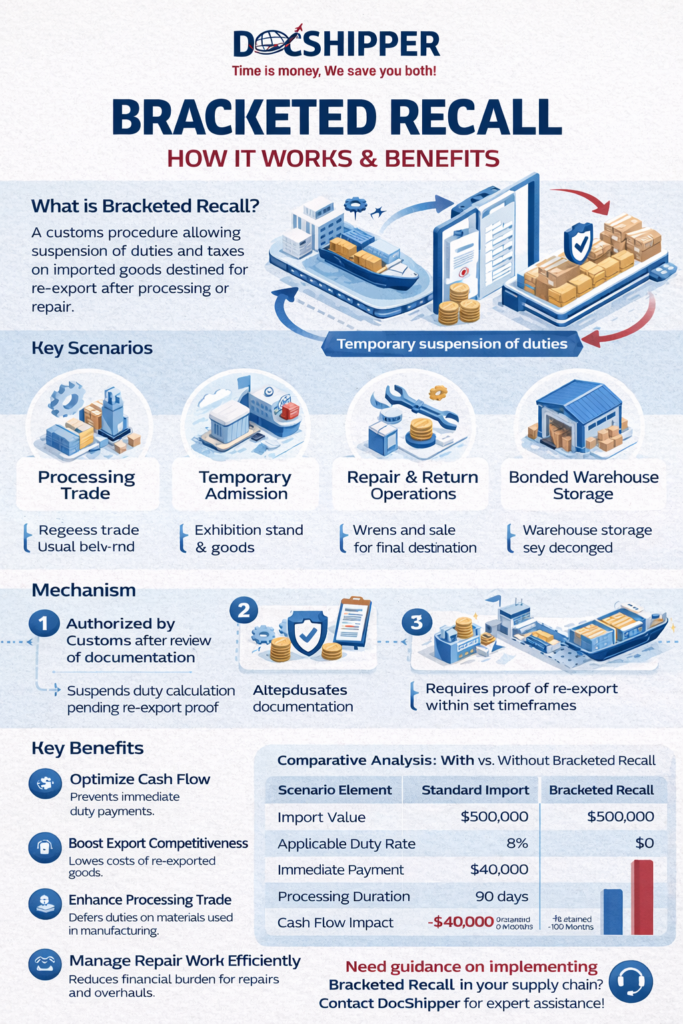
Bracketed Recall is a customs procedure allowing temporary suspension of duties and taxes on imported goods destined for re-export after processing or repair. This mechanism enables businesses to optimize cash flow by deferring payment obligations until final disposition of merchandise, crucial for international trade operations.
Introduction
Many importers face unexpected cash flow constraints when customs duties are immediately payable on goods that will ultimately be re-exported. This financial burden creates operational challenges, particularly for manufacturers engaged in processing trade or repair operations.
Bracketed Recall addresses this issue by allowing customs authorities to temporarily “bracket” or suspend duty collection. This mechanism is particularly relevant in supply chain scenarios involving:
- Inward processing relief (IPR) – raw materials imported for manufacturing then re-exported
- Temporary admission – goods entering for specific purposes with guaranteed re-export
- Repair and return operations – defective products requiring technical intervention
- Trade show exhibits – merchandise displayed temporarily without commercial sale
- Bonded warehouse storage – goods held under customs control pending final destination
Understanding this procedure is essential for optimizing working capital and ensuring regulatory compliance in cross-border operations.
Mechanism & Regulatory Framework
The Bracketed Recall system operates under strict customs supervision, requiring formal authorization and comprehensive documentation. The procedure creates a legal obligation for re-exportation or regularization within specified timeframes.
Authorization requirements typically include demonstrating economic justification, establishing financial guarantees, and maintaining detailed inventory records. Customs authorities assess the applicant’s compliance history and operational capacity before granting approval.
The suspension mechanism functions through a customs-sealed declaration that “freezes” duty calculation. Import duties remain calculated but unpaid, contingent on proof of re-export or alternative customs-approved disposition. This creates a contingent liability on the importer’s books.
Time limitations vary by jurisdiction and goods category, ranging from 6 months to 3 years. Extensions may be granted upon justified request. Failure to meet deadlines triggers immediate duty payment plus potential penalties and interest charges.
Documentation obligations include maintaining parallel accounting systems, providing periodic reports to customs, and ensuring traceability between imported inputs and exported outputs. According to EU Customs regulations, businesses must demonstrate equivalent compensation when processed goods differ from original imports.
At DocShipper, we systematically verify authorization validity and documentation completeness to prevent customs holds and unexpected duty assessments during the bracketed recall period.
Practical Examples & Data
The financial impact of Bracketed Recall becomes evident when examining real-world scenarios across different industries and trade volumes.
Comparative Analysis: With vs. Without Bracketed Recall
| Scenario Element | Standard Import | Bracketed Recall |
|---|---|---|
| Import Value | $500,000 | $500,000 |
| Applicable Duty Rate | 8% | 8% (suspended) |
| Immediate Payment | $40,000 | $0 |
| Processing Duration | 90 days | 90 days |
| Cash Flow Impact | -$40,000 (3 months) | $0 |
| Final Duty Payment | Already paid | $0 (upon re-export) |
Use Case: Electronics Manufacturing
A European electronics manufacturer imports $2 million worth of semiconductor components from Asia for assembly into finished products. Under standard procedures, the 6.5% import duty ($130,000) would be immediately payable.
By utilizing Bracketed Recall under inward processing relief:
- Initial customs clearance – components enter duty-suspended with 12-month authorization
- Manufacturing phase – components integrated into finished electronics over 4 months
- Re-export documentation – 95% of finished products exported to non-EU markets
- Duty assessment – only 5% retained for EU market incurs duty ($6,500 vs. $130,000)
- Cash flow preservation – $123,500 working capital retained for operational needs
Key Performance Indicators
- Working capital optimization – average 8-12% improvement in cash conversion cycle
- Compliance rate – 98.7% successful discharge when properly managed (EU Customs data)
- Administrative cost – typically 0.5-1.5% of suspended duty amount for documentation and guarantee fees
- Processing time – authorization approval ranges 4-8 weeks depending on jurisdiction
- Risk mitigation – reduces exposure to duty rate fluctuations during processing period
At DocShipper, we manage the entire bracketed recall lifecycle, from initial authorization applications through final discharge documentation, ensuring compliance while maximizing your financial benefits.
Conclusion
Bracketed Recall represents a strategic customs tool for businesses engaged in processing trade, enabling significant working capital optimization while maintaining regulatory compliance. Understanding its mechanisms and requirements is essential for competitive international operations.
Need expert guidance on implementing bracketed recall procedures for your supply chain? Contact DocShipper for personalized assistance with customs optimization strategies.
📚 Quiz
Test Your Knowledge: Bracketed Recall
Q1 – What is the core definition of Bracketed Recall in customs procedures?
Q2 – What happens if goods placed under Bracketed Recall are NOT re-exported within the authorized timeframe?
Q3 – A European manufacturer imports $2M of semiconductor components and re-exports 95% as finished electronics. Under Bracketed Recall, which outcome is correct?
🎯 Your Result
📞 Free Quote in 24hFAQ | Bracketed Recall: Definition, Mechanism & Concrete Examples
The main advantage is cash flow preservation by suspending duty payment on goods destined for re-export, allowing businesses to allocate capital to operational needs rather than tying it up in temporary customs obligations.
Authorization periods vary by country and goods type, generally ranging from 6 months to 3 years. Extensions can be requested with proper justification before expiration.
Failure to re-export triggers immediate duty payment obligation, plus potential penalties, interest charges, and possible revocation of future bracketed recall privileges. Alternative regularization options may include placing goods in bonded warehouse or paying duties.
Most jurisdictions require security covering suspended duties, either through bank guarantee, cash deposit, or comprehensive guarantee for authorized economic operators. The amount typically equals 100% of potential duty liability.
Yes, proportional duty assessment applies when only part of imported goods are re-exported. Customs authorities calculate duties on the retained portion based on documented usage and disposition records.
Required evidence includes export customs declarations, transport documents (bills of lading/airway bills), proof of foreign delivery, and inventory reconciliation reports linking imported inputs to exported outputs.
Bracketed recall specifically applies to tangible goods under customs control. Services are not subject to import duties and therefore fall outside this mechanism's scope.
Temporary admission covers goods entering for specific purposes without undergoing processing (exhibitions, demonstrations), while bracketed recall typically involves transformation, repair, or manufacturing activities before re-export.
Manufacturing sectors (electronics, automotive, textiles), repair facilities, contract manufacturers, and businesses engaged in processing trade or assembly operations benefit most from this customs relief mechanism.
Bracketed recall is available to businesses of all sizes meeting customs authority requirements. However, administrative complexity and guarantee costs may present barriers for smaller operations with limited resources.
Restricted or prohibited goods, items subject to anti-dumping duties, certain agricultural products, and goods under quota restrictions may be ineligible. Specific exclusions vary by jurisdiction and trade agreements.
Customs authorities use technical specifications, yield ratios, and industry standards to confirm that exported processed goods correspond to imported inputs. Businesses must maintain detailed production records demonstrating material transformation and equivalence.
Need Help with Logistics or Sourcing ?
First, we secure the right products from the right suppliers at the right price by managing the sourcing process from start to finish. Then, we simplify your shipping experience - from pickup to final delivery - ensuring any product, anywhere, is delivered at highly competitive prices.
Fill the Form
Prefer email? Send us your inquiry, and we’ll get back to you as soon as possible.
Contact us